The Ten Commandments Part 10: What Does The Bible Say About Coveting?

What does the Bible say about coveting? This article is an in-depth exegesis of the Tenth Commandment. It explains the true meaning of coveting and the consequences it can produce in individuals, families, and nations.

👉 Follow the complete Ten Commandments series:

Scripture Foundation

Exodus 20:17 NKJV

  1. “You shall not covet your neighbor’s house; you shall not covet your neighbor’s wife, nor his male servant, nor his female servant, nor his ox, nor his donkey, nor anything that is your neighbor’s.”

Understanding Covetousness

The Scripture says, “You shall not covet.” But what does it mean to covet? According to Merriam-Webster, to covet is to desire something earnestly, especially something that belongs to another person, in an excessive or wrongful way.

In simple terms, coveting is an uncontrolled desire for wealth, possessions, status, or anything that belongs to someone else.

Biblically, covetousness is a selfish, excessive desire to possess what another person has. It goes beyond ordinary desire and becomes a craving for wealth, position, or possessions that replaces contentment in God. Scripture identifies this kind of desire as idolatry.

Colossians 3:5 NKJV

  1. Therefore put to death your members which are on the earth: fornication, uncleanness, passion, evil desire, and covetousness, which is idolatry.

Colossians uses the word “covetousness,” which means the state of being covetous. The root word is covet.

Coveting is destructive because it often begins quietly—as a thought or desire—but can gradually take control of the heart and mind. If it is not confronted, it can grow into a temptation that feels difficult to resist. That is why we need God’s strength to help us reject the desire to take or pursue what does not belong to us. Covetousness is rooted in human nature and lies behind many problems in society.

The Tenth Commandment Addresses the Heart

This commandment is different from all the others.

Most of the previous commandments deal with actions, such as:

  • Murder
  • Adultery
  • Stealing
  • Lying

But coveting deals with something that may never become visible to anyone else.

It addresses the heart.

Although covetousness appears last in the Ten Commandments, it is not a lesser sin. It is often overlooked because, unlike murder or theft, it may remain hidden. Yet it is dangerous precisely because it can take hold of us before we recognize it.

Few sermons, lessons, or books focus on covetousness, even though it is one of society’s most common struggles. At its core, covetousness is a craving that can capture the heart, and our culture is saturated with it, just as Israel was.

Covetousness in Society and Culture

Let’s look at what God said through His prophet Jeremiah as He pronounced judgment upon Israel.

Jeremiah 6:13 NKJV

  1. “Because from the least of them even to the greatest of them, Everyone is given to covetousness; And from the prophet even to the priest, Everyone deals falsely.

Unchecked covetousness produces the condition Jeremiah described: “Everyone deals falsely.”

Modern culture often encourages coveting. Entire industries profit by creating dissatisfaction, and advertising frequently pushes the idea that we need more than we have.

For example, five mornings a week, I power walk outside and use an app to track my steps, time, and distance. Before I can begin, advertisements often interrupt the app, forcing me to wait. Those few seconds may seem small, but they show how aggressively advertising inserts itself into our lives. If we are not careful, it trains us to want what we do not need.

Advertising frequently says:

  • You must have more
  • You deserve more.
  • You need what they have.
  • Your life would be better if you owned this.
  • Compare yourself to others.

We live in a comparison-driven society, and social media has intensified that pressure.

People constantly see:

  • Other people’s homes
  • Vacations
  • Cars
  • Relationships
  • Success

When we focus on what others have, admiration can turn into envy, envy into resentment, and resentment into obsession.

Examples of Covetousness and Its Destruction

Covetousness is deeply destructive. It harms individuals, families, and even nations. Let’s consider both a biblical example and a modern-day example.

Biblical Example: Israel Desiring a King

First, the biblical example: Israel had been delivered from slavery in Egypt and was led by God. But over time, the people decided that God’s leadership was not enough.

1 Samuel 8:4-22 NKJV

This passage is lengthy, but it is important to read it fully. Afterward, we will consider what it reveals.

This is the account of Israel’s request to Samuel for a king.

  1. Then all the elders of Israel gathered together and came to Samuel at Ramah,
  2.  and said to him, “Look, you are old, and your sons do not walk in your ways. Now make us a king to judge us like all the nations.”
  3. But the thing displeased Samuel when they said, “Give us a king to judge us.” So Samuel prayed to the Lord.
  4. And the Lord said to Samuel, “Heed the voice of the people in all that they say to you; for they have not rejected you, but they have rejected Me, that I should not reign over them. 8. According to all the works which they have done since the day that I brought them up out of Egypt, even to this day—with which they have forsaken Me and served other gods—so they are doing to you also.
  5. Now therefore, heed their voice. However, you shall solemnly forewarn them, and show them the behavior of the king who will reign over them.”
  6. So Samuel told all the words of the Lord to the people who asked him for a king.
  7. And he said, “This will be the behavior of the king who will reign over you: He will take your sons and appoint them for his own chariots and to be his horsemen, and some will run before his chariots.
  8. He will appoint captains over his thousands and captains over his fifties, will set some to plow his ground and reap his harvest, and some to make his weapons of war and equipment for his chariots.
  9. He will take your daughters to be perfumers, cooks, and bakers.
  10. And he will take the best of your fields, your vineyards, and your olive groves, and give them to his servants.
  11. He will take a tenth of your grain and your vintage, and give it to his officers and servants.
  12. And he will take your male servants, your female servants, your finest young men, and your donkeys, and put them to his work.
  13. He will take a tenth of your sheep. And you will be his servants.
  14. And you will cry out in that day because of your king whom you have chosen for yourselves, and the Lord will not hear you in that day.”
  15. NEVERTHELESS the people refused to obey the voice of Samuel; and they said, “No, but we will have a king over us,
  16. that we also may be like all the nations, and that our king may judge us and go out before us and fight our battles.”
  17. And Samuel heard all the words of the people, and he repeated them in the hearing of the Lord.
  18. So the Lord said to Samuel, “Heed their voice, and make them a king.”

And Samuel said to the men of Israel, “Every man go to his city.”

If Israel chose to live under a monarchy, their freedom would be greatly limited. Samuel warned them of several consequences.

1) In verses 11–12, their sons would be taken for military service. They would care for horses and chariots, serve in the king’s forces, and many would be removed from their homes for war.

2) In verse 12, people would be forced into labor, working in fields and producing food, weapons, and equipment for the king.

3) In verse 13, their daughters would be taken to serve in the royal household as perfumers, cooks, and bakers.

4) In verse 14, the king would take their best fields, vineyards, and olive groves for his servants and officials.

5) In verse 15, he would impose taxes to support his government and reward his officers.

6) In verse 16, he would take servants, workers, and valuable animals for his own use.

7) In verse 17, he would take a portion of their flocks and increase their burdens.

8) In short, the people would lose freedoms and become servants of the king. His demands would come first, and their liberty would depend on his character and justice.

Yet even after hearing these warnings, the people insisted in verses 19–20: “No, but we will have a king over us, that we also may be like all the nations, and that our king may judge us and go out before us and fight our battles.”

It is important to understand that wanting a king was not wrong in itself. God had already allowed for a king in His law (Deuteronomy 17:14–20; see also Genesis 49:10; Numbers 24:7, 17).

Deuteronomy 17:15, 20 NKJV

  1. you shall surely set a king over you whom THE LORD YOUR GOD CHOOSES; one from among your brethren you shall set as king over you; you may not set a foreigner over you, who is not your brother.
  2. that his heart may not be lifted above his brethren, that he may not turn aside from the commandment to the right hand or to the left, and that he may prolong his days in his kingdom, he and his children in the midst of Israel.

The problem was their motive. They wanted a king “like all the nations,” instead of a leader chosen and shaped by God. In doing so, they rejected God’s rule and broke the covenant with Him.

There is a saying: Be careful what you ask for—you just might get it. Israel asked, and God gave them what they wanted.

As pointed out earlier, the king’s demands would come first, and their liberty would depend on his character and justice.

Because of Solomon’s sins, God divided the kingdom, leaving only one tribe, Judah in the south because of His covenant with David (1 Kings 11:13). The northern kingdom of Israel eventually had nineteen kings, all of whom were evil. Judah had twenty kings, twelve of whom were evil.

Those wicked kings led Israel and Judah into idolatry and destruction. Eventually, both kingdoms fell, and many survivors were exiled to Babylon for 70 years.

All of this began with a covetous desire to be like the surrounding nations. They wanted what others had, without considering the spiritual cost.

The lesson is clear: we must not covet what others have because we do not know the cost behind it. We may not know why they have it, how they got it, or what burdens came with it. The grass may look greener on the other side—until we get there.

The consequences of sin are not always immediate. Israel’s downfall unfolded over hundreds of years, but it still came.

Now, there are other Biblical examples of covetousness, but this is the one I was led to share.

Modern Example: Coveting What Belongs to Another Nation

Now, let’s look at a modern example of the destruction of covetousness.

Now let’s consider a modern example. Russia is geographically the largest country in the world, yet its leader desired control over Ukraine. The consequences have been devastating.

According to reports from the World Bank and Reuters:

If we use mid-range estimates:

  • Military dead: roughly 300,000–450,000+
  • Military wounded/missing: well over 1 million
  • Civilian dead: 15,000+ verified, likely more
  • Civilians injured: 40,000+ verified
  • Property damage in Ukraine alone: about $195 billion
  • Reconstruction cost: roughly $588 billion

And those figures do not fully account for economic losses, lost productivity, demographic decline, refugees, or the destruction inside Russia from Ukrainian strikes. The true economic cost on both sides is far higher.

From a historical perspective, it is already one of the bloodiest and most destructive wars in Europe since World War II.

The numbers are staggering, and the war is not over. This is what covetousness can produce when one leader desires what belongs to another nation. We must ask: is it worth it?

So, we have two examples of covetousness destroying nations. Now imagine what can happen in individual lives and families.

Covetousness Today: The Financial Cost of Wanting More

One way we see covetousness today is in the financial state of our society. According to the Federal Reserve Bank of New York, Americans together owe about $18.8 trillion in household debt. This includes mortgages, auto loans, student loans, and credit card debt. Most of this is from mortgages, but the average household still has about $21,600 in other types of debt.
Some debt is necessary, but a lot of it is optional and could be avoided. Many people take on extra debt because they spend more than they can afford, not out of need, but because they want things they see, hear about, or notice others have. This is at the heart of covetousness: always wanting more, no matter the need or the future cost.
Scripture offers a sobering perspective on such behavior. Proverbs 22:7 states:
7. “The rich rules over the poor, and the borrower is servant to the lender.”
This verse shows that too much debt can trap us financially. What starts as a wish for a better life or more comfort can end up making us dependent and less free, and it can hurt our ability to manage what we have.
Spiritually, the effects are even more serious. “If we let jealousy, envy, and the constant pursuit of material things rule our lives, we go against the values of contentment and trust in God. It makes us ask: how can we hope to inherit God’s kingdom if we are always wanting what others have?
In the end, covetousness is not just a personal issue. It is a problem in our culture that affects us financially and spiritually. To change, we need to practice careful management, be thankful, and focus on being content with what God has already given us.

Scriptural Warnings Against Coveting

We are so warned about coveting in the Scriptures.

Again, the tenth Commandment reads in  Exodus 20:17: NKJV

  1. “You shall not covet your neighbor’s house; you shall not covet your neighbor’s wife, nor his male servant, nor his female servant, nor his ox, nor his donkey, nor anything that is your neighbor’s.”

We are not to covet, as the Scripture reads, “anything that is your neighbor’s.”

That means we should not be consumed with our neighbor’s possessions, business, or blessings. Instead, we are to focus faithfully on what God has entrusted to us.

As we do, we should live with thanksgiving and contentment.

Hebrews 13:5 NKJV

  1. Let your conduct be without covetousness; be content with such things as you have. For He Himself has said, “I will never leave you nor forsake you.”

1 Timothy 6:6 NKJV

  1. Now godliness with contentment is great gain.

Our focus should be on God and godliness, not on our neighbor’s possessions or the temporary things of this world.

When we put our trust in man rather than in God, there is a price to pay.

Jeremiah 17:5 NKJV

  1. Thus says the Lord: “Cursed is the man who trusts in man And makes flesh his strength, Whose heart departs from the Lord.

This is what Israel did, and we have seen the result. The same warning applies to individuals who place their trust in people or possessions rather than in God.

And now we look at the end result.

Ephesians 5:5 NKJV

  1. For this you know, that no fornicator, unclean person, nor COVETOUS man, who is an idolater, has any inheritance in the kingdom of Christ and God.

Notice that these warnings appear in both the Old and New Testaments.

How Covetousness Leads to Other Sins

The Tenth Commandment ties the others together because covetousness can lead us to break every commandment. It can lead us to:

Have other gods before God #1

Bow down to idols #2

Take the Lord’s name in vain #3

Not honor the Sabbath #4

Dishonor our fathers and mothers #5

Kill one another #6

Commit adultery #7

To steal #8

To bear false witness #9

A covetous person cannot covet without breaking at least one or more of these commandments; depending on how severe a case may be.

Bottom line: They will not inherit the Kingdom of God.

Choosing Contentment and Trusting God

The Tenth Commandment teaches that God is concerned not only with our actions, but also with our desires.

We cannot live consumed by what our neighbors have or driven by excessive desire for the things of this world.

How can we inherit heaven while holding on to jealousy and envy? It cannot work.

But the Lord is gracious. If covetousness has taken root in us, it is not too late to turn from it and learn contentment.

My position is this: things can always be better, but they could also be worse. So I thank God for what I have and choose to be content. What is not mine was not meant for me, and what God has for me will come in His time.

As Jesus said in Matthew 6:33, But seek first the kingdom of God and His righteousness, and all these things shall be added to you.”

What Does the Bible Say About Coveting?

Seek God, trust what He has for you, and let Him bring it to pass.

Be blessed— and have a Great Day!

Amen

Questions, comments, and concerns may be left below.

👉 Videos

👉 Watch the full video presentation:

For the short version, click the link

https://youtube.com/shorts/ryDRLwZ5y6s

👉 Follow the complete Ten Commandments series:

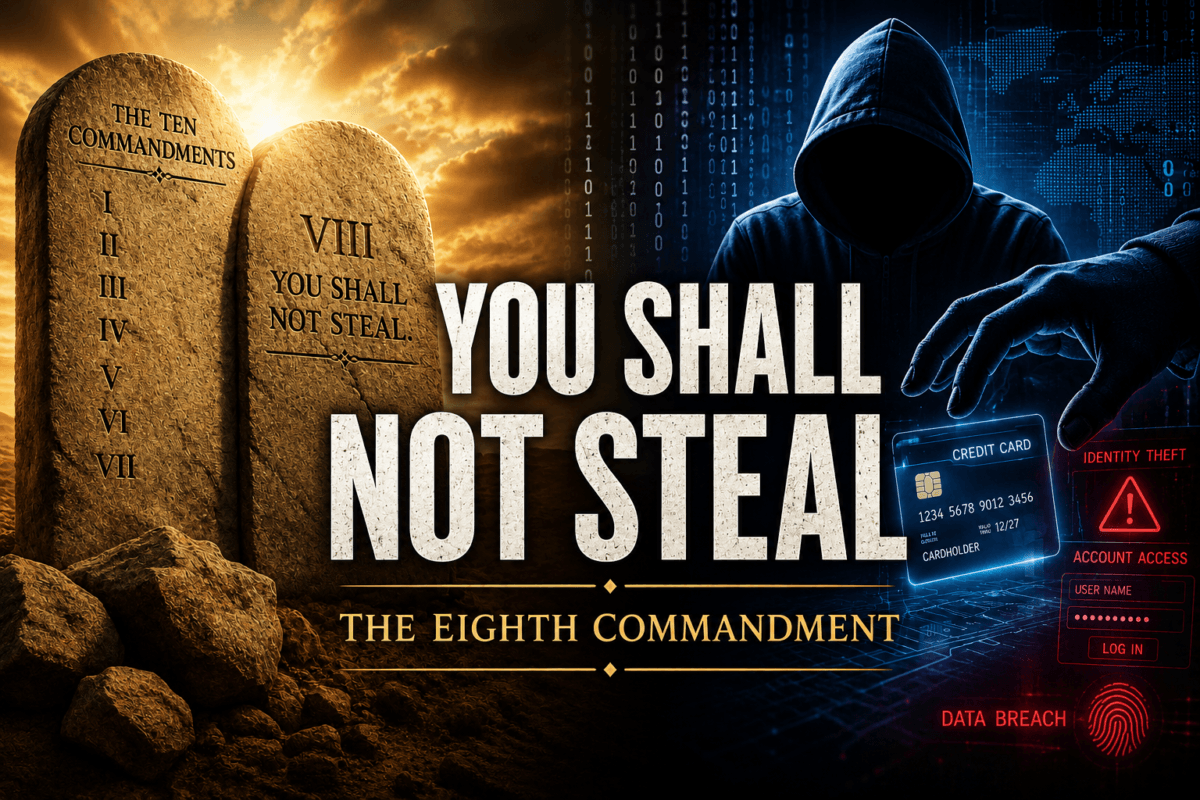
The Ten Commandments (Part 8): What Does “You Shall Not Steal” Mean?

What does “You shall not steal” mean? What do you think stealing really is? Have you ever seriously thought about it? And can you honestly say you have never stolen anything? In this article, we will examine what stealing really means as we study the Eighth Commandment: “You shall not steal.”

Today, we look at the Eighth Commandment in Exodus 20:15 NKJV:

15 “You shall not steal.”

Many people know this commandment in the older form, “Thou shalt not steal.”

As we have seen in the previous commandments of this series, our society has moved far away from them. But this eighth commandment has been violated on a massive scale. It has permeated our society to the point that it affects everybody, and everybody has contributed to it in one form or another.

Modern Examples of Theft

Let’s look at some statistics.

Theft today often happens digitally, invisibly, and remotely. One major form of theft is identity theft.

Identity theft

The FTC reported more than 1.1 million identity theft reports in 2024 through IdentityTheft.gov.

The FTC’s Consumer Sentinel Network received roughly 6.5 million consumer reports involving fraud, identity theft, and scams in 2024.

Credit card fraud was the most commonly reported form of identity theft in 2024.

Motor Vehicle Theft

According to the FBI, the nationwide motor vehicle theft rate rose significantly between 2019 and 2023.

According to the National Highway Traffic Safety Administration, more than 850,000 vehicles were stolen in the United States during 2024.

However, vehicle thefts reportedly declined about 17% from 2023 to 2024, marking the largest annual drop in decades.

However, despite improvements, vehicle theft remains an enormous nationwide problem.

Retail Theft / Shoplifting

The National Retail Federation reported that shoplifting incidents in 2023 increased 93% compared to 2019 levels.

Retailers also reported approximately a 90% increase in dollar losses due to shoplifting over the same period.

Many retailers reported increased violence associated with theft incidents.

So, we see that theft increasingly affects not only property, but public safety and social trust.

Broader Property Crime Context

FBI reporting for 2024 showed property crime overall declined nationally, but theft-related offenses still affected millions of Americans.

According to Cybersecurity Ventures, theft is not limited to one nation. Around the world, theft-related crimes cost governments, businesses, and individuals hundreds of billions of dollars every year—from shoplifting and fraud to cybercrime and identity theft.

“Worldwide, theft has become increasingly digital. Global cybercrime and theft-related fraud are now estimated to cost the world trillions of dollars annually.”

Stealing has become a major quality-of-life issue. Just think about how you feel when something has been stolen from you. You feel violated, angry, and even helpless.

What Does “You Shall Not Steal” Mean in Scripture?

But here is the point: stealing is not merely taking property—it is violating trust, ownership, honesty, and ultimately God’s order. Not only do we steal from one another, but we can also steal from God.

As we continue, we will see more clearly what that means.

We need to understand that stealing is a serious sin. It hurts the person who loses something—whether it’s something small like jewelry or electronics, or something much more important like money, food, a job, or even life itself.

That is why “You shall not steal” is one of God’s Ten Commandments—the very basis of His Law.

Now think about this: what is the most frequent crime in your community, in our country, and across the world? In most places, the answer is theft. It has become so common that people barely notice it anymore. You see it everywhere, and examples come to mind quickly:

Here are some common examples:

  • People in government who dip into public funds as though they were personal resources.
  • Workers who help themselves to what belongs to the company.
  • Businesses that exploit others through unfair pay or inflated prices.
  • Athletes and public figures who cut corners and act dishonestly.
  • Friends, neighbors, and acquaintances who lie, cheat, or take what is not theirs.
  • Scammers who steal someone’s identity to commit fraud.
  • People who selfishly hoard resources while ignoring the needs of others.
  • Those who claim far more than their share of the earth’s wealth and resources.

Here is the point: stealing is not just about taking things. It shows a lack of respect for other individuals’ property and even for human life. Once stealing becomes normal, it breeds lawlessness, and it can spiral into violence, even assault and murder. It always leaves damage behind. It can devastate families, ruin businesses, harm entire communities, and in some cases even weaken a nation. In the end, everybody loses: the victim is left without what was taken—sometimes something so personal that it cannot truly be replaced—and the thief, even if no one else finds out, loses integrity before God and, unless he repents, risks losing his soul.

So, who is this command for? Does “You shall not steal” apply only to ancient Israel, or does it still speak to us today? The truth is that theft has been around as long as people have. And God gave this command because He cares about people—about their lives, their homes, and what they work hard to provide. It doesn’t make sense to say God cared about those things then but doesn’t care about them now.

Listen to how simple—and personal—the command is: “You shall not steal.” That is not just for one time and place; it is for you, for me, and for every generation. Stealing was wrong then, a serious offense against both people and God, and it is still wrong today. This commandment stands just as firmly now as it did for Israel.

Now let’s look at what the New Testament says:

Ephesians 4:28 NKJV

28 Let him who stole steal no longer, but rather let him labor, working with his hands what is good, that he may have something to give him who has need.

In the New Testament, “thief” usually refers to someone who steals as a way of life—a bandit or habitual thief. Paul taught that when such a person comes to Christ, the old pattern must be put away and replaced with honest work. Because stealing often stems from idleness or laziness, his instruction was both negative and positive: stop stealing and start working.

He may also have had slaves in mind, since many served in households and were tempted to take what was not theirs, and many of them became believers. In any case, Christians are called to work diligently, contribute responsibly, and not live off others. But our purpose goes beyond self-support. We labor not just to provide for ourselves, but so we can share generously with those in need. Giving is at the heart of the Christian life because our true treasure is in heaven.

Remember, stealing is ultimately a heart problem. Its source is not the hand but the heart—an inner desire, craving, or coveting. Once that desire takes root and we act on it, theft follows. That is exactly what God says in James 1:14–15 NKJV:

14 But each one is tempted when he is drawn away by his own desires and enticed.
15 Then, when desire has conceived, it gives birth to sin; and sin, when it is full-grown, brings forth death.

Desires can be fed or starved. When a desire is sinful, we must refuse it—with God’s help. If we nurture it instead, it quickly turns into action. The responsibility for that sin is ours. James is describing a desire that has broken its boundaries—selfish, seductive, and out of control.

In other words, every sinful action begins as a thought in the heart.

So, how is this commandment broken? In more ways than we often realize. Because theft is so common—and so damaging—we need to be clear about what it looks like in everyday life. The following examples show how this sin appears in both obvious and overlooked ways.

Left unrepentant, it leads to death—eternal death. That is why it is helpful to examine common forms of theft.

Common Ways People Break “You Shall Not Steal”

A person breaks God’s commandment against stealing in many ways, including the following:

  • robbing a person, store, company, organization, or bank
  • shoplifting
  • loafing on the job
  • keeping items that were borrowed
  • failing to repay debts—not paying our bills
  • withholding taxes that are due—cheating on our income taxes
  • using false or deceptive advertising
  • keeping an overpayment, excessive refund, or extra shipment of goods
  • overcharging or price-gouging
  • paying unfair or unjust wages
  • giving less than a full day’s work
  • unjustly extending business trips at the company’s expense
  • manipulating information or stocks for personal gain
  • abusing sick days
  • arriving late or leaving early without permission
  • stealing someone’s reputation through lies, gossip, or rumor
  • denying a person justice (Is. 10:1–3)
  • taking from one’s employer (pens, paperclips, staplers)
  • making unauthorized phone calls at work
  • padding expense reports
  • kidnapping and enslaving people for work and profit
  • breaking rules or cheating to win a game, prize, or advantage*

We are often too casual about some of these things. They have become common everyday practices woven into our culture. But the fact remains: they break God’s commandment, “You shall not steal.”

How We Rob God

All acts of stealing are wrong, but there is one form of theft that is especially serious: robbing God. After considering how people steal from one another, we now turn to the ways people withhold from the One to whom everything ultimately belongs.

For starters, a person robs God by failing to give tithes and offerings to Him. This is not an article on tithing, but I would be remiss not to mention it in connection with this commandment.

Let’s look at what God said through His prophet Malachi.

Malachi 3:8–9 NKJV

8 “Will a man rob God? Yet you have robbed Me! But you say, ‘In what way have we robbed You?’ In tithes and offerings.

9 You are cursed with a curse, for you have robbed Me, even this whole nation.

The bottom line is: everything we have comes from God; that is the first rule of Biblical stewardship. So, when we hold back and refuse to give Him a portion of what He’s already given us, we’re really taking from Him. The question is simple—are we going to keep it all for ourselves, or will we joyfully return at least ten percent to support His work and advance His Kingdom?

But that is not the only way we can rob God. A person also robs God by living a hypocritical, inconsistent life. When someone professes to believe and follow God but fails to follow through, he robs God and others of a godly testimony.

We also rob God when we live for ourselves and the world rather than for Him. God is our Creator, so we owe Him our very lives—everything we are and everything we have. When a person insists on living his own way, he is taking his life back from God.

1 John 2:15–16 NKJV

15 Do not love the world or the things in the world. If anyone loves the world, the love of the Father is not in him.

16 For all that is in the world—the lust of the flesh, the lust of the eyes, and the pride of life—is not of the Father but is of the world.

These are some of the ways people rob God.

Scriptural Instruction for Christians

Scripture not only forbids stealing; it also teaches Christian believers what to avoid and how to live instead. These passages move from warning to instruction, showing both what must be rejected and what must be practiced.

First, what not to do: We must never withhold tithes and offerings from God. Now, we’ve already seen the Scripture addressing this.

Next, we must never cheat our brothers or sisters in anything.

1 Thessalonians 4:6–7 NKJV

6 that no one should take advantage of and defraud his brother in this matter, because the Lord is the avenger of all such, as we also forewarned you and testified.

7 For God did not call us to uncleanness, but in holiness.

We must never steal people—by kidnapping, enslaving, or holding them in bondage—because it strips them of their right to their own life.

Exodus 21:16 NKJV

16 “He who kidnaps a man and sells him, or if he is found in his hand, shall surely be put to death.”

Scripture also tells us what to do.

We need to live by the golden rule: be honest and fair with people and simply treat them the way we’d want them to treat us.

Matthew 7:12 NKJV

12 Therefore, whatever you want men to do to you, do also to them, for this is the Law and the Prophets.

Next, we need to learn contentment, remembering that we brought nothing into this world, and we will take nothing out.

Hebrews 13:5 NKJV

5 Let your conduct be without covetousness; be content with such things as you have. For He Himself has said, “I will never leave you nor forsake you.”

Therefore, stealing is futile.

Lastly, we’re called to work hard and trust God to meet our needs. When we steal, we’re really saying we don’t trust Him.

Philippians 4:19 NKJV

19 And my God shall supply all your need according to His riches in glory by Christ Jesus.

Consequences of Disobedience

So, what are the consequences of disobeying this Commandment?

What happens when we break this commandment and steal from others? Look around—respect for what belongs to someone else is collapsing. And when crisis hits—hurricanes, floods, and the like—some people do not wait for help; they rush to loot while the dust is still settling.

God hates stealing, not only because of the harm it causes, but stealing reflects the destructive nature of Satan, whom Scripture associates with theft, destruction, and death.. Scripture is blunt about him: he is a thief.

John 10:10 NKJV

  1. The thief does not come except to steal, and to kill, and to destroy. I have come that they may have life, and that they may have it more abundantly.

God will judge the greatest thief of all, and He will also repay every thief according to his deeds. Whoever breaks this holy commandment will face serious consequences.

Without repentance, condemnation is inevitable.

1 Corinthians 6:9–10 NKJV

9 Do you not know that the unrighteous will not inherit the kingdom of God? Do not be deceived. Neither fornicators, nor idolaters, nor adulterers, nor homosexuals, nor sodomites,

10 nor THIEVES, … will inherit the kingdom of God.

Stealing also corrupts the thief and makes him spiritually unclean.

Matthew 15:19–20 NKJV

19 For out of the heart proceed evil thoughts, murders, adulteries, fornications, THEFTS, false witness, blasphemies.

20 These are the things which defile a man

You Shall Not Steal
You Shall Not Steal

Blessings of Honesty and Obedience

Now, imagine a world where everyone obeyed this command—where theft did not exist. The blessings of honesty would be far-reaching, both spiritually and socially. Consider some of the blessings that follow obedience.

An honest believer walks in righteousness and lives securely.

Proverbs 10:9 NKJV

9 He who walks with integrity walks securely, but he who perverts his ways [Steals] will become known.

Honesty and devotion to the Lord free a person from falsehood and deceit.

Proverbs 30:7–9 NKJV

7 Two things I request of You (deprive me not before I die):

8 Remove falsehood and lies far from me; give me neither poverty nor riches—feed me with the food allotted to me;

9 Lest I be full and deny You, and say, “Who is the Lord?” Or lest I be poor and steal, and profane the name of my God.

Riches can tempt the soul, but so can lack. Poverty can crush the body and weigh down the spirit, and wealth is certainly no savior. Only the Lord is enough.

Therefore the best position to take is to be content with what the Lord has already blessed us with—be content with what we have.

1 Timothy 6:6 NKJV

6 Now godliness with contentment is great gain.

This statement is a key to spiritual growth and personal fulfillment. We should honor God, center our desires on Him, and be content with what He is doing in our lives. As Jesus said in Matthew 6:33, “But seek first the kingdom of God and His righteousness, and all these things shall be added to you.”

Therefore, we have no need to steal.

If we seek God’s kingdom and righteousness and learn contentment, stealing will be the last thing on our minds.

Conclusion

My friends, we must be content and obey the Eighth Commandment: “You shall not steal.”

Amen!

May the Lord give us grace to obey His Word.

Please leave any questions, comments, or concerns below.

Blessings!

Watch the full video teaching and the companion Short below.

👉 Videos

10 Commandments in the New Testament

Some Christians believe the Old Testament no longer applies to today’s Christians, including the Ten Commandments. This article will address the 10 Commandments in the New Testament.

What are the Ten Commandments?

The Ten Commandments are the ten laws God gave Moses on Mount Sinai after he led them out of Egypt. These and other laws were for guidance for daily righteous living. However, the Ten Commandments form the core of the unique covenant between God and His people, the Israelites, so much so that God wrote them in stone with His finger (Exodus 31:18).

These Commandments are found in Exodus 20:1-17

1. And God spake all these words, saying,

2. I am the LORD thy God, which have brought thee out of the land of Egypt, out of the house of bondage.

3. Thou shalt have no other gods before me.

4. Thou shalt not make unto thee any graven image, or any likeness of any thing that is in heaven above, or that is in the earth beneath, or that is in the water under the earth:

5. Thou shalt not bow down thyself to them, nor serve them: for I the LORD thy God am a jealous God, visiting the iniquity of the fathers upon the children unto the third and fourth generation of them that hate me;

6. And shewing mercy unto thousands of them that love me, and keep my commandments.

7. Thou shalt not take the name of the LORD thy God in vain; for the LORD will not hold him guiltless that taketh his name in vain.

8. Remember the sabbath day, to keep it holy.

9. Six days shalt thou labour, and do all thy work:

10. But the seventh day is the sabbath of the LORD thy God: in it thou shalt not do any work, thou, nor thy son, nor thy daughter, thy manservant, nor thy maidservant, nor thy cattle, nor thy stranger that is within thy gates:

11. For in six days the LORD made heaven and earth, the sea, and all that in them is, and rested the seventh day: wherefore the LORD blessed the sabbath day, and hallowed it.

12. Honour thy father and thy mother: that thy days may be long upon the land which the LORD thy God giveth thee.

13. Thou shalt not kill.

14. Thou shalt not commit adultery.

15. Thou shalt not steal.

16. Thou shalt not bear false witness against thy neighbour.

17. Thou shalt not covet thy neighbour’s house, thou shalt not covet thy neighbour’s wife, nor his manservant, nor his maidservant, nor his ox, nor his ass, nor any thing that is thy neighbour’s.

10 Commandments in the New Testament

It is essential to understand that these Commandments were never meant to be a means by which the Israelites could earn salvation (legalism). God had already shown His favor when He delivered them from Egyptian bondage. This grace is something that He prefaced by reminding them at the commencement of providing the Commandments (vs. 2).

The Ten Commandments in the New Testament

Despite what some believe about the Old Testament, the Ten Commandments are still applicable today. What needs to be recognized is that the Old Testament is the foundation. Without the Old Testament, there would be no New Testament. The New Testament Confirms the Old Testament. There are 343 Old Testament quotes in the New Testament and 2,309 allusions and parallels. The most-utilized books are the Psalms (333 references, 79 quotes) and Isaiah (348 references, 66 quotes). The Book of Revelation contains no quotations but at least 620 allusions.

Jesus issued this confirmation in Matt. 5:17, “Think not that I am come to destroy the law, or the prophets: I am not come to destroy, but to fulfil.” Jesus ushered in the New Covenant, the New Testament (Hebrews 8:1,6), therefore fulfilling the Law. He didn’t come to abolish the Law or the prophets but to fulfill the promises in those Scripture passages.

Jesus lived the Law and gave life to the Law. He was able to live the life described by the words and rules and set the standard for us to follow. The New Testament Law that Jesus ushered in was the Law of love. Love fulfills the Law.

This truth is confirmed in other New Testament Scripture. For example, Romans 13:8-10

8. Owe no one anything except to love one another, for he who loves another has fulfilled the Law.

9. For the commandments, “You shall not commit adultery,” “You shall not murder,” “You shall not steal,” “You shall not bear false witness,” “You shall not covet,” and if there is any other commandment, are all summed up in this saying, namely, “You shall love your neighbor as yourself.”

10. Love does no harm to a neighbor; therefore love is the fulfillment of the Law. NKJV

Notice the Commandments mentioned in this passage; all contained under the description of love, “love is the fulfillment of the Law.Several Laws are quoted here, straight from the Commandments, to illustrate how they can be kept if an individual simply acts in love.

Love Fulfills the Law
Love Fulfills the Law!

Remember the response of Jesus when asked what the greatest Commandment is. His response was in Matthew 22:37-40:

37. Jesus said unto him, Thou shalt love the Lord thy God with all thy heart, and with all thy soul, and with all thy mind.

38. This is the first and great Commandment.

39. And the second is like unto it, Thou shalt love thy neighbour as thyself.

40. On these two commandments hang all the Law and the prophets.

Jesus quoted from Deuteronomy 6:5, but also stated a second Command addressing dealing with fellow human beings. The same love and care we have for ourselves should also extend to others. Jesus also clarified that these two Commands to love God and others as ourselves keep all other Laws in the Old and New Testaments.

Lastly, our eternal destiny is based on the Commandments. This truth is evident in Luke 10:25-28, which reads:

  1. On one occasion an expert in the law stood up to test Jesus. “Teacher,” he asked, “what must I do to inherit eternal life?”
  2. “What is written in the Law?” he replied. “How do you read it?”
  3. He answered: “‘Love the Lord your God with all your heart and with all your soul and with all your strength and with all your mind’; and, ‘Love your neighbor as yourself.'”
  4. “You have answered correctly,” Jesus replied. Do this and you will live. NIV

This lawyer obviously knew the Law quoted from Deuteronomy 6:5 and Leviticus 19:18, Old Testament Scripture, which demands total devotion to God and love for one’s neighbor. These two Commands go hand in hand. An individual cannot maintain a good relationship with God without having good relationships with their neighbors (fellow human beings).

But look at Jesus’ final response in verse 28, Do this and you will live. Jesus was referring to eternal life. By following these two Commandments, we fulfill the others and will inherit eternal life. While it is impossible to obey these on our own, it is possible with the help of the Holy Spirit.

It appears clear that the Old and New Testaments are equally crucial in knowing the will of the Lord. Without the Old Testament, there would be no New Testament. They are intertwined to give us the complete picture of what was, what is, and what shall be.

Amen

Questions, comments, and concerns may be left below.

Blessings!

👉 Watch the full video presentation:

👉Videos

For the Short version, click the link below

https://youtube.com/shorts/Qg_OpwcL5UE


Spiritual Warfare: Signs And Manifestations Of Spiritual Attacks

Spiritual Warfare: Signs and Manifestations of Spiritual Attacks

Spiritual warfare is not a theory; it is a daily reality for every believer. In the article “Spiritual Warfare Pt.: Signs and Manifestations of Spiritual Attacks,” I examine how the invisible war in the spiritual realm manifests in real life—what it looks like, how it behaves, and how it affects both individual believers and the church at large.

This article follows the same teaching.

Spiritual Warfare: Signs and Manifestations of Spiritual Attacks

In this article, we will examine how the invisible war in the spiritual realm manifests in real life—what it looks like, how it behaves, and its impact on both individual believers and the church as a whole.

A manifestation is a sign or event that shows something exists or is happening. In the previous parts (1, 2, and 3), it has been made clear that Christians are engaged in a spiritual war, where it began, and who is at the helm of this opposing force—none other than Satan. Now we turn to the results of this ongoing war.

The key thing to remember throughout this teaching is this:

What happens in the natural world happens first in the spiritual.

If you have not read parts 1, 2, or 3, I encourage you to review them. This article builds on that foundation.

The Prince of the Power of the Air

Before we look at the manifestations, we need to remind ourselves who the enemy is.

Satan is a formidable foe. Before his fall, he was the most powerful angel in heaven, as described in Part 1. When he was cast out of heaven, he did not lose his power—he took it with him, along with a third of the angels (Rev. 12:4).

Paul describes him in Ephesians 2:2, speaking of the condition of Christians in Ephesus before they accepted Christ and walked in His Spirit:

“…in which you once walked according to the course of this world, according to the prince of the power of the air, the spirit who now works in the sons of disobedience.” (Ephesians 2:2, NKJV)

“Silhouette of a demonic winged figure rising above a dark city skyline under a stormy, fiery sky — symbolizing Satan as ‘the prince of the power of the air’ from Ephesians 2:2.”
The Prince of the Power of the Air

Notice this title: “the prince of the power of the air.”

·       He is called a prince – a title of authority, an exalted position.

·       But a prince is still subject to the King, so he does not have all authority.

·       However, he has more than enough to cause devastation, because he influences “the power of the air.”

Where is the air? Everywhere. There is no place on earth where there is no air. Air sustains life. So, if Satan is the prince of this power, he is exercising influence all over the world. Jesus Himself acknowledges this in John 16:11, referring to Satan as “the ruler of this world.”

What does this mean for us?

It means that Satan’s influence is all over this world. That is why the Scripture says in James 4:4:

“…Friendship with the world is enmity with God.”

His influence reaches into everything. He even tried to use that influence on Jesus Himself. Look at Matthew 4:8–9:

8. “Again, the devil took Him up on an exceedingly high mountain, and showed Him all the kingdoms of the world and their glory.

9. And he said to Him, ‘All these things I will give You if You will fall down and worship me.’” (Matthew 4:8–9, NKJV)

This reveals Satan’s ultimate goal: he wants worship. He wants all worship. And he uses his influence to get it.

He did not get it from Jesus (thank God), but he is getting it from others—including professing Christians. Hence, the spiritual warfare and the ongoing battle for souls.

One of Satan’s most effective tools is deception. When Jesus spoke His prophecy to the disciples regarding the end times, the very first thing He said was:

“Take heed that no one deceives you.” [Matthew 24:4]

But are we listening?

Satan’s Influence on This World

Understand this: Satan’s influence is in everything:

·       The government and politicians

·       The entertainment industry—Hollywood

·       The music industry

·       The sports industry

·       Wall Street

·       Big Pharma

·       And yes—even the schools

Take the music industry for example. Music originated in heaven, but you would never know it listening to much of the music today. That is a manifestation of spiritual warfare.

Satan has many of these industries pretty much sewn up.

But his main target is Christians.

Fence-Sitting Christians: A Frightening Manifestation

Satan’s attack on Christians is so strong that he has many believers sitting on the fence.

For those who may not be familiar with that expression, picture someone sitting on a fence along a path between two forces. They are not on one side or the other—stagnant, suspended between two choices.

This is a figurative illustration of a Christian who is professing Christ, but at the same time is friends with the world—living and thinking like a worldly person. It is a position of compromise and a manifestation of spiritual warfare.

“Silhouette of a young woman sitting on a fence at sunset, torn between the world and Christ, facing a distant cross — a visual illustration of spiritual warfare, compromise, and the dangers of being a worldly Christian.”
The Path of Compromise!

There are professing Christians who walk—live—in that position:

·       Sitting on the fence between two worlds

·       The world pulling from one side.

·       Christ calling from the other.

They face both directions but follow neither, even though they profess Christ. They are not walking with the world…they are not walking with God…they are:

·       Spiritually stuck

·       Spiritually stalled

·       Spiritually powerless

·       Ineffective

No good to God and no good to themselves.

This is exactly what Paul warned about in 2 Timothy 3:5. The context in verses 1–9 is the coming apostasy in the last days—which is now. Verse 5 says:

“…having a form of godliness but denying its power. And from such people turn away!” (2 Timothy 3:5, NKJV)

These, my friends, are fence sitters. They may look toward Christ and even have an outward appearance of religious godliness, but they lack a true, transformative inner faith. They inadvertently deny God’s power.

They are paralyzed on the fence.

This is a manifestation of spiritual warfare.

Satan has injected so much false doctrine into the church, and there is so much of the world in the church these days, that the fence can hardly hold all the compromised Christians.

False Doctrine #1: “Once Saved, Always Saved”

One of the popular false doctrines is: once saved, always saved—that when an individual accepts Christ, they can never be lost, even if they later backslide into sin.

Is that true or false?

In Part 3, The Mind Is the Battlefield, I explained how we are led either by the flesh or by the Spirit of God. The choice is always ours—even after we are saved—because Satan’s tactics are always on the offensive.

If we can choose not to follow the Spirit, can we not backslide into sin?

Let us look at some Scripture.

In Ephesians 4:23–24, Paul exhorts Christians to “put on the new man”:

23. and be renewed in the spirit of your mind,

24. and that you put on the new man which was created according to God, in true righteousness and holiness.”

Then in verse thirty, he adds:

“And do not grieve the Holy Spirit of God, by whom you were sealed for the day of redemption.” (Ephesians 4:30)

The Greek word translated “grieve” is lupeō—to distress, to make sad. When we grieve the Holy Spirit, we grieve God. Christians are to live in such a way that we do not grieve God by our conduct—our attitudes, and actions.

Wrong attitudes and actions hamper the Spirit’s work, making Him less effective in our lives.

Some will say, “But it says we’re sealed until the day of redemption.” Seal here refers to a mark or stamp, as with official documents in biblical times. It does not mean a container sealed shut that can never be opened.

And notice it says, “sealed for the day of redemption,” not “sealed until the day of redemption.”

We carry this seal of God if we do not grieve Him. The fact that we can have this seal for the day of redemption should motivate us to maintain righteousness.

Paul gives another warning in 1 Thessalonians 5:19:

19. “Do not quench the Spirit.”

Here, Paul goes further—not just “do not grieve” the Spirit, but “do not quench Him. The Greek word translated “quench” is sbennumi—to extinguish, to put out, like water putting out a fire.

We can literally put out the Spirit’s influence on our lives by our conduct.

Quenching the Spirit involves any action that hinders the work of the Lord in our lives or in the lives of others. Many Christians are guilty of quenching the Spirit when they throw cold water on His leading.

So, what happens when we quench the Spirit? Look at Romans 8:9:

9. “But you are not in the flesh but in the Spirit, if indeed the Spirit of God dwells in you. Now if anyone does not have the Spirit of Christ, he is not His.” (Romans 8:9, NKJV)

Romans 8 is one of my favorite chapters. Here, Paul is informing the Christians in Rome how the Spirit delivers from the power of the flesh. He tells them straight-up: anyone who does not have the Spirit of Christ does not belong to Christ.

Now let us connect the dots:

·       Scripture tells us we can quench—put out—the Holy Spirit.

·       Scripture also tells us that if we do not have the Spirit, we do not belong to Christ.

So, at that point, are we still saved?

I don’t think so!

There is no exception in Scripture that says, “Those who have once accepted Christ are exempt from this.” In fact, Paul is writing to Christians in Ephesus, Corinth, Rome, and Thessalonica.

In Ephesians 1:1–2 he opens:

1. “Paul, an apostle of Jesus Christ by the will of God,

2. To the saints who are in Ephesus, and faithful in Christ Jesus: Grace to you and peace from God our Father and the Lord Jesus Christ.”

He is speaking to saints—believers. The epistles are written to Christians, admonishing them not to grieve or quench the Spirit and warning that if they do, they do not belong to Christ.

Bottom line:

We are saved as long as we do not quench the Spirit.

Therefore, this business of “once saved, always saved” is, in a word…

HOGWASH!

It is a manifestation of spiritual warfare—teaching that we can sin and still be saved. That is just dreaming.

If all we had to do was accept Christ once and be perpetually saved no matter what, Satan would be out of business. But he is not. He continues to harass Christians in the hope that they will capitulate—as many do.

Excuses for Sin: Another Manifestation

The sad fact is that we make so many excuses for sin that are contrary to the Word of God.

Take fornication, for example. Some will say, “God knows I have needs. He understands.”

Well, of course, God knows you have needs—He created you. But what does His Word say?

“For this is the will of God, even your sanctification, that ye should abstain from fornication:” (1 Thessalonians 4:3, KJV)

This is just one of many Scriptures that address fornication. None of them say, “according to your needs.”

The New Living Translation puts it plainly:

“God’s will is for you to be holy, so stay away from all sexual sin.” (1 Thessalonians 4:3, NLT)

That is as clear as the rising sun. Fornication is the umbrella covering all sexual sin. When individuals go against this Word, it is another manifestation of spiritual warfare.

“All sexual sin” includes homosexuality. Some professing Christians will say, “They’re still human; they were born that way,” or “God loves them too.” Homosexuals may say, “I was born this way.”

Well, you were born that way? Welcome to the club. We were all born this way—born in sin.

David said in Psalm 51:5:

“Surely I was sinful at birth, sinful from the time my mother conceived me.”

Romans 3:23 says:

“…for all have sinned and fall short of the glory of God,”

All of us have some form of sin in us. All of us are experiencing some manifestation of sin because of spiritual warfare:

·       Some of us struggle with lying.

·       Some with stealing

·       Some with covetousness

·       Some with anger that turns into sin.

·       Some with murder in the heart

The list goes on.

The point is: we are all victims of spiritual warfare. We all need a Savior.

And God has made a way for all of us to be saved through His Son, Jesus Christ. John 3:16–17 says:

16. “For God so loved the world that He gave His only begotten Son, that whoever believes in Him should not perish but have everlasting life.

17. For God did not send His Son into the world to condemn the world, but that the world through Him might be saved.”  

“The world” means everybody. We all need to be saved.

Sin is sin. Being “born this way”—whatever that way is—is no excuse. It is not a “get out of jail free” card.

False Doctrine #2: The Myth of the “Carnal Christian”

Another false doctrine circulating in Christian circles is the idea of a “carnal Christian”—that someone can be a Christian yet live carnally, led by the flesh.

To be carnal is to be:

·       Worldly

·       Fleshly

·       Led by the flesh

Is there such a thing as a carnal Christian? Let us see what Scripture says in Romans 8:1–8:

1.“There is therefore now no condemnation to those who are in Christ Jesus, who do not walk according to the flesh, but according to the Spirit.

2. For the law of the Spirit of life in Christ Jesus has made me free from the law of sin and death.

3. For what the law could not do in that it was weak through the flesh, God did by sending His own Son in the likeness of sinful flesh, on account of sin: He condemned sin in the flesh,

4. that the righteous requirement of the law might be fulfilled in us who do not walk according to the flesh but according to the Spirit.”

5. “For those who live according to the flesh set their minds on the things of the flesh, but those who live according to the Spirit, the things of the Spirit.

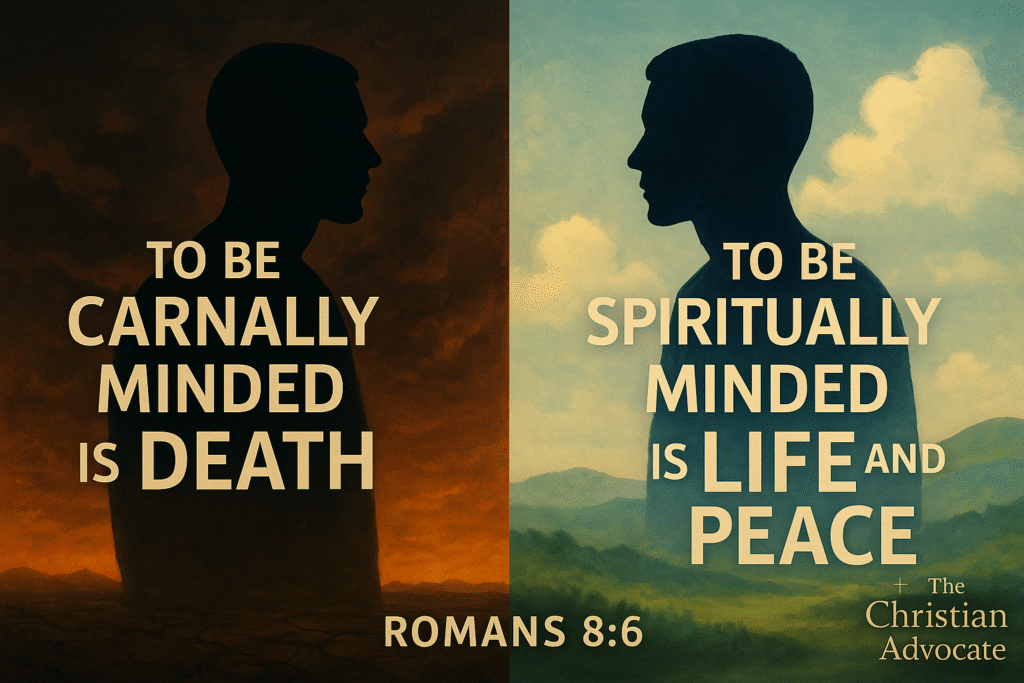
6. For to be carnally minded is death, but to be spiritually minded is life and peace.

7. Because the carnal mind is enmity against God; for it is not subject to the law of God, nor indeed can be.

8. So then, those who are in the flesh cannot please God.”  

Scripture says:

·       “To be carnally minded is death.”

·       “The carnal mind is enmity against God.” (Enmity = hostility, antagonism, hatred.)

·       “Those who are in the flesh cannot please God.”

Silhouettes of two men facing opposite directions, one in a fiery barren landscape and the other in a peaceful green valley, illustrating “To be carnally minded is death, but to be spiritually minded is life and peace” from Romans 8:6.
To be carnally minded is death, but to be spiritually minded is life and peace (Romans 8:6).

Now, how can an individual have a carnal mind—a mind at enmity with God—and yet be a Christian?

It is impossible. It will never work.

It is like throwing a sugar cube into a cesspit.

This business of being a “carnal Christian” is—what is my word? —HOGWASH!

It is an oxymoron. According to Scripture, there is no such thing. We are either Christian or carnal. Period!

This, too, is a manifestation of spiritual warfare, because this kind of thinking is what keeps us on the fence:

·       We want to live the way we want to live.

·       We still want to be saved.

·       We want to have our cake and eat it too.

Now, yes, when we first accept Christ, we are still immature and carnal in many ways. But we are required to grow. For more on that, see the full article on this Website titled “How to Grow in Christ.”

Lukewarm Christianity: The Laodicean Condition

What does God—what does Christ—say about this fence-sitting condition?

Jesus calls this state “lukewarm.” Individuals in this state are neither hot nor cold for God.

In Revelation 3:15–16, addressing the church of Laodicea, Jesus says:

15. I know your works, that you are neither cold nor hot. I could wish you were cold or hot.

16. So then, because you are lukewarm, and neither cold nor hot, I will vomit you out of My mouth.

There is no room here for a so-called “carnal, fence-sitting Christian.” Christ has nothing for a lukewarm Christian. He says, “I will vomit you out of My mouth.”

Why do we vomit? Because the body rejects what is:

·       Distasteful

·       Harmful

·       Of no value

Lukewarm is ineffective. Lukewarm water is not hot enough to kill germs, and not cold enough to refresh. What good is it?

Personally, I like my coffee or tea either hot or ice cold. A lukewarm cup of tea is tasteless, of no value, forcing me to make several trips to the microwave to heat it up.

Some professing Christians need to make some trips to the “microwave” to heat up their spirits for the Lord.

Why does Jesus have such disdain for lukewarm, fence-sitting Christians? Consider this:

A lukewarm Christian is only half-committed:

·       Half-committed to Christ

·       Half-committed to proclaiming Jesus as the Son of God

·       Half-committed to studying the Word

·       Half-committed to evangelism and missions.

·       Half-committed to holy and pure living.

·       Half-committed to self-denial and sacrificial living.

Half-committed all the way down the line—lukewarm and of no value to God and His kingdom.

The present church is in the Laodicean age, full of lukewarm Christians.

Jesus sums it up in Matthew 6:24:

24. “No one can serve two masters; for either he will hate the one and love the other, or else he will be loyal to the one and despise the other.” (Matthew 6:24)

He also says in Luke 11:23:

23. He who is not with Me is against Me, and he who does not gather with Me scatters. (Luke 11:23)

There are only two masters:

·       The Godhead—God and Jesus

·       And Satan

We can only serve one.

If we walk through life with one eye on Christendom and one eye on the world, we are only fooling ourselves.

Manifestations in Church Leadership

Up to now, we have focused on individual manifestations, but there are also collective manifestations—especially in the church.

Satan’s attacks on the church have risen exponentially. He has been causing havoc with the church for centuries, but in the last twenty years, this assault has really stepped up.

Satan knows his time is short. He knows that to wipe out a body, you strike the head. So, he targets the church’s leadership, and the damage permeates the entire body.

I have a friend who is a Christian counselor, and some of the things shared with me have made me want to do a backward flip:

·       Pastors (plural) involved in adulterous affairs.

·       Pastors hooked on drugs

·       Pastors addicted to pornography

·       Pastors beating and mistreating their wives.

These are well-known leaders. No names are given—of course, that would be unethical. But the point is to shed light on manifestations of spiritual warfare—even on the heads of the church.

This is no game. It is a fierce, unseen spiritual war manifesting itself in the natural.

To women chasing after pastors, wanting to be “first ladies”:

Be careful what you ask for. Satan is chasing pastors like a fox chasing chickens. If the pastor is strong and will not relent, guess what? The next in line is the family.

In my growing up, some of the most rebellious children I saw were those of pastors and ministers.

Forget about status—you could end up sleeping with the enemy.

Pastors who allow themselves to become victims of this warfare had better repent before they become casualties instead of victims.

Jeremiah 23:1–2 says:

1. Woe be unto the pastors that destroy and scatter the sheep of my pasture! saith the Lord.

2. Therefore thus saith the Lord God of Israel against the pastors that feed my people;

Ye have scattered my flock, and driven them away, and have not visited them:

behold, I will visit upon you the evil of your doings, saith the Lord.”  

This prophecy was initially directed at Israel—at leaders tasked with guiding the people in accordance with God’s will. But instead, they contributed to the nation’s troubles, leading God to pronounce severe judgment on them.

Prophecies like this often express principles of God that have multiple applications, leading to more than one fulfillment. Here, the principle is: we are answerable to God for the people we guide and influence under His authority. Leaders bear responsibility for those entrusted to their care.

When pastors fall, they scatter the sheep—the congregation. People leave, they gossip, confusion erupts, and the church becomes crippled. As God says, they “destroy and scatter the sheep of My pasture.”

Yet another manifestation of spiritual warfare.

Some may say, “Well, pastors are only human.” That is true. But look at the instruction in 1 Timothy 4:12. Paul is charging Timothy, a young pastor:

12. Let no one despise your youth, but be an example to the believers in word, in conduct, in love, in spirit, in faith, in purity.”

Pastors are expected to serve as role models. Though they are human, they are called to exemplify a visible commitment to living in Christ.

If a pastor becomes so “human” that he can no longer be that example, he needs to step down, so the church can remain effective. Otherwise, he will be held accountable not only for himself but for the whole congregation—double jeopardy.

Cultural Movements as Manifestations of Spiritual Warfare

We have only touched on a few manifestations of spiritual warfare. They are far too numerous to cover in one teaching.

But know this: all the destruction and chaos in the country and the world are manifestations.

Consider the Postmodern era, which ushered in:

·       The sexual revolution

·       The Women’s Liberation movement

·       The pro-choice movement

·       The gay rights movement

All of these are manifestations of spiritual warfare, shaping culture to move further and further away from God’s design, against the will of God.

Conclusion

Get Off the Fence and Walk With Christ

We must get off the fence and walk the path with Christ.

If we stay on that fence, we are not only stagnant—we are lost.

We must make a choice. Since we are born with a sinful nature and, as Scripture says, “walked according to the course of this world,” it is vital to understand this:

Not to choose Christ is to make a choice against Him.

But if we choose Christ, then we must walk with Himin Spirit and in truth.

The effects of spiritual warfare are all around us and are always knocking at our door. So, we must follow the Scripture, which reads:

“Be sober, be vigilant; because your adversary the devil, as a roaring lion, walketh about, seeking whom he may devour:” (1 Peter 5:8, KJV)

Be on guard—and fight when necessary.

Closing Call to Action

If you see these signs and manifestations of spiritual attacks in your own life, do not ignore them and do not stay on the fence.

Take time to:

·       Examine your walk with Christ honestly.

·       Repent where the Holy Spirit brings conviction.

·       Ask the Lord to renew your mind, your zeal, and your love for Him.

·       Pray for your pastors, leaders, and fellow believers who are also under assault 1 Tim. 2:1-2).

This article is part of a larger journey. In the earlier teachings on spiritual warfare, we looked at what the battle is and where it is fought. In the next part of this series, we will not only talk about the attack—we will talk about the fight.

Watch for the next installment on Overcoming Spiritual Warfare, and in the meantime, stay sober, stay vigilant, and keep walking with Christ—off the fence and firmly on His side.

Questions, comments, and concerns may be left below.

Blessings!

📺 Watch the Companion Teaching Videos (Full & Shorts)

For those who enjoy receiving the message in video format, the teaching is also available below.


Here is a brief Short highlighting one of the key points from this message.


Spiritual Warfare: The Conditions of the Mind

This is the third part of the series on Spiritual warfare. This segment is entitled “Spiritual Warfare: The Conditions of the Mind.”

For a brief review, I addressed the fact that we were all born with a sinful

All About Spiritual Warfare - The instant you accept Jesus as Lord and Savior, war is delcared against you. But all is not lost!
War is declared, but all is not lost!

nature, contrary to God—separated from God; that because of God’s mercy and grace, he established a way for us to be rejoined with Him, through His son Jesus. Therefore, making a way for us to have a spiritual renewal or rebirth: in other words, being born again. I also established that, because of our spiritual rebirth, we have been placed in a war—a spiritual war; a war that is ongoing and fierce. Also, we need to be aware of this war, who is at the helm of the opposing force, and how to fight and win this battle.

Review and Focus for Part 3

In the last article, The Mind is the Battlefield, I addressed the fact that Spiritual Warfare takes place in the mind. Satan attacks the mind—he sends his fiery darts, his evil-negative thoughts directly into our minds. But we must learn to dispel those thoughts—to cast them out, in the name of Jesus. One of the scriptures that I covered was what Jesus said in Matthew 12:33: “Either make the tree good, and his fruit good; or else make the tree corrupt, and his fruit corrupt: for the tree is known by his fruit.”  To repeat, He said: Make the tree good: How do we make the tree good? By feeding it with good fertilizer. We must feed our trees—our minds with good fertilizer—good thoughts in order to bear good fruit, or a positive life. So we must dispel Satan’s evil thoughts.

All About Spiritual Warfare-the mind is the battlefield

Why Mental “Conditions” Matter in Spiritual Warfare

Satan’s attacks, if allowed to nest in our minds, can manifest themselves in numerous ways, causing any number of conditions. In this article, I will begin by addressing the various conditions of the mind.

The Normal Christian Mind: Led by the Spirit

Let’s first look at the normal mind of a Christian. What makes a Christian’s mind tick? 1 Corinthians 2: 13-16

13 Which things also we speak, not in the words which man’s wisdom teacheth, but which the Holy Ghost teacheth; comparing spiritual things with spiritual.

14 But the natural man receiveth not the things of the Spirit of God: for they are foolishness unto him: neither can he know them, because they are spiritually discerned.

15 But he that is spiritual judgeth all things, yet he himself is judged of no man.

16 For who hath known the mind of the Lord, that he may instruct him? But we have the mind of Christ.

The normal mind of a Christian is one led by the Spirit of Christ.

Faith vs Doubt: The Double-Minded Man

Let’s review a passage that I covered in the last article. Romans 8:9

9 But ye are not in the flesh, but in the Spirit, if so be that the Spirit of God dwell in you. Now if any man have not the Spirit of Christ, he is none of his.

The scripture says that we are not to be in the flesh, but in the spirit. If we don’t have the spirit of Christ in us, then we aren’t his—we aren’t Christians. So again, the normal Christian mind is one that is led by the spirit of Christ.

How the Mind and Spirit Work Together

What we must understand regarding the mind of a Christian is that the mind and the spirit work together. Let’s look at this in 1 Corinthians 2:11

11 For what man knoweth the things of a man, save the spirit of man which is in him? even so the things of God knoweth no man, but the Spirit of God.

Now what this scripture is saying is that no one knows the thoughts and plans of man, other than himself—his spirit. The only way anyone else will know our thoughts is if we reveal them. By the same token, no one knows the things—the thoughts, the mind of God, other than His spirit. So the mind and the spirit work together. The spirit knows what in the mind.

Now, when a person receives Christ as His personal Savior, the Holy Spirit comes to dwell in him. As we have just seen in scripture, the Holy Spirit knows the mind of God.

Revelation and Understanding: The Eyes of the Mind

Now let’s take this a little further and look at Ephesians 1: verses 15-23 contain Paul’s prayer of revelation for the Ephesians, and in verses 17-18, it reads:

17 That the God of our Lord Jesus Christ, the Father of glory, may give unto you the spirit of wisdom and revelation in the knowledge of him:

Now Paul is praying that God would impart to them (the Ephesians) His Holy Spirit so that He would be revealed to them and they would know more of Him.  Continuing with verse 18:

18 The eyes of your understanding being enlightened; that ye may know what is the hope of his calling, and what the riches of the glory of his inheritance in the saints,

The eye of your understanding is the mind. The NIV translation actually reads, “the eyes of your Heart,” and as I mentioned in the last article, I mentioned that the word translated as heart and soul [leb] (labe)], is also translated as mind.

Since the Holy Spirit dwells in us and since He knows the mind of God, one of His purposes is to reveal to us God’s wisdom and revelation. That wisdom and revelation are imparted to our spirit, and our spirit then enlightens the eyes of our hearts—or our minds.

An Illustration: Power, Transmission, and Direction

Take a car, for example: you have the engine, the transmission, and the wheels. The power starts with the engine—that’s where the power is produced; the power then goes to the transmission; and from the transmission to the wheels, and the wheels move the car.

Now taking this divinely: the engine is God—that’s where the power comes

The Holy Spirit - Our power source
Our transmission

from; it then goes to the Holy Spirit—which is the transmission; and from the transmission, the power goes to the mind—which is the wheels, which move and control the body. The body reacts to the mind accordingly.

Now, if our power comes from God, then our transmission is the Holy Spirit, sending our wheels (our minds) in the right direction; but if our power comes from Satan, our transmission is the flesh, and will send our wheels spinning in the complete opposite direction.

As Born Again Christians, we are both spiritual and natural. As I mentioned during the introduction of the series, before we were born again, our flesh, our natural self, led the way. Whatever our flesh wanted, that’s what we set out to satisfy. Whether it was sex, drugs, alcohol, or any overindulgence to appease our flesh, we did it. But as Christians, our spirits, which are connected to the Holy Spirit, are to do the leading. But the natural doesn’t always understand the spiritual. So the mind often misses what the spirit is trying to reveal to us, because it’s too busy. A mind that is too occupied is not normal; it is abnormal. The mind is normal when it is at rest. That doesn’t mean we should have blank minds, but it does mean they should be at peace.

Mental Junk Food and the Overloaded Mind

Our minds should not be filled with what I call mental junk food. If we feed our bodies with a constant diet of junk food and fast food, our bodies will

All About Spiritual Warfare: The Conditions of our minds
WE must control the thoughts we allow to dwell in our minds!

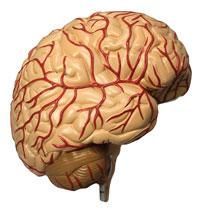
eventually break down. But this also holds true of the mind. Junk food for the mind consists of excessive reasoning, worry, anxiety, fears, and so forth. The mind shouldn’t be filled with this junk food, but should be quiet, calm, and serene as much as possible. But if filled with mental junk food, the mind, just as the body, will break down. I’m sure that we’ve all heard of the condition: a nervous breakdown. A condition that results when the mind has had so much of a diet of mental junk food, it becomes so overloaded that it just snaps; breaks down—it simply can’t take anymore. Our minds simply become—a junk yard. Other conditions include: depression, anxiousness, and anguish.

In addition to being at peace, the mind of a Christian believer should also be alert. The Bible says, “Be sober, be vigilant.”  That doesn’t only mean don’t drink. It means be alert, clear-headed, on the lookout, and on the defensive.

Now this isn’t easy because Satan makes it difficult—on purpose—it’s his job. Satan is addressed by several names in the scriptures: For example,the Prince of this world, and the prince of the power of the air. [John 12:31, Ephesians 2:2]  But if there was such a thing as rewriting the bible, one of the names I would give Satan is The King of Junk. He is the King of Mental Junk Food—the chief distributor, clogging our minds. He attacks us, waging a war against our minds. He attacks us by attempting to overload and overwork our minds by filling them with every kind of wrong thought—junk, so they cannot be free and available to the Holy Spirit working through our own human spirit. And Christians are yielding. There are Christians claiming to walk in Christ’s spirit, when in fact they are walking in the flesh. Why? Simply because we’re feeding their minds with the junk of this world. [that’s future article]  This is why we hear so very little from God. The reason we hear so little from God is that we can’t receive His Spirit, which leaves us lacking in wisdom and revelation. Therefore, it is impossible to have a healthy mind when it is loaded down with things it was never intended to carry.

Perfect Peace: A Mind Stayed on God

To close on the normal mind, we’re going to look at one last scripture: Isaiah 26:3—Isaiah writes concerning the Lord:

3 Thou wilt keep him in perfect peace, whose mind is stayed on thee: because he trusteth in thee. In order to keep our minds at peace, we must keep our minds on God and trust God. We must visualize ourselves obeying God and being greatly blessed by Him.

The Abnormal Mind: When the Mind Becomes Clogged

All About Spiritual Warfare-the mind is the battlefield
The mind is the battlefield

Let’s now look at some conditions of the abnormal mind: minds that get clogged with mental junk food. This junk food manifests in ways that cause various mental illnesses. Much like junk food can do to our bodies.

Condition 1: A Wandering Mind

The first condition is a wandering [wandering] mind. To wander [waunder] is to move or go about aimlessly, without a plan or fixed destination. So, a wandering mind is one that doesn’t stay focused on a fixed topic or plan. Now, in childhood, this is one of the leading causes of learning disabilities. It causes a lack of concentration. The inability to stay focused on a topic or task. Now, to some this is involuntary—they can’t help themselves, while others do this voluntarily. I’m sure that most of us can remember daydreaming in class or even in a meeting. Not because we couldn’t help ourselves, we simply wanted to be somewhere else (I know I did). It was a means of escape to someplace or somewhere we wanted to be. But if we do anything long enough, it will become a habit—good or bad. If we allow ourselves to form a habit of this, it can reach near-uncontrollable levels when we should and want to concentrate but can’t.

If our minds are filled with enough anxiety, worry, and confusion—mental junk food, it becomes impossible to concentrate, leaving our minds to wander. Satan loves it! It prevents Christians from listening to sermons, teachings, and Bible studies and receiving from them. While our bodies may be in church, our minds have drifted to some far place or circumstance. It can also prevent us from reading and receiving from the Word. Unable to concentrate, we can just drift off to sleep, which can cause havoc in our jobs and places of business, affecting our communications and sound judgment.

This can be a very subtle process, like all of Satan’s destructive works. It can happen gradually with age. As we progress further into adulthood, our responsibilities increase, placing greater strain on our minds. And if we aren’t careful, we’ll become complete scatterbrains, unable to accomplish anything.

The Biblical Remedy: Gird Up the Loins of Your Mind

Now the scriptures instruct us on this issue of the wandering [wandering] mind.  Let’s look at 1 Peter 1:13

13 Wherefore gird up the loins of your mind, be sober, and hope to the end for the grace that is to be brought unto you at the revelation of Jesus Christ;

Now, the people in biblical times would gather up their long robes and tie them around their waists so that they could move more freely and quickly. We Christians today must also tie up the robes in our minds that can keep them from moving or operating freely. We need to do whatever it takes to focus our thoughts on those things that allow us to serve our God successfully, while eliminating any thoughts that would tie or bind us.

A Warning for Worship: Don’t Bring a Mindless Offering

Let’s look at another warning against a wandering mind:

Ecclesiastes 5:1

1 Keep thy foot when thou goest to the house of God, and be more ready to hear, than to give the sacrifice of fools: for they consider not that they do evil.

Now, to keep our feet means, in this case, to stay alert so as not to slip, lose our balance, or get off track when we go to God’s house. We are to do this, rather than give the sacrifice of a fool. When we sit in church and allow our minds to wander to the point that we receive nothing for being there, it’s useless to go. We may make the sacrifice to be there, but it is a useless sacrifice—we’re only taking up space. It is the sacrifice— of a fool.

Now a fool is an individual who has no good sense—to the point that they do evil, and don’t even know it. Now, for clarity, here is the same scripture from the New Living Translation. It reads:

1 As you enter the house of God, keep your ears open and your mouth shut! Don’t be a fool who doesn’t realize that mindless offerings to God are evil. Is that to the point or what?

Now, to not receive from God is evil. To be a mindless offering is evil. God has given us His Spirit, and we are to use it for our benefit. He has also given us free will, and we are to willfully keep our minds from wandering to the point of self-destruction.

Practical Discipline: Training the Mind to Focus

Now, how do we do this? How do we obey this Scripture? Only through prayer and discipline. If concentrating becomes difficult, we must make a greater effort to focus. If we’re reading and find that we’re not focusing and receiving, stop—go back and read it again. If we miss a space in a conversation, we apologize and ask the person to repeat themselves. By the end of the Sunday message, we know whether our minds have wandered and we missed what was said; so, buy the tape. Take a quiet moment to listen to it, and if we miss parts, rewind and play it back. Sometimes, when I have a lot on my mind, I have to reverse a segment of a video 2 or 3 times. I simply refuse to let Satan steal anything from me that I’m going to benefit from. The Bible says: “resist the devil and he will flee from you.” [James 4:7]

The Devil will give up if he sees that we won’t give in. But only for a season; he’s tenacious, so we must always be on guard. In addition, when we have numerous tasks to complete, prioritize them. This enables us to focus on what’s most important. Then, instead of having our minds aimlessly buzzing between numerous tasks, we can concentrate on one task to completion. Of course, it always helps to eat and rest properly.

Condition 2: A Wondering Mind

The next condition I want to address is the wondering mind. To wonder is to be filled with puzzlement and doubt. When one has a wondering mind they’re never really sure about anything—unstable. Anyone who has a wondering mind can’t pray properly, can’t get answers to their prayers because they have too much doubt in their minds—their hearts. Let’s review the familiar passage in James 1:5-8

5 If any of you lack wisdom, let him ask of God, that giveth to all men liberally, and upbraideth not; and it shall be given him.

6 But let him ask in faith, nothing wavering. For he that wavereth is like a wave of the sea driven with the wind and tossed.

7 For let not that man think that he shall receive any thing of the Lord.

8 A double minded man is unstable in all his ways.

We can’t approach God wondering whether He’ll answer our prayers. We are to approach him in faith, knowing that He will answer them.

Christians, who are walking in the Spirit of Christ, should never wonder, but walk victoriously. Remember what Jesus said in Mark 11:24: “Therefore I say unto you, What things soever ye desire, when ye pray, believe that ye receive them, and ye shall have them.”

Now with a promise like that from our Lord and Saviour, Jesus, whose spirit we’re to walk in, how can we allow Satan to give us a wandering [waundering]—wondering, mind? We must replace our doubtful thoughts with positive thoughts. Instead of asking, I wonder if God’s going to answer my prayer? We should be declaring: I know God is going to answer my prayer, and when He answers it, and how He answers it, is up to Him.  Period!

Condition 3: A Confused Mind

Looking at one more condition, next, we’re going to look at: the confused mind. Now the wondering mind and the confused mind are first cousins.  They are very closely related. James 1:5-8 covers both conditions. When we have a mind full of doubt—a wondering mind, we are confused about everything. From what we believe to what we’re going to wear. We want to live single but be married. We want to be saved, but we want to live like the world. We want to be secure, but the fact is, we’re very insecure. Do we see a pattern here? It’s a double mind. A wondering, confused mind is, in a word, a mess. Unstable in all it does.

When Reasoning Turns Dangerous

Now, in the case of the confused mind, here is where Satan can really strut his stuff. If you’ll remember back to my last article, I mentioned that one of the functions of the mind is to reason. Now, what does it mean to reason? It is the ability to think, form judgments, and draw
conclusions. This is a power that God gave man when he created him. Remember, in Genesis 1:26, God said

“Let us make man in our image, after our likeness:” God gave man the ability to think and reason, and create like Him, but on a much more limited basis. But remember, along came Satan, who twisted God’s words and confused
man’s reasoning.

Now the scriptures tell us that Jesus is the same yesterday, today, and forever. [Heb 13:8] But also, we must always remember that Satan is the same yesterday, today, and from now on, until his time is up. And he’s using the same schemes today that he used yesterday. He is still interfering with man’s reasoning today, leaving many Christians with confused minds. Now let’s examine how this works.

Reasoning is when a person tries to figure out the how and why behind

The Inspired Word of God

something like: an issue, event, or a situation, trying to figure out all of the intricate parts of it. If it is logical and makes sense, we accept it. If it doesn’t, we reject it. But reasoning must be grounded in the right spirit.

Satan often steals the will of God from a Christian because of reasoning. We can literally reason ourselves right out of God’s will. God may speak something to our spirits, but if it doesn’t make sense to us, we’ll reject it. What God leads us to do does not always make logical sense to our minds. While our spirits may affirm it, our minds will reject it.

Natural Reasoning vs Spiritual Discernment

For example, God’s Word in James 1:2 reads:” My brethren, count it all joy when ye fall into divers temptations.” [or various trails]  Now, to our reasoning mind, this makes absolutely no sense whatsoever. How can anybody possibly have joy when going through a trial? A trial involves some form of adversity; some form of resistance. There’s no such thing as a happy trial, or a joyous trial, and in our natural reasoning, a trial is something to be avoided at all costs.

But in the mind of God, a trial is a good thing. It proves us, and tests us, and He knows that when we come through the trial, that we are tried and true unto Him.  So we must turn our reasoning—our minds—our spirits over to God’s spirit, who knows the mind of God. So, for the Christian to encounter adversity is to undergo a trial in which his or her faith is proved either true or false before God, the highest judge. Since many positive things come about through such trials, Christians are urged in this scripture to rejoice at their occurrence. It’s the complete opposite of our natural reasoning. Another more literal example is what it says in Luke 4:1, which is: “And Jesus, being full of the Holy Ghost, returned from Jordan, and was led by the Spirit into the wilderness.”  Now in Matthew 4:1 it says: “Then was Jesus led up of the Spirit into the wilderness to be [tempted of the devil].  Now, natural reasoning may wonder: Why would God lead Jesus to the devil? It just doesn’t make sense to natural reasoning, and when we try to apply natural reasoning to spiritual things, it leads to confusion.

The same goes for tithing. Natural reasoning cannot comprehend the Tithingprinciples of tithing. It can never understand that a blessed 90%

is far better than an unblessed 100%. Natural reasoning will never comprehend the three T’s of Christianity: trials, tribulations, and tithes. Now this is Satan’s game!

That’s why if you look at the ways of the world, and the ways of God with the teachings of Christ, they are the complete opposite of one another.

It’s Satan’s objective to keep our reasoning in the natural, instead of the spiritual. Remember what Satan said to Eve: “Did God really say, ‘You must not eat from any tree in the garden’?”[Gen 3:1 NIV]  He interfered with her reasoning; turned it away from God—the spiritual, and switched it to the natural. She had already received the instructions from God and accepted them in the spirit. But after listening to Satan, she switched to the natural. The scriptures read: “And when the woman saw that the tree was good for food, and that it was pleasant to the eyes, and a tree to be desired to make one wise, she took of the fruit thereof, and did eat, and gave also unto her husband with her; and he did eat. [Genesis 3:6]

Once she switched to the natural reasoning, she saw all of the natural
benefits and totally forgot about the spiritual—what God said.

All About Spiritual Warfare - The Mind is the Battlefield
Keep Satan at bay!!

This is why one of the worst things we can ever do is have a conversation with Satan. Once we open a dialog with him, he has the opportunity to step in with his reasoning, unleashing havoc and confusion in our minds. However, the best thing we can ever do is give him the hand (to stop), and keep on walking in Christ’s spirit. We must recognize him for what he is: a deceiver and a liar.

Now again, reasoning is a natural, God-given ability. But Satan comes along with temptation. Now I’m going to cover temptation later on in this series. But temptation is when we are enticed to take our God given abilities beyond God’s boundaries. And this is what Satan does with our reasoning. This is a very serious component regarding the battle in the mind. This is a very serious aspect of Spiritual Warfare. So we need to look at some solutions, which of course are in the scriptures. Let’s first look back to 1 Corinthians 2:14

14 But the natural man receiveth not the things of the Spirit of God: for they are foolishness unto him: neither can he know them, because they are spiritually discerned. [separated]

You see, the natural man cannot receive from God’s spirit. The Scripture says that the natural man is spiritually separated. Why? Because he’s stuck in his own reasoning, therefore, the things of the spirit are simply foolishness, as far as he’s concerned. So he remains stuck in his own, limited wisdom. That’s why when addressing the ungodly, the bible says in Romans 1:22, “professing themselves to be wise, they became fools.” They are fools because they are stuck in the world’s wisdom, which is nothing in comparison to the wisdom of God. The bible confirms this by saying: “because the foolishness of God is wiser than men; and the weakness of God is stronger than men.” [1 Cor 1:25, cf. vss. 18-27]  So the natural man simply cannot receive any wisdom from God.

Why the World Can’t See: Blinded Minds

Now this is no accident:  Let’s look at this in 2 Corinthians 4:4

4 In whom the god of this world hath blinded the minds of them which believe not, lest the light of the glorious gospel of Christ, who is the image of God, should shine unto them.

The mind is the battlefield
Satan only wants your mind

The god of the world is Satan. Satan is blinding the mind of man today by causing confusion, just as he did in the Garden of Eden.

So this goes back to what I’ve been addressing all along. Walk in the spirit of God and Christ, and that will help us to understand God’s will for us. This is what renewing our minds is about, which was addressed in my article. It’s about hooking up—with the spirit of God. That’s why God said in His word:  Be still and know that I am God. [Ps. 46:10]  So we must learn not to always reason in our minds, but just obey the spirit.

The Path Forward: Obedience Over Argument

Let’s now go back to James 1:22

22 But be ye doers of the word, and not hearers only, deceiving your own selves.

The Inspired Word of God

We simply must obey God’s Word. Not just listen to it, but do what it says. If we listen to the Word, but don’t obey it, we’re only deceiving ourselves. This goes back to what I said earlier about sitting in church and not receiving. We may look like we’re listening and receiving, fooling others, but in essence, we’re only fooling ourselves. It’s like cheating on a test: in the long run, we’ve only cheated ourselves. We must not only listen to and study the Word, but also receive it and apply it to our lives. We can’t always reason and rationalize everything God says to us. We are to just obey. How many times have we heard bosses say: Just do it! And what happens? We do it!

You see, a leader—a boss, sees things from a different perspective, a bigger picture, and has to answer to somebody higher than he is. So we may not understand why they ask us to do, or not to do, certain things. But nevertheless, we must do what they tell us, and it’s biblical. [Eph 6:5-7]

In addition, we must always remember that what applies in the natural applies in the spiritual. God also sees the bigger picture—a much bigger picture. So we must just do what the spirit of God leads us to do.

Trust God, Not Your Own Understanding

Now we’re going to look at another scripture that deals with trusting God. Proverbs 3:5

5 Trust in the LORD with all thine heart; and lean not unto thine own understanding.

Again, trust God and not human reasoning. Reasoning opens the door for deception and brings much confusion, leading to a confused mind. So, girding up the loins of our minds and trusting God is the only way to win—The Battle of the Mind.

Please feel free to leave any questions, comments, or concerns regarding Spiritual Warfare below.

Blessings!

📺 Watch the Teaching Video

The battle for the mind is real—but so is God’s power to transform it.
Watch the full teaching below, and then the Short for a quick highlight.

All about the Trinity

Continue reading “All about the Trinity”

error

Enjoying this blog? Please spread the word :)