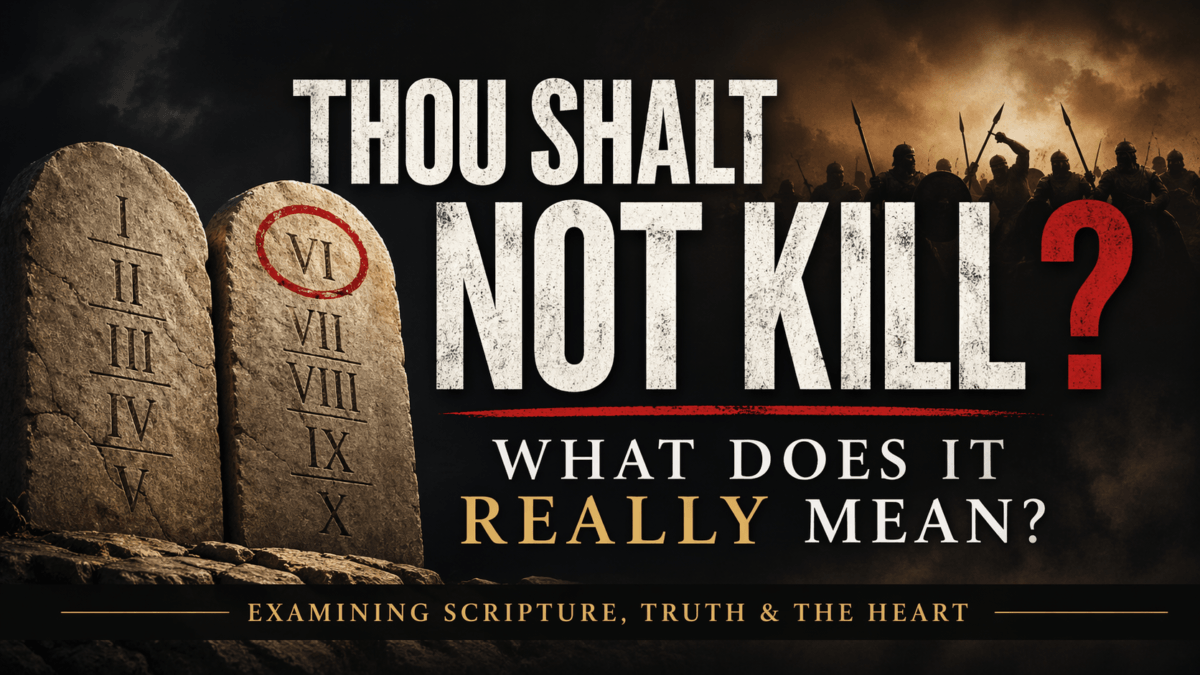
Thou Shalt Not Kill? What Does It Really Mean?

Thou Shalt Not Kill? What Does It Really Mean? When the Bible says, “Do not kill,” does that mean all killing is sinful? This question has led many to believe that the Bible contradicts itself when examined alongside the events of the Old Testament.

I want to begin by taking a minute to address the state of the world as we know it today.

Across the globe, murder, lawlessness, and violence are on the rise. Each year, hundreds of thousands of individuals fall victim to heinous acts, resulting in widespread suffering. In certain societies, the sanctity of human life seems to hold little value.

Throughout history, various societies have often reduced the value of human beings, including young children, to mere property or laborers serving the interests of the ruling class and the wealthy.

Moreover, it is concerning how prevalent depictions of violence and lawlessness have become in films and other media, frequently exposed even to young audiences. This constant exposure can leave a lasting impact on the human psyche, potentially leading to significant consequences.

As a result, many people may find themselves desensitized to violence and crime. Headlines and reports often focus on horrific events, and many forms of entertainment—such as television, movies, video games, music, and literature—often center around themes of lawlessness, violence, and immorality. This can contribute to a societal perception that devalues life.

It’s worth reflecting on how much daily life is saturated with these images and narratives. For many, this bombardment of violent content through various media can complicate our understanding of human life and morality.

👉 The Ten Commandments Series

Part 1: No Other Gods
Part 2: No Idols
Part 3: Do Not Take His Name in Vain
Part 4: The Sabbath
Part 5: Honor Your Father and Mother
Part 6: Thou Shalt Not Kill (Current Article)

The Sixth Commandment — What Does It Say?

When we look at the condition of the world today, does it not make perfect sense why God gave the sixth Commandment?

Let’s look at what it is in Exodus 20:13 NKJV

  1. You shall not murder.

As indicated in the introduction, the world has moved far—far away from this Commandment.

So, let’s take a good look at this Commandment and see what it’s really all about.

Does the Bible Contradict Itself? Thou shalt not kill

First, different Bible translations can create misunderstandings about its meaning. One common misunderstanding is that the Bible contradicts itself, and it is based on the following question:

How can the Bible state “Thou shalt not kill” (KJV), with all of the killing that took place in the Old Testament? That is a reasonable observation and question.

The Difference Between Murder and Killing

The fact is, different Bible translations can create misunderstandings about this verse and the meaning of the Commandment, deeming it necessary to look below the surface.

The Hebrew word in the original text is [Rat-sakh], which is murder. Murder is the unlawful termination of an individual’s life by another individual. Especially with premeditated malice or hatred. This is the true meaning of the Commandment.

The Hebrew word for to kill is [harag], which is generally used for the putting away of animals, including sacrificially, and for ruthless, personal violence of man against man—war. This is not the word used in this Commandment. That is why most modern translations (i.e., The New King James Translation above) render the sixth commandment “You shall not murder” rather than “You shall not kill.”

Therefore, a very large issue can arise depending on which translation an individual studies.

Just think, if the intended meaning of “Thou shalt not kill” meant—no killing at all—it would include the totality of the God-endorsed conflicts implemented by the nation of Israel, a violation of God’s own commandment. But understand that God does not break His commandments; therefore, the verse does not demand a total ban on taking human life.

When Is Killing Permissible in Scripture?

This commandment does not prohibit all killing. The Bible indicates that taking a life is permissible in certain situations; let’s look at these in Scripture:

– As capital punishment

Genesis 9:6 NKJV

  1. Whoever sheds man’s blood, By man his blood shall be shed; For in the image of God He made man.

– During a justified war

1 Samuel 15:3 NKJV

This is God’s instructions to King Saul through the prophet Samuel:

  1. Now go and attack Amalek, and utterly destroy all that they have, and do not spare them. But kill both man and woman, infant and nursing child, ox and sheep, camel and donkey.’ ”

– In cases of adultery, which was meant to protect the family unit, is crucial for society’s stability.

Leviticus 20:10 NKJV

  1. ‘The man who commits adultery with another man’s wife, he who commits adultery with his neighbor’s wife, the adulterer and the adulteress, shall surely be put to death.

– In self-defense, such as when a thief breaks into a home

Exodus 22:2 NKJV

  1. If the thief is found breaking in, and he is struck so that he dies, there shall be no guilt for his bloodshed.

In cases of accidental killing

Deuteronomy 19:4-5 NKJV

4.Whoever kills his neighbor unintentionally, not having hated him in time past—

  1. as when a man goes to the woods with his neighbor to cut timber, and his hand swings a stroke with the ax to cut down the tree, and the head slips from the handle and strikes his neighbor so that he dies—he shall flee to one of these cities and live;

Lastly, For killing animals for food

Genesis 9:3 NKJV

  1. Every moving thing that lives shall be food for you. I have given you all things, even as the green herbs.

So we must understand that there is a Biblical difference between justified killing and murder, the unlawful, intentional homicide. In the same way, most nations’ laws distinguish between these acts. Accordingly, the Ten Commandments forbid murder specifically, but not all forms of killing.

This is why, when disputes arise regarding Scripture, it’s necessary to examine the original texts (Greek & Hebrew) to determine more clearly what the author was expressing.

How Far Has Society Drifted?

Now that we know the difference between murder and killing, and it is clear what this Commandment commands, let’s look at how far we are from this Commandment, and how much it matters.

Every single day in America, over 50 people are murdered. Around the world, that number exceeds 1,200 per day. The fact is, human life has become cheap in society’s eyes. Let’s look at some statistics.

U.S. Murder / Homicide Statistics

Annual U.S. Homicides

  • According to the CDC, roughly 20,000–23,000 people are murdered each year in the United States, depending on the year measured.
  • The most recent CDC data lists 20,162 homicide deaths in 2024.

U.S. Homicide Rate

  • The current U.S. homicide rate is approximately 5.9 per 100,000 people.
  • That remains well above many other developed nations.

Daily Equivalent

  • That averages to approximately:
    • 55 murders per day
    • More than 2 murders every hour

Worldwide Murder Statistics

Global Annual Murders

  • According to United Nations homicide data, the world sees approximately 450,000–470,000 intentional homicides per year.
  • Latest UN estimates place the number around 458,000+ annually.

Daily / Hourly Equivalent

  • That equals approximately:
    • 1,250 murders per day worldwide
    • 52 murders every hour globally

These are concerning statistics! How did we get here?

Well, as mentioned in the introduction, we have become desensitized to murder. It no longer shocks or causes sorrow to hear about it. We have lost our sense of self-control, which causes us to sin. We are encouraged to rein this in. As the Bible states in Ephesians 4:26, “Be angry, and do not sin.”

This commandment is broken either by a planned murderous attack upon a person(s) or by a rash, reckless attack. This commandment forbids the taking of a life because a person is—let’s look at these behaviors

  • angry
  • bitter
  • violent
  • uncontrolled
  • passionate
  • vengeful
  • selfish
  • stealing
  • lusting
  • coveting
  • rebelling

Within this list is the breaking of another commandment, which will be covered later in this series.

Murder is always wrong, no matter the reasons behind it. This belief is crucial for the safety of our community and society. We cannot allow lawlessness and violence to thrive. We must uphold God’s Holy Word: murder driven by anger, robbery, or violence should always be condemned and punished.

The Heart Behind Murder

Furthermore, there are other acts just as unacceptable as directly killing someone physically.

There are those who, while not taking life by their own hand, show reckless or intentional disregard for human life and become morally complicit in its destruction. Many people around the world engage in such acts. For example, people are being pushed to work in unsafe conditions that can injure or kill them. They’re forced to live in terrible environments that lack basic necessities, leading to premature death. Additionally, individuals are being sold drugs that enslave them and ultimately lead to their demise.

Jesus Expands the Commandment

Further, Jesus expanded the commandment against killing to include not just the physical act itself, but also the anger and wrongful motives that can lead someone to murder.

Matthew 5:21-22 NKJV

  1. “You have heard that it was said to those of old, ‘You shall not murder, and whoever murders will be in danger of the judgment.’
  2. But I say to you that whoever is angry with his brother without a cause shall be in danger of the judgment. And whoever says to his brother, ‘Raca!’ shall be in danger of the council. But whoever says, ‘You fool!’ shall be in danger of hell fire.

Calling another “Raca,” which is a transliteration of an Aramaic term implying “empty-headed,” is an insult.

Saying “you fool” to a person is another insult. Fool is a translation of the Aramaic word Mōre, which is most likely a case form of the Greek word mōros (the origin of the English word moron), implying a person who regularly acts like an idiot.

To treat a person with such contempt was to strip away their personal identity and wrongly make him or her into something he or she was not.

Jesus said this behavior subjects one to “Judgment” and “in danger of hell fire.”

You see, we can murder an individual with our tongues.

Murder is more than a physical act; it’s rooted in internal feelings such as anger, bitterness, and enmity. It stems from an uncontrolled spirit and inner turmoil. Anger is the foundational sin that violates God’s law. It encompasses negative mindsets, such as:

– Bitterness and enmity

– Indignation and wrath

– Striking out at others

– Disappointment or self-hatred

– Rage and fury

– Lack of self-control

– Desire to harm others

– Envy and resentment towards others’ happiness

– Slander and attempts to ruin another’s reputation. This is wrong especially since everyone is created in God’s image.

To God, murder is not just physical in nature but also the condition of one’s heart towards another.

So to observe what the Scripture says in Ephesians 4:26-27 NKJV

  1. “Be angry, and do not sin”: do not let the sun go down on your wrath,
  2. nor give place to the devil.

Now, understand that there is justified anger. Justified anger is essential for believers; they should be angry at those who sin, act unjustly, or behave selfishly. However, this anger must be disciplined and controlled, focusing only on wrongdoing against God or others. The key difference between justified and unjustified anger is that justified anger is not selfish and doesn’t arise from personal grievances. It serves a purpose: to address the situation peacefully and constructively.

Romans 12:18-19 NKJV

  1. If it is possible, as much as depends on you, live peaceably with all men.
  2. Beloved, do not avenge yourselves, but rather give place to wrath; for it is written, “Vengeance is Mine, I will repay,” says the Lord.

If only we could live by this verse alone! To live peaceably with all men!

Modern Violations of the Commandment

Now, thus far, we’ve looked at murder from the perspective of individual against individual. But there is another form of murder that has become highly acceptable in the societies of the world—Abortion.

Abortion, which involves ending the lives of unborn babies, has long been a significant moral failure of humanity. The sanctity of life is consistently under threat.

According to the CDC, over 20,000 people are murdered in America each year…
But over one million unborn children are aborted in America annually.
Worldwide, that number rises to roughly 73 million.

Unfortunately, public opinion often contradicts the fundamental commandment, “You shall not murder,” when it comes to abortion.

I won’t further address that topic here. However, there is a full article on this website that addresses it. Here is the link.

Another form of murder that doesn’t involve person-to-person involvement is suicide. Suicide is the termination of one’s own life,

Suicide is perceived differently across various cultures and beliefs. For instance:

– Some may wonder if a Christian can take their own life due to extreme despair.

– Others question if someone can be seen as noble for committing suicide in the name of a cause or country, like the Japanese kamikaze pilots in World War II. 4970

Regardless of circumstances, suicide as a way to escape life’s struggles is a grave mistake. It occurs all too frequently but is never a solution. Every human life reflects God’s image, and no one should end their own life. Here are three compelling reasons to avoid suicide:

  1. God forbids murder, and suicide is self-murder.
  2. It destroys the image of God within us.
  3. Jesus Christ loves us and provides the strength to face and overcome our challenges.

Hebrews 2:18 confirms this:

  1. For in that He Himself has suffered, being tempted, He is able to aid those who are tempted.

The Consequences of Murder

The Commandment is, “You shall not murder.” These four words have behind them the eternal force of God, who is the Author of life. Human life is sanctified. The sacredness of life has and always will remain unmoved in the eyes of God. Individuals who break this commandment will face the Righteous Judge who will hold them completely accountable for murder. No murderer can escape these terrible consequences. So, let’s address some of these consequences, and then we’ll look at the blessings of obedience to this command.

First, the individual who murders another will suffer the wrath of God.

Romans 1:18, 29 NKJV

  1. For the wrath of God is revealed from heaven against all ungodliness and unrighteousness of men, who suppress the truth in unrighteousness,
  2. being filled with all unrighteousness, sexual immorality, wickedness, covetousness, maliciousness; full of envy, MURDER, strife, deceit, evil-mindedness; they are whisperers,

Next, the individual who murders another will be judged and will not inherit the kingdom of God. They will not inherit eternal life.

1 John 3:15 NKJV

  1. Whoever hates his brother is a murderer, and you know that no murderer has eternal life abiding in him.

And next, the individual who murders another is to face civil court, sentencing, imprisonment, the death penalty, or some other form of retribution.

Leviticus 24:17 NKJV

  1. ‘Whoever kills any man shall surely be put to death.

Lastly, the individual who murders another confirms that he is defiled and has an evil heart.

Matthew 15:19–20 NKJV

  1. For out of the heart proceed evil thoughts, MURDERS, adulteries, fornications, thefts, false witness, blasphemies.
  2. These are the things which defile a man…

The Blessings of Obedience

To address obedience to the Command: On the other hand, obedience yields blessings.

The individual who obeys this commandment and does not murder another person has decided to value life.

The contrast is stark between a culture that allows or executes the innocent and helpless, and a culture that honors and protects the sacredness of human life.

Those who really love, defend, and protect life benefit an entire community, nation, and world.

So, what are the benefits when God’s people speak out against murder?

What are the benefits to Christian believers who respect the sanctity of life?

Well, first, an individual who honors the Lord and values life will avoid killing and live by the Spirit, showing its qualities.

Let’s look at what the fruit of the Spirit is: Galatians 5:22-25 NKJV 

  1. But the fruit of the Spirit is love, joy, peace, longsuffering, kindness, goodness, faithfulness,
  2. gentleness, self-control. Against such there is no law.
  3. And those who are Christ’s have crucified the flesh with its passions and desires.
  4. If we live in the Spirit, let us also walk in the Spirit.

Next, the individual who follows God and respects the sanctity of life will have a sacrificial love for his brother.

1 John 3:14-16 NKJV

  1. We know that we have passed from death to life, because we love the brethren. He who does not love his brother abides in death.
  2. Whoever hates his brother is a murderer, and you know that no murderer has eternal life abiding in him.
  3. By this we know love, because He laid down His life for us. And we also ought to lay down our lives for the brethren.

Those who embrace God’s salvation and value life will feel a genuine urgency, stay alert to the times, maintain a clear perspective, and recognize the fragility of life, as addressed in God’s Word.

James 4:14 NKJV

  1. whereas you do not know what will happen tomorrow. For what is your life? It is even a vapor that appears for a little time and then vanishes away.

Lastly, the individual who truly respects the sacredness of life will understand that the only way to save his life is to give it away to Christ.

Matthew 16:25-26 NKJV

  1. 25. For whoever desires to save his life will lose it, but whoever loses his life for My sake will find it.
  2. For what profit is it to a man if he gains the whole world, and loses his own soul? Or what will a man give in exchange for his soul?

A Call to Repentance

Anyone who has murdered another human being, either physically or spiritually in their heart, must repent. If you have violated this commandment—whether by your hands or by hatred in your heart—repent.

Christ still offers mercy to all who come to Him.

Jesus is ever knocking on our doors for us to let Him in and save us.

As Jesus said in Revelation 3:19-21 NKJV.

  1. As many as I love, I rebuke and chasten. Therefore be zealous and repent.
  2. Behold, I stand at the door and knock. If anyone hears My voice and opens the door, I will come in to him and dine with him, and he with Me.
  3. To him who overcomes I will grant to sit with Me on My throne, as I also overcame and sat down with My Father on His throne.

My friends, we must respect the life that God has created, ours and that of others. We must obey the sixth Commandment, “You shall not murder.”

Amen!

Questions, comments, and concerns may be left below.

Blessings!

👉 Videos

Watch the full video presentation

Short on time? Watch the Short!

👉 The Ten Commandments Series

Explore the full Ten Commandments series below:

Part 1: No Other Gods
Part 2: No Idols
Part 3: Do Not Take His Name in Vain
Part 4: The Sabbath
Part 5: Honor Your Father and Mother
Part 6: Thou Shalt Not Kill (Current Article)


The Fifth Commandment: Honor Your Father and Mother.

The Fifth Commandment: Honor Your Father and Mother is one of the most well-known instructions in the Bible, yet it is often misunderstood. What does it truly mean to honor your parents, and how should this commandment be applied in today’s world? In this article, we will explore the biblical meaning behind this command and why it still matters.

In the previous article, we explored the Fourth Commandment and our responsibility to honor God through the Sabbath. Now, we move into the next section of the Ten Commandments, where God shifts our focus to our relationships with others—beginning with the family.

Did you know…that one of the greatest problems in society today can be traced back to one thing…to a breakdown in the family? How can we prevent this?

Today, we continue our series on the Ten Commandments…and we come to the fifth commandment: Honor Your Father and Your Mother.

👉 Continue through the Ten Commandments series:

👉 Part 4: The Fourth Commandment – The Sabbath
👉 Part 5: The Fifth Commandment – Honor Your Father and Mother
👉 Part 6: The Sixth Commandment – You Shall Not Murder

What is the Fifth Commandment?

Let’s take a look at this Commandment in Scripture: Exodus 20:12 NKJV

12.“Honor your father and your mother, that your days may be long upon the land which the Lord your God is giving you.

The family is fundamental to humanity. The family was the first institution formed upon earth. God created Adam and Eve, the first man and the first woman, and they became man and wife. Consequently, Eve bore a son. Therefore, the first family became the key institution, forming the basis for all subsequent human life and development.

It is the family that shapes the community, society, and governments of the world. From the beginning, God designed men and women not to simply exist, but to establish families and raise the next generation. They must produce children, or else everything crucial to humanity would eventually stop existing:

⇒           Human life would end.

⇒           Human society would end.

⇒           Human government would end.

Why This Commandment Still Matters Today

The main idea is that each generation has a responsibility to support and strengthen families for both their own time and for the future. Ignoring this duty is unwise, as the well-being of society and civilization relies on strong families where parents and children respect one another. Therefore, it’s important to focus on building up our families and addressing harmful influences that can threaten them all.

As the Scripture says in Hebrews 12:1 NKJV

  1. Therefore we also, since we are surrounded by so great a cloud of witnesses, let us lay aside every weight, and the sin which so easily ensnares us, and let us run with endurance the race that is set before us,

So, we must, as the Scripture reads, “…lay aside every weight, and the sin which so easily ensnares us.”  The sins such as:

  • selfishness
  • disrespect
  • disobedience
  • rebellion

God established the family’s prevalence and magnitude forever when He created the first man and the first woman. He reinforces the superiority of the family with this great commandment: “Honor your father and your mother.”

God commands us—all of us—to honor and respect our fathers and mothers.

Should the family unit crumble, many essential values that support personal well-being—such as honor, respect, concern, responsibility, decency, love, joy, and peace—may diminish. The erosion of these fundamental virtues can, in turn, weaken both the community and society at large.

Therefore, this Commandment is perpetual. It does not apply only to the Old Testament or the Jews. Therefore, as long as men, women, and children live on the earth, we are to honor and obey our parents.

Who Should We Honor After God?

How important is this Commandment? Well, take note that the first four Commandments addressed our duty to God. But once we have done our duty to God, notice that our very next duty is to honor our parents—right behind honoring God—that’s how important this duty is. This is divine order…

honor God first…

Honor parents next.

How Do We Honor Our Parents?

To understand this commandment, we must first understand what it means to honor.

The Hebrew word for honor (kabed) means that we are to respect, esteem, and have a high regard for our parents. The concept of honor includes reverence; we are to esteem and value our parents, showing respect, kindness, and obedience, as suggested by the Greek word timao. In practical terms, the commandment means we are to …

  • Respect and obey our parents
  • Accept their guidance and corrections
  • Consider their advice and concerns
  • Provide comfort to them

To honor means listening to our parents and never despising them when they are old.

It is important to recognize that mothers should be respected equally with fathers, and vice versa, as indicated by the directive: “honor your father and your mother.” Both parents are afforded equal status. According to the scripture, God honors and regards mothers and fathers alike, instructing children to show respect to each parent without distinction.

Moving on, this commandment highlights an important principle: learning through example. Children are taught to honor their parents by observing how their own parents honor theirs. The commandment applies to everyone, including adults who are both parents and children; it encourages them to continue showing respect to their parents. Parents should foster a home environment filled with respect and honor, thereby teaching their children by example. Ultimately, this commandment underscores the crucial role parents play in modeling proper behavior for their children.

Titus 2:7 NKJV

  1. in all things showing yourself to be a pattern of good works; in doctrine showing integrity, reverence, incorruptibility

Proverbs 22:6 NKJV

  1. Train up a child in the way he should go, And when he is old he will not depart from it.

Parents are responsible for teaching their children this commandment as well as others.

Does Honor Mean Obedience?

Why should children obey their parents?

Children should obey their parents because the Scriptures say so.

Ephesians 6:1-3 says:

  1. Children, obey your parents in the Lord, for this is right.
  2. “Honor your father and mother,” which is the first commandment with promise: 3. “that it may be well with you and you may live long on the earth.”

The phrase “in the Lord” explains why children should obey their parents. As it reads, “Children, obey your parents in the Lord,” means that obeying your parents is the right thing to do, it comes from God, and it pleases Him. So, when parents guide and teach them, they should listen.

Children are not told to obey parents because it pleases the parent, but because it pleases the Lord.

Notice the two promises made to children who honor their parents.

First, things will go well for the child. Does this mean that the child will never have problems or have to suffer? No! This is not what the Scripture means. God means that He will be with the child, strengthen and take care of him so that he can walk through the trials of life victoriously. The child will be strengthened and made strong where it counts—in the inner self. It will be enabled to conquer and be victorious over whatever confronts it as it journeys through life.

Second, the child is assured that it will live a long life on earth. Frankly, there is little question that Paul meant this and that we should take it at face value. If a child honestly obeys and honors its parents faithfully—really obeys and honors from the depths of its heart—God will give it a long life on earth.

Difficult Situations: When Honoring is Difficult

However, it is important to note that we must not follow in the steps of evil parents as some have done in the past. Although honoring parents is a fundamental obligation, this does not necessitate emulating parents whose actions are inconsistent with moral or ethical standards.

Ezekiel 20:18-19

  1. “But I said to their children in the wilderness, ‘Do not walk in the statutes of your fathers, nor observe their judgments, nor defile yourselves with their idols.
  2. I am the Lord your God: Walk in My statutes, keep My judgments, and do them;

What About Abused Children?

Children are to obey their parents. But what about the problems that are so repulsively evident in society: the problems of parental abuse, the problems of physical abuse, sexual abuse, and mental abuse? Is a child to obey a parent when the parent is so devilishly wrong? No!

A child’s obedience has its limits. If a parent acts in ways that do not honor the Lord, the child is not required to obey. The Lord does not support unrighteousness or the mistreatment of children. If a child can escape such harmful behavior, it has the right to do so. The Lord’s purpose is to free people from abuse and sin, not to keep them trapped in it, and certainly not to let children suffer under it.

Jesus gave one of the strongest warnings in history to adults who harm children:

Mark 9:42 NKJV

  1. “But whoever causes one of these little ones who believe in Me to stumble, it would be better for him if a millstone were hung around his neck, and he were thrown into the sea.

Any parent who abuses a child should take this seriously because God will not tolerate the abuse of a child. We must share what the Bible says: children should obey their parents, but only if their parents’ wishes and instructions align with the Lord’s will.

God’s Order: Honor God First, Parents Next

If a parent ever instructs a child to do something that clearly contradicts God’s commands, that child must obey God rather than his/her parents.

Further, if a child is able to escape the harmful influence and mistreatment of its parents, it deserves the right to be separated from them. The child should go to another adult they feel close to and ask for help.

Let’s look at what it reads in Acts 5:29 NKJV

  1. But Peter and the other apostles answered and said: “We ought to obey God rather than men.

Honoring Parents as Adults

Now, understand that Scripture does not address only children of a certain age. Instead, it speaks to everyone who still has living parents. We are called to honor our fathers and mothers, to see them as precious, and to show them respect and reverence. Sadly, this attitude is becoming less common. Too often, children respond to their parents in ways such as:

  • talking back
  • cutting the parent
  • ignoring the parent
  • grumbling
  • speaking disrespectfully
  • not listening
  • acting like a know-it-all
  • calling the parent a cute but disrespectful name
  • disregarding instructions
  • putting off instructions

In addition to these, there is the dishonor of delinquency, crime, drugs, alcohol, and the abuse of property, and the list could go on and on. And when it comes to adult children with aged parents, there is the dishonor of neglect, the ignoring of their needs, and the shuffling of them to the side and failing to adequately care for them.

Too many adult children forget how much their parents have done for them—bringing them into the world and caring for them for years. Too many children forget the rich experience and knowledge their parents have gained over the years, which could be put to great use in meeting community and world needs. And even if the parents failed to be and to do all they should have, we as Christian children are instructed to honor them as followers of the Lord Jesus Christ.

Consequences of Disobedience

So, what are the consequences of disobedience?

This commandment is presented positively as an invitation from God to obey. Obedience is met with promised blessings, while disobedience results in serious consequences.

An individual who consistently fails to honor their parents risks jeopardizing their eternal destiny. According to Scripture, those characterized by sinful actions will not inherit the kingdom of God.

Romans 1:28-32 reads:

  1. And even as they did not like to retain God in their knowledge, God gave them over to a debased mind, to do those things which are not fitting;
  2. being filled with all unrighteousness, sexual immorality, wickedness, covetousness, maliciousness; full of envy, murder, strife, deceit, evil-mindedness; they are whisperers,
  3. backbiters, haters of God, violent, proud, boasters, inventors of evil things, DISOBEDIENT TO PARENTS,
  4. undiscerning, untrustworthy, unloving, unforgiving, unmerciful;
  5. who, knowing the righteous judgment of God, that those who practice such things are DESERVING OF DEATH, not only do the same but also approve of those who practice them.

Disregarding and disobeying parents is deserving of death. This is not a small matter!

Practical Ways to Honor Your Parents

What does this commandment ask of us? Simply this—obedience.

The point is simply this: the law of obedience is part of the very nature of things. It lies at the heart of the universe and shapes how people live and act on Earth.

Many of the world’s problems, maybe even most, could be solved if people followed the fifth commandment. This commandment is clear and positive: we are to honor our fathers and mothers.

Let’s look at what Scripture teaches and the choices this commandment calls for:

We should honor our parents because it is one of God’s Ten Commandments.

We should honor our parents because it is simply the right thing to do.

Honoring our parents can lead to a longer life and a happier home, instead of one filled with tension. This is how:

We should show our parents respect and reverence.

We are called to obey our parents in the Lord.

We should hold on to and follow the teachings our parents give us.

We should pay attention to the Christian example our parents set for us.

We are to obey our parents even after we become adults.

We should care for our parents as they grow older.

That sums up the fifth Commandment!

Final Thoughts

Bottom line:

As Paul wrote in 1 Corinthians 7:19 NKJV

  1. Circumcision is nothing and uncircumcision is nothing, but keeping the commandments of God is what matters.

You see, it’s not about ceremony; that was important at one time. But what is really important today is keeping the Commandments of God. All of them! And that is what really matters.

We must obey the Fifth Commandment!

Amen!

Questions, comments, and concerns may be left below.

Blessings!

👉 Videos

For a visual presentation, watch the full video below.

If you’re tight on time, watch the Short.

Continue through the Ten Commandments series below:

👉 Part 1: The First Commandment – No Other Gods
👉 Part 2: The Second Commandment – No Idols
👉 Part 3: The Third Commandment – Do Not Take His Name in Vain
👉 Part 4: The Fourth Commandment – The Sabbath
👉 Part 5: The Fifth Commandment – Honor Your Father and Mother
👉 Part 6: The Sixth Commandment – You Shall Not Murder


The Ten Commandments (Part 4): The Sabbath (Saturday or Sunday?)

The Sabbath Saturday or Sunday question is one many Christians are asking today: Are we worshipping God according to His command, or according to tradition?

Did you know that most Christians today are worshipping on a day the Bible never commanded?

The Sabbath: Saturday or Sunday?

Is the Sabbath Saturday—or Sunday? Does it really matter?

## 📖 The Ten Commandments Series

– Part 1: No Other Gods

– Part 2: No Idols

– Part 3: The Meaning of God’s Name in Vain

– Part 4: The Truth About the Sabbath (Saturday or Sunday?) (current)

Today, we continue with the series on the Ten Commandments as we look at the fourth Commandment. The title of this presentation is, The Ten Commandments Part 4: The truth about the Sabbath (Saturday or Sunday?)

The Fourth Commandment

So, let us first look at this fourth Commandment, found in Exodus 20:8-11 NKJV  

8.“Remember the Sabbath day, to keep it holy.

  1. Six days you shall labor and do all your work,
  2. but the seventh day is the Sabbath of the Lord your God. In it you shall do no work: you, nor your son, nor your daughter, nor your male servant, nor your female servant, nor your cattle, nor your stranger who is within your gates.
  3. For in six days the Lord made the heavens and the earth, the sea, and all that is in them, and rested the seventh day. Therefore the Lord blessed the Sabbath day and hallowed it.

What Is the Sabbath?

The Commandment begins by stating, “Remember the Sabbath day…” So let’s begin by addressing what the Sabbath day is.

The Hebrew word translated as Sabbath is shabbath, which means “rest.” Another accurate translation is “ceasing [from work].

The Origin of the Sabbath

Its origin goes back to creation when God rested upon its completion. Let’s take a look at that account in Genesis 2:1-3 NKJV

  1. Thus the heavens and the earth, and all the host of them, were finished.
  2. And on the seventh day God ended His work which He had done, and He rested on the seventh day from all His work which He had done.
  3. Then God blessed the seventh day and sanctified it, because in it He rested from all His work which God had created and made.

This is the origin of the Sabbath rest. It is the celebration of God’s creation. Additionally, with the advent of Christ to save mankind from his sins, it is also a celebration of our salvation.

This connects directly to what we saw in Part 1: No Other Gods and Part 2: No Idols, where God established that He alone defines how He is to be worshiped.

God’s Command further states: “to keep it holy.” That means keeping it as a day consecrated, sanctified, and dedicated to God. The Sabbath day is intended for rest, offering renewal for both body and spirit. We experience physical rest by taking a break from work, while spiritual rest is achieved through worship that rejuvenates the soul.

Moving on, the verse states, “six days you shall labor and do all your work.” Now this is based on the fact that, as the Scripture reads, six days the Lord made the heaven and the earth … and rested the seventh day.”

We also see that this includes everybody: father, son, daughter, male servant, female servant, the stranger/visitor, and even the cattle. Everything and everybody is to honor the Sabbath. It is the fourth of the Ten Commandments.

Has the Sabbath Changed?

Now, how does this apply to today? Well, for starters, let me just say, we have swayed far, far away from this Commandment.

Today, roughly 90–95% of Christians worship on Sunday, the first day of the week. Yet surveys show that only about 70% of Christians actually treat Sunday as a day of rest. While many Christians attend church on Sunday, they do not treat it as a true Sabbath. They attend church, then go shopping at the mall, travel, and seek entertainment as they do on any other day. So, they worship on Sunday but do not consciously observe a “day of rest.”

This is in violation of the fourth Commandment. Only 1-3% of Christians observe the Saturday Sabbath. That is a true remnant!

Somewhere along the way, we stopped taking this Commandment seriously. Because this is one of the most overlooked Commandments today!

Why is this? Well, there are all kinds of doctrines and reasonings as to why, and we’re going to look at some of them today.

The Sabbath Saturday or Sunday debate is not new—it has been discussed for centuries.

Common Objection: The Sabbath Was Only for the Jews

The first: we are no longer under the Law: the Sabbath is for the Jews. Now that is grossly inaccurate! Contrary to common belief, this command was not exclusive to the Jews. The Sabbath existed even before it became part of the Ten Commandments—the Law. As we see in Genesis, it was established at the conclusion of creation. It predated sin.

Adam and Eve were not Jewish! But they were intended to be consecrated unto God, and God gave them the Law. But after they chose to sin by violating the Law, that was no longer the case. Fast forward, when God chose the nation of Israel to be His chosen—consecrated people, He gave them the Law—the Mosaic Law to keep them holy unto Him.

Now that takes care of the Old Testament. The Old Testament is basically the history of Israel. As the New Testament Scripture states in 1 Corinthians 10:11 NKJV

Early in the chapter, the Israelites’ trials and triumphs are addressed. In verse 11 it reads:

  1. Now all these things happened to them as examples, and they were written for our admonition (warning), upon whom the ends of the ages have come.

The Old Testament is the foundation and was provided to give us warnings not to follow the footsteps of the forefathers. The question is, are we heeding the warnings?

Now moving to the New Testament, this is where the Scripture twisting comes into play.

But first, let me say this: there is not one Scripture in the New Testament declaring the cessation of keeping the seventh-day Sabbath—not one!

But let’s look at some objections and the Scriptures cited.

First, many focus on Scriptures that mention “the first day of the week.” The proponents of this focus are that the Sabbath changed from Saturday to Sunday because Jesus was resurrected on Sunday, the first day of the week.

Does the New Testament Change the Sabbath?

John 20:1 NKJV

  1. Now on the first day of the week Mary Magdalene went to the tomb early, while it was still dark, and saw that the stone had been taken away from the tomb.

John 20:19 NKJV

  1. Then, the same day at evening, being the first day of the week, when the doors were shut where the disciples were assembled, for fear of the Jews, Jesus came and stood in the midst, and said to them, “Peace be with you.”

While Scripture confirms that Jesus appeared on the first day of the week, it nowhere confirms that Jesus ended the Sabbath to celebrate His resurrection.

Let’s look at what He did say regarding the Sabbath. Luke 6:5 NKJV

  1. And He said to them, “The Son of Man is also Lord of the Sabbath.”

Here, Jesus sanctioned the Sabbath and declared His authority over it, putting the Pharisees in their place. He was the Son of Man, and He was the Lord of the Sabbath. He did not change the day of the Sabbath, nor did he cancel it.

Mark 2:27 NKJV

  1. And He said to them, “The Sabbath was made for man, and not man for the Sabbath.

Here again, Jesus asserted His authority over the Sabbath. There is no sign of Christ abolishing the Sabbath. Also, notice that He said, “The sabbath was made for MAN,” not the Jews.

Now, back to those who focus on gatherings on the first day of the week. Let’s continue to look at the Scriptures they focus on. Acts 20:7 NKJV

  1. Now on the first day of the week, when the disciples came together to break bread, Paul, ready to depart the next day, spoke to them and continued his message until midnight.

If Paul’s gathering with the disciples at Troas started on the evening of the first day of the week (after Saturday sunset), it likely continued throughout the night into Sunday morning. The worship activity happened late Saturday night, making Sunday Paul’s travel day (see v. 13). This passage does not provide evidence for regular worship services occurring on Sundays or any other specific day. It also does not describe the first day of the week as sacred time, nor does it suggest that such a meeting should recur every Sunday.

1 Corinthians 16:2 NKJV

  1. On the first day of the week let each one of you lay something aside, storing up as he may prosper, that there be no collections when I come.

This passage does not mandate or imply the holding of a religious service. The text suggests no assembly; instead, it states, “let each one of you lay something aside, storing up as he may prosper.” There is no mention of prayer, singing, or preaching, nor any indication that Paul’s instructions were to be carried out within a meeting or worship context. Additionally, Paul’s instruction—“that there be no collections when I come”—does not establish a precedent for activities typically associated with regular gatherings.

A straightforward reading of Paul’s directions indicates that he intended for individual believers to set aside their contributions in advance of his arrival, with his instructions being fulfilled once these gifts were delivered to Jerusalem.

Now these Scriptures have nothing to do with worship. Upon examining these texts, it becomes clear that there is no scriptural basis for the idea that Sunday has replaced the Sabbath as the Bible’s designated day of rest and worship. In fact, the references to the “first day” simply note when events occurred, without assigning them any specific theological importance.

Sabbath Observance in the Early Church

New Testament Scripture clearly indicates that the Sabbath was recognized and celebrated in the early church. Let’s look at some Scripture, Acts 13:13-16 NKJV

  1. Now when Paul and his party set sail from Paphos, they came to Perga in Pamphylia; and John, departing from them, returned to Jerusalem.
  2. But when they departed from Perga, they came to Antioch in Pisidia, and went into the synagogue on the Sabbath day and sat down.
  3.  And after the reading of the Law and the Prophets, the rulers of the synagogue sent to them, saying, “Men and brethren, if you have any word of exhortation for the people, say on.”
  4. Then Paul stood up, and motioning with his hand said, “Men of Israel, and you who fear God, listen: And Paul began to address the congregation.

Acts 17:1-4 NKJV

  1. Now when they had passed through Amphipolis and Apollonia, they came to Thessalonica, where there was a synagogue of the Jews.
  2. Then Paul, as his custom was, went in to them, and for three Sabbaths reasoned with them from the Scriptures,
  3. explaining and demonstrating that the Christ had to suffer and rise again from the dead, and saying, “This Jesus whom I preach to you is the Christ.”
  4. And some of them were persuaded; and a great multitude of the devout Greeks, and not a few of the leading women, joined Paul and Silas.

Acts 18:1-4 NKJV

1.After these things Paul departed from Athens and went to Corinth.

  1. And he found a certain Jew named Aquila, born in Pontus, who had recently come from Italy with his wife Priscilla (because Claudius had commanded all the Jews to depart from Rome); and he came to them.
  2. So, because he was of the same trade, he stayed with them and worked; for by occupation they were tentmakers.
  3. And he reasoned in the synagogue every Sabbath, and persuaded both Jews and Greeks.

Take notice that these passages address worship. Paul ministered to both Jews and Greeks—Jews and Gentiles. And he did it on the Sabbath.

Were going to look at one more in Acts 13:42 NKJV

  1.  So when the Jews went out of the synagogue, the Gentiles begged that these words might be preached to them the next Sabbath.

Now this scene takes place at the close of worship on the sabbath. The gospel that Paul preached was so powerful that the Gentiles begged to hear more on the next SABBATH.

It doesn’t appear that the Sabbath was for Jews only.

Misunderstanding Hebrews 4

Moving on, there are those who say, Jesus is our Sabbath rest, and there’s no need to keep the seventh-day Sabbath under the Law. They use Hebrews 4:9-11 NKJV

9 .There remains therefore a rest for the people of God.

  1. For he who has entered His rest has himself also ceased from his works as God did from His.
  2. Let us therefore be diligent to enter that rest, lest anyone fall according to the same example of disobedience.

Hebrews 4 is a meaty chapter. But let me just say, this passage, verses 9-11, has nothing to do with the Sabbath day.

So, what is this “rest” of which the writer of Hebrews speaks, which should be an object of concern for the Christian community? The “rest” is something a Christian believer enters (and thus experiences) now, but this rest in its fullness remains a promised destination for the future. The Scripture says in verse 9, “There remains therefore a rest for the people of God.”  In this context, the Sabbath is a new-covenant Day of Atonement, in which God’s people are cleansed from their sins.

This rest does not replace the seventh-day Sabbath rest.

Jesus offers the ultimate source for true rest, for true rest is found only in a right relationship with God. The rest is His rest, for His people, found by obeying His word.

In the wake of a culture leaving the fragmented, fragile, and fatigued in its wake, the church has a phenomenal opportunity to point people to the ultimate land of promise and spiritual well-being.

In summary, what does the writer of Hebrews mean by “rest,” and why should it matter to Christians? This ‘rest’ is both present and future… found in relationship with God through Christ.

As Jesus said in Matthew 11:28

  1. “Come to Me, all you who labor and are heavy laden, and I will give you rest.”

Jesus is the source of genuine rest, which comes only from being in right relationship with God.

1 John 3:24 NLT

  1. Those who obey God’s commandments remain in fellowship with him, and he with them. And we know he lives in us because the Spirit he gave us lives in us.

We maintain our relationship with God by keeping His Commandments—all of them. Does that mean omitting the 4th one? Hardly!

My friends, this is about salvation in Christ. It has nothing to do with keeping the seventh day Sabbath. This does not remove the obligation to keep the Sabbath.

Understanding Colossians 2:16

There are many more examples of Scripture twisting regarding the Sabbath. But to address one more, the Scripture used for this one is Colossians 2:16 NKJV

  1. So let no one judge you in food or in drink, or regarding a festival or a new moon or sabbaths,

First of all, notice that it reads “sabbaths” (plural), not the Sabbath.

Some  religious festivals and celebrations required a sabbath from a day of work. Paul’s point was not to judge anyone by the festival or sabbath days that they recognized in that regard. He was not referring to the Seventh-day Sabbath. Why would he? After all, we saw earlier (in Scripture) that he participated in worship in the synagogues on the sabbath!

My friends, we must stop compromising the Commandments of God!

It’s time to stop monkeying around with what God has made clear.”

The Commandment says:

Remember the Sabbath day, to keep it holy.   Six days you shall labor and do all your work,  but the seventh day is the Sabbath of the Lord your God.

How Sunday Worship Began

So why do most Christians today honor the first day instead of the seventh?

Now to fully answer that question requires a separate—full article of its own. But this is the condensed version

It goes all the way back to the first century A.D. and a Roman Emperor named Constantine.

In 330 A.D., Constantine relocated his capital from Rome to Constantinople.  This is now modern-day Istanbul, Turkey, thereby paving the way for the Roman Catholic Popes to hold power in Rome as his successors.

“In 321 A.D., Constantine issued the first civil law promoting Sunday rest.

When the Catholic Church grew in influence, it promoted Sunday as a sacred day instead of observing the Sabbath, officially establishing this change at the Council of Laodicea (A.D. 363-364).

So the question becomes, on what authority did the Catholic church institute this change?

James Gibbons, Roman Catholic Theologian and author of the book “The Faith of our Fathers,” wrote:  

But you may read the Bible from Genesis to Revelation, and you will not find a single line authorizing the sanctification of Sunday. The Scriptures enforce the religious observance of Saturday, a day which we never sanctify.”

To put it plainly, it was the Catholic Church’s authority that shifted worship from Saturday to Sunday, rather than any directive in the New Testament Scriptures.

This is a significant acknowledgment from a Catholic prelate—the horse’s mouth, so to speak. Additionally, some religious leaders concede that there is no biblical authorization for designating Sunday as the new Sabbath Day.

When Christianity became aligned with the Roman Empire in the fourth century, a union between church and state began to form. Political power began influencing religious practice, and this period saw the introduction of Sunday laws and later church decrees promoting Sunday observance. [Spoiler alert: This is beginning to occur again—another article forthcoming]

But the point: we are disobeying God’s Commandment and worshipping God on the wrong day.

Now there’s a lot more to this story. However, you can read the full article on the Christian Advocate website, and here’s the link:

https://thechristianadvocate.org/saturday-vs-sunday-worship/

The Danger of Following Tradition

Moving on, the fact of the matter is: Sunday worship is pagan—a tradition of men—established in Rome.

Jesus called the religious leaders out on this following of traditions in Mark 7:6-9

  1. He answered and said to them, “Well did Isaiah prophesy of you hypocrites, as it is written:

‘This people honors Me with their lips, But their heart is far from Me.

  1. And in vain they worship Me, TEACHING AS DOCTRINES THE COMMANDMENTS OF MEN.’
  1. For laying aside the commandment of God, you hold the tradition of men—the washing of pitchers and cups, and many other such things you do.”
  2. He said to them, “ALL TOO WELL YOU REJECT THE COMMANDMENT OF GOD, THAT YOU MAY KEEP YOUR TRADITION.

Here, Jesus quoted Isaiah’s condemnation of Israel’s hypocrisy when he spoke to the Pharisees, the religious leaders of his day (Matthew 15:7–9; Mark 7:6, 7). We are all capable of hypocrisy, and we’re guilty of it today—As the Scripture states: laying aside the Commandment of God and holding the tradition of men.”

God has never left worship up to human preference. In Deuteronomy 12:29–31, God said:

29 “When the Lord your God cuts off from before you the nations which you go to dispossess, and you displace them and dwell in their land,

  1. take heed to yourself that you are not ensnared to follow them, after they are destroyed from before you, and that you do not inquire after their gods, saying, ‘How did these nations serve their gods? I also will do likewise.’
  2. You shall not worship the Lord your God in that way; for every abomination to the Lord which He hates they have done to their gods; for they burn even their sons and daughters in the fire to their gods.

32 “Whatever I command you, be careful to observe it; you shall not add to it nor take away from it.

 The Lord stated: “You shall not worship the Lord your God in that way.” Instead of copying how others worshiped their gods, Israel was commanded to worship God according to His instructions alone. This reveals an important truth: God does not accept worship that is shaped by culture, tradition, or human reasoning—but only that which He has commanded.

Israel was condemned for it, and we will be condemned also if we don’t make a change.

As we saw in Part 3: The Meaning of God’s Name in Vain, God does not accept worship shaped by human tradition, but only that which He has commanded.

Has the Sabbath Changed?

Yes, this was for the Israelites, but has God changed? In Malachi 3:6, He is quoted saying, “For I am the Lord, I do not change;”

A Call to Return to God’s Command

My friends, this is a big problem. But there is a solution, it’s time to show Jesus the love He deserves, and keep the Commandments—all of them. As He said in John 14:21 NKJV:

  1. He who has My commandments and keeps them, it is he who loves Me. And he who loves Me will be loved by My Father, and I will love him and manifest Myself to him.”

The fact is, we are too concerned about being enslaved, and we want to be free. But the Sabbath was never meant to enslave us to a day — it was meant to lead us to the One who gives true rest.

We must worship God on the Day He designated, not the one designated by man!

One day, we will have to choose who we truly love—God or man?

Make the correct choice before it’s too late!

Amen.

Feel free to leave any questions, comments, or concerns below.

Blessings!

👉 Videos

Watch the full teaching on Video

Watch the Short

## 📖 The Ten Commandments Series

– Part 1: No Other Gods

– Part 2: No Idols

– Part 3: The Meaning of God’s Name in Vain

– Part 4: The Truth About the Sabbath (Saturday or Sunday?) (current)


The Meaning of God’s Name in Vain

The Meaning of God’s Name in Vain. It is often misunderstood by many today. Most people assume it only refers to using God’s name as a curse, but this command reaches much deeper. It speaks to how we live, how we represent God, and whether we truly honor His name in our daily lives.

📖 The Ten Commandments Series

Does this Commandment apply today? Is it being violated? The answer may surprise you. And what this commandment really covers might surprise you as well.

Let’s look at this Commandment.

  1. “You shall not take the name of the Lord your God in vain, for the Lord will not hold him guiltless who takes His name in vain.

What Does it Mean to Take the Lord’s Name in Vain?

What does it mean to take the Lord’s name in vain?

According to the Strong’s Greek-Hebrew Dictionary, the Hebrew word translated as “in vain” is shav’ (shawv), which means “to desolate, destroy, or ruin.” To make useless.

So, in other words, in the context of this Scripture, it means to use God’s name in a useless, profane, or unholy way.

The way we refer to and regard the name of God is considered highly significant. As the Creator and Supreme Ruler of the universe, His name is to be treated with respect and reverence. Due to His status and attributes, it is expected that His name will not be used improperly or without due consideration.

In the Old Testament, misuse of God’s Name carried severe consequences. In fact, over time, the Israelites treated God’s Name with such reverence that many became afraid to even pronounce it, lest they misuse it.

But bringing this to today:

This Commandment requires us to never, under any circumstances, misuse God’s name.

Therefore, His name is always to be honored, praised, and worshipped. And:

⇒ We must never curse nor abuse His name.

⇒ We must never use His name in a frivolous or insincere way.

⇒ We must never take the name of the LORD God in vain.

We must understand that this commandment is not only for the Jews. It is directed to you. It is directed to me. It is directed at every human being on the face of the earth.

The Importance of God’s Name in Scripture 

Let’s look at a couple of examples of how God’s name is used in the Scriptures:

PS. 8:1 NKJV 

  1. O Lord, our Lord, How excellent is Your name in all the earth, Who have set Your glory above the heavens! 

Ps. 111:9 KJV

  1. He sent redemption unto his people: he hath commanded his covenant for ever: holy and reverend is his name.

God’s name is recognized as excellent, Holy, and it is revered in the Scriptures.

How Do We Misuse God’s Name?

Now, take note that there are four ways we can misuse God’s name. We’re going to look at all four.

Cursing or Abusing God’s Name 

This is the most well-known way, and the one most of us think of when considering this Commandment, and it involves profanity.

Profanity refers to the use of language that is considered offensive, including cursing, abusive, or irreverent expressions involving the name of God. The improper use of such language includes vulgarity and profanity: for example, foul or distasteful slang, as well as terms such as “damn,” “hell,” “darn,” and similar words.

The connection between these words and the misuse of God’s name lies in the disrespect they express toward Him. It is highly regarded as inappropriate to profane or curse Him or any aspect of His creation.

Therefore, maintaining respect for language use is encouraged. Our present culture has lost respect for language. Profanity is ubiquitous in our culture.

One of the things I treasure about no longer being involved in secular work is that I don’t have to listen to the copious profanity that permeates the workplace. It is even amongst our youth. Any Christian should be offended by it.

Profanity becomes especially serious when it involves cursing God or using His name in vain. Such actions are considered direct insults to God and, according to belief, lead to severe consequences for the person who uses His name disrespectfully.

An individual’s name represents their identity. Hearing someone’s name typically suggests thoughts of their personality, behavior, values, and reputation. This association is even stronger regarding God’s name.

The descriptions of God highlight that He is holy, just, loving, compassionate, and gracious. He is portrayed as the Creator, Sustainer, and Sovereign Ruler of the Universe, as well as the Redeemer and Savior of humanity. Names given to God, such as Wonderful, Counselor, Mighty God, Everlasting Father, and Prince of Peace (Isaiah 9:6), emphasize His greatness and uniqueness.

God’s name is considered sacred and distinct—exalted above all other names, whether in heaven or on earth. Because of this, we are urged to treat God’s name with deep respect and reverence, never using it carelessly or as a curse. Instead, God’s name should inspire awe, reverence, and even a sense of humility and fear. Misusing God’s name, especially as a curse word, is strongly discouraged.

I even saw in a church bulletin once: “God’s last name is not dam.” Now that was direct!

God’s name is important because it represents who He is. Many people use it carelessly or as part of a curse without thinking about how serious that can be. The way we speak God’s name shows our true feelings toward him. Because of this, it’s important to treat his name with respect, using it for praise or worship instead of jokes or swearing. Therefore, we shouldn’t ignore or take lightly any misuse of his name.

Using God’s name in an honorable way is part of worship to Him. This builds on what we saw in Part 1: No Other Gods, where God established that He alone is worthy of our worship.

Moving on:

Using God’s Name Carelessly or Irreverently 

Addressing the second point, we must never use His name in a frivolous or insincere way.

Now here is where we fall into dangerous territory in a big way. The fact is, we don’t have to curse to use the Lord’s name in vain.

We misuse God’s name by using His name in some irreverent way, in some frivolous, dishonoring, or light way. How do we do this? Reverence is the keyword. When God’s name is used, it is always to be done reverently. God’s name is never to be used in any irreverent way whatsoever.

All the little common everyday sayings that use God’s name in an irreverent or careless way are wrong. For example:

⇒  God Almighty

⇒  Sweet Jesus

⇒  Lord have mercy

⇒  Oh God

⇒  The Man upstairs

⇒  Somebody up
there

⇒  God damn

⇒  God or Jesus Christ or Christ (by themselves, when spoken carelessly

Now, how many times have we heard or used these expressions?

Let’s look at some common usages:

Lord, God almighty, what on earth is going on?

Oh, sweet Jesus, I have never heard anything so funny!

Lord have mercy! How can that be possible?

Oh God, I can’t believe you said that!

I don’t know, the man upstairs must be looking after me.

It is a miracle that no one was injured or killed—somebody up there must have intervened.

Jesus Christ, what the hell is going on?

Jesus, Mary, and Joseph, that’s the most ridiculous thing I’ve ever heard! 

For God’s sake, turn that God-damned music down! 

And I even heard someone say, God be damned! Now that is especially the personification of disrespect for God!

Even in music, there was a soul singer who, in the middle of his secular songs, would say:  Good God! 

Leading the youth to run around saying the same thing

And the most common one of all time: Oh my God!  

Now, how many times have we heard that?! If only I had a dollar for every time I heard it! 

Oh my God, I can’t believe it’s you!

Oh my God, I’m so happy!

Oh my God, I’m late!

Oh my God, my wife, my husband, is going to kill me!

Oh my God, Oh my God, Oh my God! 

We really wear this one out! 

And it has gotten so popular that it has become an insignia—OMG!

Let’s look at this insignia in detail: This is the definition according to Google:

What does omg mean?

AI Overview

“OMG is an abbreviation for “Oh My God!” used in texts, online chats, and social media to express strong emotions like surprise, shock, excitement, disbelief, or even frustration, becoming popular with digital communication after an early appearance in a 1917 letter.”

As if that isn’t enough, in 2012 there was a movie titled, OMG – OH MY GOD a satirical comedy-drama.

Using OMG casually in text messages as an example of taking God’s name in vain.The Meaning of God's name in vain
Using OMG (Oh my God) casually in text messages as an example of taking God’s name in vain

Now, notice in all these contexts that they have nothing to do with God. This is our culture that has moved so far from God that it’s downright pathetic! No regard for God’s name!

Now there are those who will say: Oh, it’s just a figure of speech, God knows my heart. But that’s not what God says. Again, He says, “for the Lord will not hold him guiltless who takes His name in vain. There is nothing in this Scripture that says, unless He knows your heart! 

But for those who insist that it’s the heart, let’s look at what Jesus said in Matthew 15:18-20 KJV

  1. But those things which proceed out of the mouth come forth from the HEART; and they defile the man.
  2. For out of the heart proceed evil thoughts, murders, adulteries, fornications, thefts, false witness, BLASPHEMIES:
  3. These are the things which defile a man:

So, we see that God does know the heart!

Let’s quickly examine the word ” blasphemies.

In the original Greek, the term, which is blasphemiai, denotes slander, detraction, or language that damages the reputation of others and or of God. Modern English limits Blasphemy to God alone.

Jesus emphasized that these sins are fashioned—in the corrupt heart of man.

So, for us to use the Lord’s name in vain—blasphemies, whether it’s Oh my God, or any other way, that’s what comes from the heart. It must be in your heart for it to come out of your mouth.

So, oh yes, God knows your heart, do you?

What is truly in your heart about God? Do you have the reverence for Him that He deserves?

The Subtle Danger of Cultural Language 

We Christians pacify ourselves by saying, “Oh my gosh.”

Well, while it is true that it isn’t using God’s name, it’s only a heartbeat away. Think about what we’re doing. We’re imitating the world—alluding to God in the process.

Let’s look at what the Scripture says about that, James 4:2 NKJV

  1. Adulterers and adulteresses! Do you not know that friendship with the world is enmity with God? Whoever therefore wants to be a friend of the world makes himself an enemy of God.

God is not an allusion. An allusion is a type of figurative language. It functions as a figure of speech by making a subtle, indirect reference to a well-known person, place, event, or literary work to add deeper meaning or emotional context without overtly addressing it.

Now, the fact that we adopt this approach illustrates that we know saying “oh my God” is wrong, so we replace it with “gosh”. But that’s like putting a Band-Aid on a gunshot wound. We are simply attempting to blend in with the world—Period!

My friends, we are not to copy, imitate, or emulate the world. It’s a slippery slope heading to become, as the Scripture reads, “an enemy of God.”

Let’s look at what David wrote to God about His enemies in Ps. 139:20: NKJV 

  1. For they speak against You wickedly; Your enemies take Your name in vain.

It is a dangerous position to profess Christianity and claim to be a disciple of Christ, yet use God’s name in vain. Profession alone is not enough, because it must be followed by action.

Let’s look at what Jesus said in Matthew 7:21 NKJV 

  1. “Not everyone who says to Me, ‘Lord, Lord,’ shall enter the kingdom of heaven, but he who does the will of My Father in heaven.

Not everyone who professes Christ, “Lord, Lord” is saved, but the ones who genuinely love Him and do His will.

And the will of the Father, as He expressed in the third Commandment, is: honor His name. “You shall not take the name of the Lord your God in vain.”

Understand that there is nothing wrong with calling on the name of the Lord! Scripture says in Acts 2:21 NKJV 

  1. And it shall come to pass That whoever calls on the name of the Lord Shall be saved.

The point: when we call on the name of the Lord, mean it—with honor, reverence, and respect. Not flippantly, and as a figure of speech—as slang.

Using God’s name in a way that disrespects Him or His character is considered taking His name in vain.

Hypocrisy — Claiming God but Living Contrary 

Thirdly, we must never take the name of the LORD God in vain hypocritically what we call a hypocrite. A hypocrite in this context is a person who professes the name of God but lives for themselves and the world.

They claim belief in God, but they act for personal gain. They use religious actions (praying, tithing, fasting) as works to be seen by others rather than as an earnest expression of love for God. There is a sharp contrast between their public persona and their private actions, with their daily lives often filled with selfish pursuits, greed, or immorality.

A marked discrepancy exists between their public façade and private conduct, as their daily activities frequently reflect self-interest, materialism, or actions not aligned with widely accepted ethical standards.

Now, Jesus called out this behavior. Matthew 15:8 NKJV

  1. “These people draw near to Me with their mouth, And honor Me with their lips, But their heart is far from Me.

He went into greater detail in Matthew 23:23-28 NKJV

  1. Woe to you, scribes and Pharisees, hypocrites! For you pay tithe of mint and anise and cummin, and have neglected the weightier matters of the law: justice and mercy and faith. These you ought to have done, without leaving the others undone.

You see, they (the religious leaders) were tithing, but not practicing the serious matters of the law. Jesus said, they should have done it all! 

  1. Blind guides, who strain out a gnat and swallow a camel!
  2. “Woe to you, scribes and Pharisees, hypocrites! For you cleanse the outside of the cup and dish, but inside they are full of extortion and self-indulgence.
  3. Blind Pharisee, first cleanse the inside of the cup and dish, that the outside of them may be clean also.

“Woe to you, scribes and Pharisees, hypocrites! For you are like whitewashed tombs which indeed appear beautiful outwardly, but inside are full of dead men’s bones and all uncleanness.

  1. Even so you also outwardly appear righteous to men, but inside you are full of hypocrisy and lawlessness.

These religious leaders were hypocrites to the core. Squeaky clean on the outside, stinky and filthy on the inside. They were a dishonor to God’s name.

False Swearing and Oaths

Moving to the fourth and last, an individual misuses God’s name through false swearing. Perjury—providing false testimony under oath—is improper. Invoking God as a witness to deliberate untruths constitutes misuse of the divine name. False swearing may occur before various parties, including neighbors, business associates, spouses, or judicial authorities. Unfortunately, when called upon to testify or affirm our honesty, individuals sometimes resort to dishonesty and make false oaths. God hates false oaths, and He gets extremely specific about this.

Lev. 19:12 NKJV

  1. And you shall not swear by My name falsely, nor shall you profane the name of your God: I am the Lord.

And lastly

Zech. 8:16-17 NKJV 

  1. These are the things you shall do: Speak each man the truth to his neighbor; Give judgment in your gates for truth, justice, and peace;
  2. Let none of you think evil in your heart against your neighbor; And do not love a FALSE OATH. For all these are things that I hate,’ Says the Lord.”

What is Required by the Third Commandment?

So, what is required by this commandment? We are expected to refrain from cursing and swearing; instead, we should seek salvation and forgiveness from God. Specifically, one should:

  • abstain from cursing and swearing,
  • avoid using God’s name irreverently or carelessly,
  • refrain from invoking God’s name hypocritically.
  • Avoid using God’s name falsely in oaths.

Why This Commandment Still Matters Today

We need to take God seriously. Scripture says in Prov 9:10, NKJV “The fear of the Lord is the beginning of wisdom, And the knowledge of the Holy One is understanding.” In the Bible context, “fear of the Lord” is to have reverence for Him, not be afraid.

Now, we say that we want to have a relationship with Him, but how can we if we dishonor His name? How many of us would have a relationship with someone who dishonored our name?

Honoring and having reverence for God—fearing Him—is the beginning. That’s step one after recognizing God for who He is (the first Commandment). Remember the last part of the third Commandment, “for the Lord will not hold him guiltless who takes His name in vain.

To use God’s name in vain is a violation of His Law and is sin. As we saw in Part 2: No Idols, sin is idolatry.

God’s name is sacred; God’s name is powerful. Let’s look at what Peter said during his sermon to the Sanhedrin concerning God’s name in Acts 4:12:

  1. Nor is there salvation in any other, for there is no other name under heaven given among men by which we must be saved.”

The third commandment is “You shall not take the name of the Lord your God in vain.

Amen!

Questions, comments, and concerns may be left below.

👉 Videos

Watch the full presentation

Watch the short


📖 Continue the Ten Commandments Series

The Second Commandment: No Idols

In The Second Commandment: No Idols, God commands His people, “You shall not make for yourself a carved image… you shall not bow down to them nor serve them” (Exodus 20:4–5).

In part one, The Ten Commandments (Part 1): No Other Gods, I addressed the first Commandment, “You shall have no gods before me.” This presentation will address the second commandment, “You shall not make for yourself a carved image.”

Now these two Commandments are closely related in that they both address worship. The first one addresses who we worship, while the second addresses how we distort worship.

The Ten Commandment Series

– Part 1: No Other Gods

– Part 2: No Idols (current)

– Part 3: The Meaning of God’s Name in Vain

Part 4: The Truth About the Sabbath (Saturday or Sunday?) 

The Commandment Explained

The Second Commandment – Exodus 20:4–6 Scripture image The Second Commandment Pt. 2: No Idols

Let’s look at the second Commandment found in Exodus 20:4-6

4.You shall not make for yourself a carved image—any likeness of anything that is in heaven above, or that is in the earth beneath, or that is in the water under the earth;

  1. you shall not bow down to them nor serve them. For I, the Lord your God, am a jealous God, visiting the iniquity of the fathers upon the children to the third and fourth generations of those who hate Me,
  2. but showing mercy to thousands, to those who love Me and keep My commandments.

In the first Commandment, God established Himself as the only and true God, and we see in this second that He is the only one to be worshiped.

While we can recognize God as the one and true God on one hand, we can worship another god. How many times have we heard: “I believe in God,” but they don’t accept Jesus and continue living in the world.

Let’s do a quick examination of this Commandment:

Verse 4 says, “You shall not make for yourself a carved image—any likeness of anything that is in heaven above, or that is in the earth beneath, or that is in the water under the earth;” That means, you shall not make any image—period full stop!

Verse 5 says, “you shall not bow down to them nor serve them. For I, the Lord your God, am a jealous God.” So, nor should we worship any idol whatsoever. God Himself spoke these words as it states in (vs.1).

This commandment also prohibits creating any image of God Himself, as He is a heavenly being. It’s important to note that “no image or form or likeness of anything in heaven is to be made” since God exists in heaven—a spiritual realm or dimension. For this reason, making an image of God is not allowed.

This commandment absolutely forbids the making and worshiping of anything other than God Himself.

Do We Bow to Idols Today?

Now, there are some who will say, “That doesn’t apply to us today; we don’t bow down to idols and statues.” Well, actually, some do, but that is to be discussed another time. But the point I want to make very clear is we don’t have to bow down to statues to serve idols.

Many of us today have idols in our minds. We can believe in God, and that’s a good start. But if we have the wrong mindset—the wrong frame of mind—the wrong way of thinking, we will build idols in our minds. More on that as we move forward.

We may not bow down to idols and statues today, but we certainly do have our idols today. The fact is, idolatry did not disappear. It evolved. Our idols are more sophisticated — but they are idols, nonetheless.

When Moses walked down the mountain after receiving the Law on the tablets of stone, he saw the golden calf that the Israelites had produced and were worshipping. In his dismay, he threw down the tablets of stone and broke them. That was just one idol.

Moses breaking the tablets in The Second Commandment: No Idols after Israel worshiped the golden calf (Exodus 32)
One idol was enough to shatter the tablets.


But if Moses walked down from the mountain today, he would be very busy!

In our modern society, money, fame, work, and pleasure can quietly rise to a place they were never meant to occupy. When we rely on them for identity, meaning, or security, they begin to control us.

Although we do not intentionally elevate these elements to a central role, the time and attention we invest in them can lead to disproportionate influence over our thoughts and actions. Maintaining appropriate priorities helps prevent these factors from becoming dominant in our lives.

Today’s Idols

Idolatry is not always loud or obvious. Often, it grows quietly in the ordinary areas of life.

Now let’s look at some of the things we can allow to become idols:

  • Money
  • Education
  • Success
  • Politics
  • Relationships
  • Even ministry

Money

Money is at the top of the list. The almighty dollar! There are so many individuals, including professing Christians, who worship money. Making money is all they think about. No amount is enough! As the Scripture reads in Ecclesiastes 5:10, “He who loves silver [money] will not be satisfied with silver; Nor he who loves abundance, with increase. This also is vanity.”

We set goals, and when we reach those goals, we set higher ones. I was guilty of this before I was saved. We can be very materialistic, desiring the best that money can buy! They work from sunup to sundown to attain it.

Simply put, it is a dangerous mindset. As the Scripture warns us in 1 Timothy 6:10,  For the love of money is a root of all kinds of evil, for which some have strayed from the faith in their greediness, and pierced themselves through with many sorrows.”

Therefore, if we’re not careful, money will pull us right out of God’s reach. Not money itself, but the love of money. The materialistic culture that we live in today makes this love a genuine force.

But we must recognize that God is the source; money is a resource. We are reminded of this in Deuteronomy 8:18, which says,

  1. “And you shall remember the Lord your God, for it is He who gives you power to get wealth,”

The fact of the matter is we forget the source — and when we forget the source, we begin to worship the resource.

Education—

It may be hard to believe that education can be an idol. To some, their degrees are their idol. It becomes an obsession. Their degrees are their god.

Education is great—education is necessary, but it must be kept in its proper place, and not a preoccupation in our souls.

Success—

Success can be another idol. Some individuals can be so wrapped up in their success that it literally goes to their head. In their minds, they are the greatest on earth. And they, too, can never achieve enough. They set goals on top of goals. Success and reputation are their god.

Some individuals let success go to their heads, becoming puffed up and prideful, which God hates and judges. Proverbs 16 :18 says “Pride goes before destruction, And a haughty spirit before a fall.”

Politics—

When it comes to leadership of our villages, towns, states and country, we forget about  God and focus on man—through politics. Our society today has turned further from God to the government. But notice that the government has become increasingly dysfunctional.

A few years back, a politician said on national television that the nation is depending on the government more and more, and that’s a problem. Now imagine that—from a politician! Now, let’s look at what God says about it in His Word in Jeremiah 17:5 NKJV

  1. Thus says the Lord: “Cursed is the man who trusts in man And makes flesh his strength, Whose heart departs from the Lord.

One thing about God—He pulls no punches!

Now the Scripture says, “cursed is the man.” But think about this, if enough men, and enough women, and enough children trust in man instead of God, the whole nation—is cursed.

Relationships—

Boyfriends, girlfriends, spouses, and children can all become idols—if we allow them to. But Jesus said this in Luke 14:26 NKJV:

  1. 26“If anyone comes to Me and does not hate his father and mother, wife and children, brothers and sisters, yes, and his own life also, he cannot be My disciple.

The Lord is very direct. If an individual desires to follow Him, he must hate father, mother, wife, children, brothers, sisters, and even his or her own life. The meaning of “hate” carries a proportional weight here. The idea is that, regarding Jesus, if we are forced to choose, the winner in that choice must be Jesus.

Ministry—

Yes, even the ministry can become an idol. We can get so caught up in ministry that we forget who we are serving, thus becoming an idol. Pride can overtake us, and we end up serving ourselves.

Ourselves—

We can make ourselves an idol. By focusing on our own survival, provision and comfort to the point that we can forget all about God—the one who can help us the most! This is an easy trap to fall into due to the narcissistic culture that we live in.

Six mindsets have been addressed that can lead us down the road of idolatry. None of which are idols themselves, but if handled inappropriately, can become one. We must realize that these things are resources, but God, and only God is the source—of all things.

There are more, and anything that takes the place of God’s authority in our lives becomes an idol. God is to be first in all aspects of life.

Taking this further, sin itself is idolatry. The fact is, every time we choose our will over God’s, we bow to self and become idolaters.

Scripture addresses this in Ephesians 5:1-6 NKJV

1.Therefore be imitators of God as dear children.

  1. And walk in love, as Christ also has loved us and given Himself for us, an offering and a sacrifice to God for a sweet-smelling aroma.
  2. But fornication and all uncleanness or covetousness, let it not even be named among you, as is fitting for saints;
  3. neither filthiness, nor foolish talking, nor coarse jesting, which are not fitting, but rather giving of thanks.
  4. For this you know, that no fornicator, unclean person, nor covetous man, who is an IDOLATER, has any inheritance in the kingdom of Christ and God.
  5. Let no one deceive you with empty words, for because of these things the wrath of God comes upon the sons of disobedience.

This broadens the umbrella; this Scripture casts a big net.

Since this is New Testament Scripture, the question must be asked: Is the second Commandment only for Israel? Is it out of date?  It doesn’t appear to be the case. And notice — the New Testament speaks just as clearly about idolatry as the Old Testament. Therefore, this second Commandment is in full force as long as sin exists!

Understand that sin promises pleasure, power, identity, or control, and when we believe that promise, we’ve bowed.

Bottom line: sin is idolatry, and anyone who is disobedient and lives a life of sin and rebellion is an idolater. Period—full stop!

The Remedy for Idolatry

So, what must we do to fall in line with the second Commandment? What’s the remedy? Well, of course, the prescription is in the Scriptures. 1 Peter 5:8-9 NKJV reads:

  1. Be sober, be vigilant; because your adversary the devil walks about like a roaring lion, seeking whom he may devour.
  2. Resist him, steadfast in the faith, knowing that the same sufferings are experienced by your brotherhood in the world.

To be sober is to be alert, serious. Lions typically prey on sick, young, or isolated animals, often targeting individuals who appear vulnerable or inattentive.

To be vigilant is to be watchful, observant—on the lookout for the enemy who is in this case, Satan the Devil.

Lion representing Satan the Devil in The Second Commandment: No Idols, based on 1 Peter 5:8
“Your adversary the devil walks about like a roaring lion…” (1 Peter 5:8)

Satan is crafty, and idolatry can be a very insidious condition. We can be in an idolatrous state without realizing it.

Verse 9 says, “resist him,” being “steadfast in the faith.” We must resist him (the devil) by being steadfast in our faith, knowing that if we do, we will be victorious. As the Scripture says in James 4:7-8  Therefore submit to God. Resist the devil and he will flee from you. Draw near to God and He will draw near to you.”

While we may not physically bow down to Idols and statues these days, we bow to them in our minds. When we allow this, they become strongholds in our minds. Because this isn’t physical, we can’t fight this battle on our own. It is a Spiritual one—this is Spiritual Warfare, and we can’t fight it in the physical—tanks, guns, or fighter jets mean nothing in this war.  2 Corinthians 10:3-5 NKJV

  1. For though we walk in the flesh, we do not war according to the flesh.
  2. For the weapons of our warfare are not carnal but mighty in God for pulling down strongholds,
  3. casting down arguments and every high thing that exalts itself against the knowledge of God, bringing every thought into captivity to the obedience of Christ,

Our weapons for this battle are not carnal or physical, for the pulling down of strongholds.

We must use our Spiritual armor.

The bottom line is, there’s competition for worship, and a battle for souls between God and Satan, and we’re in the middle.

I’m not going to address Spiritual Warfare any further. There is a whole series on this website that addresses it.

The Battle for Worship

So, to close: we must be sober, vigilant, and resist.

The Scripture says, we are to cast “down arguments and every high thing that exalts itself” against God.

To repeat—the second Commandment:

4.“You shall not make for yourself a carved image—any likeness of anything that is in heaven above, or that is in the earth beneath, or that is in the water under the earth; you shall not bow down to them nor serve them.

We may not bow to statues…but if something controls us more than God does, we have built an idol.

Therefore, we must be sober and vigilant, paying attention to where our focus is and directing it to God.

As Jesus said in Matthew 22:37-38, “And you shall love the Lord your God with all your heart, with all your soul, with all your mind, and with all your strength.’ This is the first and great commandment.

We must worship God only!

Amen!

Please leave your questions, comments, and concerns below.

Blessings!

Watch the Full and short Videos Below 👇

👉 Watch the full and short videos

Short on time, watch the Short

The Ten Commandment Series

Part 1: No Other Gods

– Part 2: No Idols (current)

– Part 3: The Meaning of God’s Name in Vain

Part 4: The Truth About the Sabbath (Saturday or Sunday?) 

The Ten Commandments (Part 1): No Other Gods

Introduction

In the previous presentation titled “Law or Grace: Are Christians Still Under the Law Today,” I laid the foundation of this series on the Law. In it, I made clear, through the Scriptures, that we are under both the Law and grace. Now that it is clear that the Law applies to us, the balance of this series will be an exposition of each of the Ten Commandments, which are the base of the Law, and how they apply to our lives today as Christians. This article, The Ten Commandments (Part 1): No Other Gods, is the first of ten articles addressing each of these Laws.

Part 1: No Other Gods

– Part 2: No Idols

– Part 3: The Meaning of God’s Name in Vain

Part 4: The Truth About the Sabbath (Saturday or Sunday?) 

What are the Ten Commandments?

With the foundation of the Law in place, the next question becomes simple and necessary. What are the Ten Commandments? The Ten Commandments are ten Laws handed to Moses from God on Mt. Sinai, also known as Mt. Horeb. God presented them on tablets of stone.  As mentioned earlier, these Laws are the basis of the Mosaic Law. All of the Commandments contained in the Old Testament Law (613) derive from these Ten Commandments.

Moses holding the Ten Commandments tablets on Mount Sinai.

The Ten Commandments Listed

They are as follows:

1.                    You shall have no other gods before me

2.                    You shall not make for yourself a carved image

3.                    You shall not take the name of the Lord your God in vain

4.                    Remember the Sabbath day, to keep it holy.

5.                    Honor your father and your mother

6.                    You shall not murder

7.                    You shall not commit adultery

8.                    You shall not steal

9.                    You shall not bear false witness against your neighbor

10.              You shall not covet

The Structure and Purpose of the Law

When we look at these ten laws together, it becomes clear why they stand at the heart of all moral law. Because if the world obeyed these Laws, what a different world would we live in!

The initial four commandments focus on how we connect with God, while the remaining six address how we interact with other people—a complete package. We can’t go wrong if we follow God’s Laws!

Therefore, these commandments are not random or disconnected; they are carefully ordered to address every relationship in life.

The First Commandment

In this article, we will begin by discussing the first Commandment. To understand the weight of the first commandment, we must hear it directly from God Himself.

The First Commandment in Scripture

So, let’s look at this Commandment in Scripture, Exodus 20:1-3 NKJV:

1. And God spoke all these words, saying:

2.“I am the Lord your God, who brought you out of the land of Egypt, out of the house of bondage.

3.“You shall have no other gods before Me.

Before we look at the command itself, notice how God introduces it by looking closely at verse 2, which quotes God as saying, I am the Lord your God, who brought you out of the land of Egypt, out of the house of bondage.”

One thing is clear: our God is not shy! Here He is making his position crystal clear. It is He who freed the Israelites from bondage. It is He that bought the Israelites out of Egypt, it is He that provided for them in the wilderness into the Promised Land, and as a result He is to receive the honor and the glory—nobody else!

Therefore, in verse 3, He said, “You shall have no other gods before Me.”

What the First Commandment Declares About God

This first commandment addresses what is forbidden and how it can be violated. It focuses on the nature of God, declaring that only He is the Supreme Being and the ultimate authority in the universe. No other being or god shares His role as Creator, ruler, or sovereign over all existence. God alone is the living and true Lord and Creator.

This commandment is not vague or symbolic; it establishes clear and uncompromising boundaries regarding who God is.

Three Uncompromising Truths of the First Commandment

This commandment establishes three clear and uncompromising truths.

Firstly, individuals should refrain from regarding themselves as deities. It is important to recognize that neither humans nor any other entity or force within the universe constitutes the ultimate origin of existence.

Secondly, people should not consider animals, other creatures, or material objects to be God. Individuals are also advised not to look to the sky, the earth, or the sea and claim that anything found there is divine.

Thirdly, Man is not to believe in many gods (polytheism). There is only one living and true God, only one true Architect, only one Lord and Majesty of the universe (monotheism). Therefore, man is to have no other gods of any kind. All other so-called gods are nothing more than things created by the imaginations and thoughts of individuals.

Modern Forms of Idolatry

Moreover, if we allow something else to take priority in our hearts and minds—if it demands the love and devotion meant only for the true God—it essentially becomes a different god to us. Anything that our heart holds onto above all else transforms into our god.

When the true God is displaced from the heart, something else inevitably takes His place.

Common Modern Examples of False Gods

Consequently, let’s consider some common modern examples:

• The proud person worships themselves.

• The ambitious seek approval as their highest aim.

• The covetous make wealth their priority.

• The greedy hold possessions above all else.

• The immoral elevate desire for sex.

• The glutton values food most.

• The doting lover puts another person before everything else.

Anything we value, love, fear, or serve more than God can become our “god.” Essentially, whatever our hearts cling to fills that role—even ourselves. In fact, many people are primarily devoted to pleasing themselves, prioritizing their own values, feelings, comfort, desires, and pleasures. They act according to their own wishes and follow their personal path, effectively putting themselves in the place of God. Others might turn different things into their gods, from heavenly bodies to recreation.

A god can be anything or any person. However, our first allegiance, first loyalty, first devotion is to be to the Lord God. The Lord God is to be first in an individual’s life; He is to be enthroned in the heart of mankind. An individual is to know and acknowledge that there is one God and one God alone.

Bottom line: The first commandment of the Lord is to be obeyed.

False Worldviews That Reject God

Now let’s look at this in today’s world. Again, verse 3 quotes God as saying, “You shall have no other gods before Me. On the contrary, we have all kinds of doctrines of the world advancing principles contrary to God.

This commandment is not confined to ancient Israel; it directly confronts the belief systems shaping our world today.

For example:

We are not to deny God, declaring there is no God (atheism).

⇒           We are not to question God, saying God may exist but He also may not exist (agnosticism).

⇒           We are not to declare that man himself is the supreme being, the ultimate authority of his world (humanism).

⇒           We are not to look to science and technology as the ultimate power in life (secularism)

Here are a few of the doctrines in the world today that refute God.

The Consequences of Obeying and Disobeying

Scripture does not leave this commandment in the realm of theory—it reveals real consequences tied to how we respond to it.

Now, let’s look at the Biblical consequences of obeying and disobeying this first Commandment.

The Consequences of Disobeying

God is grieved when we don’t follow Him and sin.

We often think first about how sin affects us, but Scripture shows that rejecting God first affects God Himself.

Consequences Upon God

Foremost, we must realize that there are consequences upon God himself when we disobey. Especially this Commandment. There is a reason why it is the first Commandment.

The first consequence is: the individual who chooses not to follow God pierces the very heart of God, causing pain and hurt for Him.

Let’s look at some examples, 1 Samuel 8:7-8: NKJV

7.  And the Lord said to Samuel, “Heed the voice of the people in all that they say to you; for they have not rejected you, but they have rejected Me, that I should not reign over them.

According to all the works which they have done since the day that I brought them up out of Egypt, even to this day—with which they have forsaken Me and served other gods—so they are doing to you also.

The pain in God’s heart can be seen here. This is when Israel demanded to be ruled by a king rather than by God. They desired man over God? What a foolish choice!

Let’s look at another example, Psalm 81:11 NKJV

11.“But My people would not heed My voice, And Israel would have none of Me.

Again, you can see God’s pain and disappointment.

Moving to the next example of how rejecting God pierces His heart. Despite the rejection of His people (including us today), He patiently waits.

2 Peter 3:9 NKJV

9. The Lord is not slack concerning His promise, as some count slackness, but is longsuffering toward us, not willing that any should perish but that all should come to repentance.

We’ve seen how not accepting God affects Him, but in this verse we see that He is still patiently waiting, hoping that all will come to repentance.

The next consequence is—the individual who does not follow God causes the name of God to be blasphemed.

Before we go further, in the Bible, blasphemy refers to speaking or writing with disrespect, mockery, or insolence to God, His name, His works, or the Holy Spirit. This serious sin involves slandering God’s character or sacred things. In the Old Testament, blasphemy was punishable by death; in the New Testament, it also includes denying Christ or wrongly claiming the Holy Spirit’s work is of Satan.

Let’s look at Romans 2:23-24 NKJV

23. You who make your boast in the law, do you dishonor God through breaking the law?

24. For “the name of God is blasphemed among the Gentiles because of you,” as it is written.

This is a strong admonition of hypocrisy. Professing Law keepers were, in actuality, breaking the Law. This caused God’s name to be blasphemed.

The next consequence that is upon God is – the person who does not follow God lives a life that is detestable to God.

Titus 1:16 NKJV

16. They profess to know God, but in works they deny Him, being abominable, disobedient, and disqualified for every good work.

Here we have more hypocrisy. Though they profess God, they live a life that, as the Scripture reads, is “disqualified for every good work.” A life that is despicable to God, as well as abominable, morally disgusting, and utterly loathsome to God, provoking His intense displeasure and judgment. Think He’s happy about this?

So, we see that when we choose not to follow God, He suffers.

These are the consequences for God.

Rejecting God not only wounds His heart—it also devastates the life of the individual who turns away.

Consequences Upon the Individual

Next, we look at the consequences on oneself, an individual’s day-to-day life.

First, the individual who does not follow God follows after dumb, lifeless idols, man-made gods that can never help them.

Jeremiah 16:20 NKJV

20. Will a man make gods for himself, Which are not gods?

Idolatry was the major reason for Israel’s judgment. In this verse, Jeremiah addresses idolatry as being utterly dumb and useless — lifeless objects incapable of saving, speaking, or acting..

Now think about it. How can we make an object ourselves and worship it, and expect to be blessed by it? It makes no sense! It’s dumb!

1 Corinthians 12:2 NKJV

2. You know that you were Gentiles, carried away to these dumb idols, however you were led.

Here, Paul reminded the Corinthians Christians that in the past they followed “dumb idols.”

The next consequence is – The person who does not follow God lives a life of hopelessness.

Ephesians 2:11-12 NKJV

11.  Therefore remember that you, once Gentiles in the flesh—who are called Uncircumcision by what is called the Circumcision made in the flesh by hands—

12. that at that time you were without Christ, being aliens from the commonwealth of Israel and strangers from the covenants of promise, having no hope and without God in the world.

Here again, Paul is addressing the previous state without God. This time to the Ephesians, that they were aliens and strangers from the covenant and had no hope without God.

Lastly, the person who does not follow God lives a life that is enslaved to sin.

Galatians 4:8-9 NKJV

8. But then, indeed, when you did not know God, you served those which by nature are not gods.

9. But now after you have known God, or rather are known by God, how is it that you turn again to the weak and beggarly elements, to which you desire again to be in bondage?

Here, Paul rebukes the Galatians for leaving the false gods and knowing the true God, only to return to the bondage of following the false gods again. When we don’t follow God—don’t obey God—or keep His Commandments, we are in bondage to sin.

If rejection of God remains unrepentant, Scripture shows that it ultimately leads to judgment.

The Consequence of Judgment

Next, we look at the consequence of Judgment.

The person who does not follow God will not inherit the kingdom of God.

1 Corinthians 6:9-10 NKJV

Do you not know that the unrighteous will not inherit the kingdom of God? Do not be deceived. Neither fornicators, nor idolaters, nor adulterers, nor homosexuals, nor sodomites,

10. nor thieves, nor covetous, nor drunkards, nor revilers, nor extortioners will inherit the kingdom of God.

Now this passage covers a gamut of unrighteous behaviors; all of which are against God’s Laws. The point is, you cannot be a follower of God and engage in sinful behaviors—live lives of iniquity. Those who do are under the influence of Satan. Sin is ubiquitous in the world, and as a result, the world will be judged. As Jesus said in John 16:11 regarding the functions of the Holy Spirit, He says, “of judgment, because the ruler of this world is judged.” This ruler is none other than Satan.

Next, the individual who does not follow God displeases God and arouses His anger and wrath.

In order to please God, the Father, and receive eternal life, we must believe in His Son. Let’s look at John 3:36 NKJV

36. He who believes in the Son has everlasting life; and he who does not believe the Son shall not see life, but the wrath of God abides on him.”

Let’s look at what Jesus said in John 14:6, NKJV

6. ““I am the way…, the truth…, and the life… No one comes to the Father except through Me.”

Now, it doesn’t get any clearer than this—but let’s go further:

John 8:24 NKJV

24. Therefore I said to you that you will die in your sins; for if you do not believe that I am He, you will die in your sins.”

Jesus was addressing the Pharisees firmly because they didn’t believe He was who He said He was (He had previously said He was the light of the world). So because of their unbelief, they were sinners, and He declared that they would die in their sins.

Today, individuals will die in their sins if they reject Jesus, because they are rejecting the only way to be rescued from sin. Regrettably, many are so preoccupied with the values of this world that they are blind to the priceless gift that only Christ offers.

Next, 2 Thessalonians 2:12 [NKJV]

Paul was recounting the events preceding the second coming of the Lord. And he said in verse 12:

12. that they all may be condemned who did not believe the truth but had pleasure in unrighteousness.

Those who don’t believe the truth of God and Jesus and instead choose unrighteousness will be condemned and judged.

Next, the person who does not follow God shall face the fierce judgment of God and perish.

2 Peter 3:7 NKJV

7. But the heavens and the earth which are now preserved by the same word, are reserved for fire until the day of judgment and perdition of ungodly men.

The first seven verses of this chapter 3 address mockery in the last days, and speak to judgment on the ungodly that was implemented in the past by the Word of God. And in verse 7, the Scripture makes clear that the same Word is preserving the world for the day of judgment on the ungodly; those who do not follow God.

Let’s look at John 12:48 NKJV

48. But all who reject me and my message will be judged on the day of judgment by the truth I have spoken.

The initial mission of Jesus on earth was to guide individuals toward salvation and eternal life, rather than to pass judgment. However, upon his return, a principal objective will be to evaluate individuals based on their actions during their lives on earth. According to Christ’s teachings, those words that are not accepted and followed will serve as grounds for condemnation.

Bottom line – those who reject Jesus and live any way they please will face eternal punishment (cf. Revelation 20:11–15).

So, we have seen, in Scripture, the terrible consequences of not following the true God and following other gods.

The Consequences of Obeying

But God does not leave humanity under condemnation alone—He provides a way of redemption and blessing through Jesus Christ.

Next, we look at the blessed consequences—the benefits of keeping this Commandment of not following false gods.

Keeping this commandment brings blessings from the Lord, the only living and true God, to those who believe in and follow Him.

Now, originally this applied to the Jews, and everybody else was cursed by the Law, but with the advent of Jesus, His death and resurrection opened the way for all. Let’s look at this in Galatians 3:13-14, 28-29: NKJV

13. Christ has redeemed us from the curse of the law, having become a curse for us (for it is written, “Cursed is everyone who hangs on a tree”),

14. that the blessing of Abraham might come upon the Gentiles in Christ Jesus, that we might receive the promise of the Spirit through faith.

With the Advent of Christ, this curse was lifted and opened to all who accept Christ Jesus, the covenant God made with Abraham.

Let’s look at the result.

28. There is neither Jew nor Greek, there is neither slave nor free, there is neither male nor female; for you are all one in Christ Jesus.

29. And if you are Christ’s, then you are Abraham’s seed, and heirs according to the promise.

PRASE God!

So, for us today, following God through His Son Jesus Christ opens the door to the wonderful benefits of His grace.

Let’s look at some Scripture illuminating these benefits.

To begin, an individual who sincerely holds faith in God will attain salvation, eternal life, and not face condemnation through God’s Son, the Lord Jesus Christ.

Let’s look at the promise by Jesus in John 3:16-18 NKJV

16. For God so loved the world that He gave His only begotten Son, that whoever believes in Him should not perish but have everlasting life.

17. For God did not send His Son into the world to condemn the world, but that the world through Him might be saved.

18. “He who believes in Him is not condemned;

Here we have the promise by the Lord Himself. He came to save the world that the world through Him might be saved; saved from eternal death to eternal life.

Let’s look at some benefits while we are here on earth today.

An individual who maintains faith in God is likely to experience a sense of peace, serenity, and confidence throughout life, as they place their trust in God and remain mindful of Him.

Let’s look at Isaiah 26:3 KJV

3. Thou wilt keep him in perfect peace, Whose mind is stayed on thee: Because he trusteth in thee.

This verse is part of Israel’s kingdom song, singing to the Lord, and stating that those who keep their mind on Him, and trust Him, will be in perfect peace.

New Testament—Romans 5:1-4 NKJV

1.Therefore, having been justified by faith, we have peace with God through our Lord Jesus Christ,

2. through whom also we have access by faith into this grace in which we stand, and rejoice in hope of the glory of God.

 And not only that, but we also glory in tribulations, knowing that tribulation produces perseverance;

4. and perseverance, character; and character, hope.

This just get’s better and better. Even during our time in tribulations, we have peace because we recognize that they work for good. [Romans 8:28]

Continuing on trials and tribulations, let’s look at Psalm 34 19: NKJV

19. Many are the afflictions of the righteous, But the Lord delivers him out of them all.  

If we follow and trust God, He will be our source, and He will deliver us from our afflictions and trials.

This brings us to another advantage: those who have faith in God receive ongoing strength from Him each day, even sharing in God’s own enduring power.

Isaiah 26:4 NKJV

4. Trust in the Lord forever, For in Yah, the Lord (Yahweh), is everlasting strength.

As we trust in the Lord, the true God, we have the assurance of His everlasting strength.

Finally, individuals who maintain faith in God, trust that they will be guided, supported and directed by God’s divine care.

Psalm 37:5 NKJV

5. Commit your way to the Lord, Trust also in Him, And He shall bring it to pass.

Proverbs 3:5-6 NKJV

5. Trust in the Lord with all your heart, And lean not on your own understanding;

6. In all your ways acknowledge Him, And He shall direct your paths.

So, the first Commandment is “thou shalt have no other gods before me. If we follow Him—obey His Commandments, we will be blessed!

The Heart of the First Commandment

At its core, the first commandment is not merely about restriction—it is about love.

As Jesus answered the lawyer regarding the greatest commandment in Mark 12:37,  ‘You shall love the Lord your God with all your heart, with all your soul, and with all your mind.’ 38 This is the first and great commandment.

The first commandment is foundational because all other commandments flow from it.

Loving God is the greatest thing we can do!

Amen!

Questions, comments, and concerns may be left below.

Next, we’ll look at the second Commandment:

You shall not make for yourself a carved image

Blessings!

👉 Watch the Full Video Presentation

👉 Watch the 60-Second Version

The Ten Commandments Series

Part 1: No Other Gods

– Part 2: No Idols

– Part 3: The Meaning of God’s Name in Vain

Part 4: The Truth About the Sabbath (Saturday or Sunday?) 


Law Or Grace? Are Christians Still Under The Law?

Law or Grace? Are Christians Still Under the Law? Are Christians under the Law, or are we under Grace? This question has generated debate and confusion within the church for generations. Some conclude that the Law no longer matters at all. Others attempt to return believers to the Law as a means of righteousness. Scripture, however, presents a balanced and unified answer when we allow it to speak for itself.

This article follows the biblical flow of the accompanying video teaching and explains how God’s Law and God’s Grace work together in the life of a believer—without legalism and without license.

What is the Law?

When Scripture speaks of “the Law,” it primarily refers to the Law given by God to Israel through Moses, often called the Mosaic Law or the Torah. This Law is recorded in the first five books of the Bible (Genesis, Exodus, Leviticus, Numbers, Deuteronomy), and includes moral commandments, ceremonial instructions, and civil regulations.

The Law was not merely a list of rules. It revealed God’s holiness, defined righteousness, and showed humanity what obedience to God looks like. It governed Israel’s worship, community life, and moral conduct, and it distinguished God’s people from the surrounding nations.

Most importantly, the Law revealed God’s standard—perfect righteousness.

What is Grace?

Now that we have defined the Law, what is grace?

In the Scriptures, the word “grace” comes from the Greek term charis in the New Testament and the Old Testament Hebrew ḥēn. It refers to God’s unearned favor, love, and kindness freely given to people who do not deserve it. Grace enables forgiveness, salvation, and blessings through Jesus Christ—not because of human efforts or merit. This concept highlights God’s generous and benevolent power offered to sinners, making transformation and a relationship with Him possible, as illustrated in Ephesians 2:8-9 NKJV.

8. For by grace you have been saved through faith, and that not of yourselves; it is the gift of God,

not of works, lest anyone should boast.

Law or Grace
Grace is the gift of God’s love

Grace is the very core of the Gospel, showing God’s great love by offering freely what individuals cannot achieve on their own, which enables reconciliation and the promise of eternal life.

So, we have the definitions of Law and Grace. So, the question: Are we under the Law, or are we under Grace? With the arrival, death, and resurrection of Jesus, are we no longer subject to the Law? Was the Law done away with in the New Testament?

The Purpose of the Law?

So let’s take a good look at this. What was the purpose of the law? The purpose of the Law was to set a standard of conduct. This involves worship to God as well as everyday life. It separated Israel from the other nations as God’s special nation.

So, is the Law for Israel only? Is the Law only part of the Old Testament? Hardly! Let’s take the Ten Commandments, the very base and foundation of the Law. There is not one Scripture in the New Testament that refutes any of the Ten Commandments—not one.

In fact, the opposite applies. Let’s look at some Scripture.

1 Timothy 1:8-10 NKJV

 8. But we know that the law is good if one uses it lawfully,

The New Testament Scripture says: “the law is good.” What makes the Law good? God’s Law gives direction for living a holy life. But it is to be used “lawfully” for its intended purpose, not to hold those who are righteous in bondage, but for those who have not recognized and repented of their sins.

Let’s continue:

9. knowing this: that the law is not made for a righteous person, but for the lawless and insubordinate, for the ungodly and for sinners, for the unholy and profane, for murderers of fathers and murderers of mothers, for manslayers,

10. for fornicators, for sodomites, for kidnappers, for liars, for perjurers, and if there is any other thing that is contrary to sound doctrine,

It is clear that the law is for the unrighteous—which we all were at one time.

Next, Romans 5:12-13 NKJV [cf. Rom 4:15]

12. Therefore, just as through one man sin entered the world, and death through sin, and thus death spread to all men, because all sinned—

13. (For until the law sin was in the world, but sin is not imputed when there is no law.

Romans 4:15:

15. because the law brings about wrath; for where there is no law there is no transgression.

The purpose of the Law is to make us aware of sin. Without the Law, there’s no transgression—no sin. For us today, the purpose of the Law is to make us aware of sin, and lead us to Christ. It reveals God’s holiness and our sin.

Galatians 3:22-24 NKJV

22. But the Scripture has confined all under sin, that the promise by faith in Jesus Christ might be given to those who believe.

23. But before faith came, we were kept under guard by the law, kept for the faith which would afterward be revealed.

24. Therefore the law was our tutor to bring us to Christ, that we might be justified by faith.

The law is described as our tutor, teaching us the need for salvation because of our sins, thereby leading us to Christ.

To summarize, the purpose of the Law is to make us aware of sin and lead us to Christ.

Law or Grace

What is sin?

The New Testament provides a clear definition:

1 John 3:4 KJV

4. Whosoever committeth sin transgresseth also the law: for sin is the transgression of the law.

To transgress is to disobey. Now, note that we are looking at New Testament Scriptures, and the Scripture says, “Whoever commits sin transgresses the Law.” Now, what law is the Scripture referring to? The only Law in the Scriptures is God’s law.

Bottom line: to break God’s Law is sin! Period—Full stop!

Why We Need Grace

Grace has already been defined as unearned favor, love, and kindness freely given to those who do not deserve it.

But what is the purpose of grace? Why do we need it? All we have to do is obey the Law, right? Well, let’s see what Scripture says about this.

Romans 3:19-20 NKJV

19. Now we know that whatever the law says, it says to those who are under the law, that every mouth may be stopped, and all the world may become guilty before God.

20. Therefore by the deeds of the law no flesh will be justified in His sight, for by the law is the knowledge of sin.

The Law convicts the whole world of being guilty of sin because no one can keep the Law perfectly. Therefore, as the Scripture reads, “no flesh”—no one will be justified by the Law.

The fact of the matter is, the Law condemns and convicts; it does not give the power to obey; only the Holy Spirit gives us that power.

 Therefore, we are all condemned by the Law, and we need a savior—we need grace—we don’t deserve it because we’ve broken the Law—we’ve sinned. But as the Scripture says in Romans 6:23, “For the wages of sin is death; BUT the gift of God is eternal life through Jesus Christ our Lord. It is by faith in Jesus Christ, given to us by the grace of God, that we are saved.

In a sense, Jesus is our get out of jail free card! Amen! He paid a debt that we could never pay.

So what is the purpose of grace? To save us from our sins!

Did Jesus Abolish the Law?

Back to the law. There are those who say, and it has also been written, that we are no longer under the law of Moses, but the law of Christ.

Now this is where confusion often enters—when people hear the phrase “the Law of Christ.” That phrase is interesting because Jesus said that He came to fulfill the Law of Moses. Let’s look at what He said in Matthew 5:17-19 NKJV

17. “Do not think that I came to destroy the Law or the Prophets. I did not come to destroy but to fulfill.

18. For assuredly, I say to you, till heaven and earth pass away, one jot or one tittle will by no means pass from the law till all is fulfilled.

19. Whoever therefore breaks one of the least of these commandments, and teaches men so, shall be called least in the kingdom of heaven; but whoever does and teaches them, he shall be called great in the kingdom of heaven.

It appears that Jesus was serious about the Law of Moses. Jesus said, DON’T EVEN THINK ABOUT IT – don’t even think about destroying the Law! He also made the point clear that anyone breaking one of even the least of the Commandments would be called least in the Kingdom of Heaven.

Jesus fulfilled the Law of Moses by fully obeying its commands, living without sin, and offering the ultimate sacrifice (shedding His blood), therefore completing its requirements and revealing its spiritual purpose centered on love for God and neighbor. Rather than abolishing the law, he brought it to fulfillment, setting believers free from condemnation of the Law and continual sacrifices.

“Jesus fulfills the Law – Matthew 5:17”

Bottom line, Jesus completed the Law of Moses—He did not replace it.

Reference to The Law of Christ may be based on the Scripture in Galatians 6:2, which reads:

2. Bear one another’s burdens, and so fulfill the law of Christ.

Law or Grace

Bearing one another’s burdens is a manifestation of love. But is that a new law? Absolutely not! Let’s look at some Scripture. Matthew 22:34-40

34. But when the Pharisees heard that He had silenced the Sadducees, they gathered together.

35. Then one of them, a lawyer, asked Him a question, testing Him, and saying, 36. “Teacher, which is the great commandment in the law?”

37. Jesus said to him, “ ‘You shall love the Lord your God with all your heart, with all your soul, and with all your mind.’

38. This is the first and great commandment.

39. And the second is like it: ‘You shall love your neighbor as yourself.’

40. On these two commandments hang all the Law and the Prophets.”

Jesus Christ, our Lord and Savior, said the greatest Commandment was love; love for God, and love for our neighbor. Jesus didn’t mention a new law or a law of Christ. He directed the lawyer to the Commandments—the Law.

Let’s look further at what Jesus said in John 13:34

34. “A new commandment I give to you, that you love one another; as I have loved you, that you also love one another.

35. By this all will know that you are My disciples, if you have love for one another.”

While loving others was already taught in the Old Testament (Leviticus 19:18), Jesus introduced a new standard: we are now to love others as he loved us— with sacrificial love. A new standard, not a new law.

Let’s look at another New Testament Scripture, Romans 13:8-10

8. Owe no one anything except to love one another, for he who loves another has FULFILLED THE LAW.

9. For the commandments, “You shall not commit adultery,” “You shall not murder,” “You shall not steal,” “You shall not bear false witness,” “You shall not covet,” and if there is any other commandment, are all summed up in this saying, namely, “You shall love your neighbor as yourself.”

10. Love does no harm to a neighbor; therefore love is THE FULFILLMENT OF THE LAW.

Now look at this! The Commandments in the New Testament! The point is made very clear that love fulfills the Law. Love, the very act that Jesus promoted—fulfills the Law!

Bottom line, you can’t separate the Old Testament from the New Testament. A dog has a better chance of chasing and catching its own tail than of us separating the Testaments.

It’s not possible! In fact, the New Testament confirms the Old Testament!

The law teaches us the need for salvation; God’s grace gives us that salvation. The Old Testament still applies today. In it, God reveals his nature, his will for humanity, his moral laws, and his guidelines for living. But we cannot be saved by keeping that law only; we must trust in Jesus.

We just need to choose Him by faith.

Another passage used to dismiss the Law is Colossians 2:13-15.

13. And you, being dead in your trespasses and the uncircumcision of your flesh, He has made alive together with Him, having forgiven you all trespasses,

14. having wiped out the handwriting of requirements that was against us, which was contrary to us. And He has taken it out of the way, having nailed it to the cross.

15. Having disarmed principalities and powers, He made a public spectacle of them, triumphing over them in it. 

This passage explains the nature of Christ’s forgiveness. By forgiving our sins (vs.13), Christ removed our record of wrongdoing. This document served as a written account of our violations of the law. Humanity could not repay the debt of sin, so God erased it.

Christ eliminated the record of our wrongdoings by taking it to the cross, where He in essence (figuratively illustrated), nailed it and wiped out our debts with His blood. Because of His sacrifice, nothing can stand in our way or keep us from freedom. No human rules or religious rituals—whether from Judaism or false teachings—can replace or add to what Christ has accomplished for us. The death of Jesus fully settled believers’ obligations to God.

However, Christ’s death did not cancel the Law. As I mentioned earlier, it fulfilled the Law. Nailing it to the cross meant that the death of Jesus on the cross cancelled our debt of sin.

Now, let’s dig a little deeper into this fulfillment in New Testament Scripture found in Hebrews 9:22. It reads:

22. And according to the law almost all things are purified with blood, and without shedding of blood there is no remission.

Now, the Scripture says, “according to the Law.” Now, what law is it referring to?

It goes right back to the Old Testament in Leviticus 17:11which reads:

11. For the life of the flesh is in the blood, and I have given it to you upon the altar to make atonement for your souls; for it is the blood that makes atonement for the soul.

It is the shed blood of Jesus on Calvary that made atonement for our souls.

Again, Jesus Christ fulfilled the Law. He did not condemn the Law.

The key point is that we are not free from the Law; we must still obey it. But we are free from the curse of the law. We are born cursed under the law, which is why we, as Jesus stated, “must be born again.”

Now let’s look at a passage of Scripture that addresses this clearly. Galatians 3:10-14.

10. For as many as are of the works of the law are under the curse; for it is written, “Cursed is everyone who does not continue in all things which are written in the book of the law, to do them.”

11. But that no one is justified by the law in the sight of God is evident, for “the just shall live by faith.”

12. Yet the law is not of faith, but “the man who does them shall live by them.”

13. Christ has redeemed us from the CURSE of the law, having become a curse for us (for it is written, “Cursed is everyone who hangs on a tree”),

14. that the blessing of Abraham might come upon the Gentiles in Christ Jesus, that we might receive the promise of the Spirit through faith.

This passage confirms it! We are free from the CURSE of the Law, we are NOT free from the LAW. The curse is—When we break the Law, we’re doomed. That’s where Christ comes in.

The bottom line: we need the Law, we still need to know right from wrong, we need to know when we have sinned so we can repent. Remember what we saw back in Romans 19:20, “Therefore by the deeds of the law no flesh will be justified in His sight, for by the law is the knowledge of sin.”

We need the Law, and we need to obey the Law.

Legalism vs. Obedience

Now, some say that obeying the Law is legalism. Well, actually it is, without Christ.

Let’s understand what legalism is; legalism is seeking salvation by strictly obeying the Law—being saved on our own—no Christ. But when we accept Christ by faith and are born again, we don’t obey the Law to be saved; we obey the Law because we are saved.

Listen, Jesus said, “If you love me, keep my Commandments.” We follow the Law of God out of our love for Him. Remember the greatest Commandment. “Love the Lord thy God…” We love God by keeping His Commandments.

We are to keep the Commandments of God—we are to obey the law.

Listen, this business of being free from the Law is simply NONSENSE!

This is yet another manifestation of Spiritual Warfare on mankind. It is an insidious assault by Satan to discount God’s Law, putting in the minds of unwitting professing Christians that they can sin and still be saved because they are free from the Law.

GRACE IS NOT PERMISSION TO SIN

Listen, grace does indeed give us freedom, but this freedom does NOT give us permission to sin! We are now warned about this in the Scriptures. First, Romans 5:20–6:2 NKJV

20. Moreover the law entered that the offense might abound. But where sin abounded, grace abounded much more,

21. so that as sin reigned in death, even so grace might reign through righteousness to eternal life through Jesus Christ our Lord.

6:1. What shall we say then? Shall we continue in sin that grace may abound?

2. Certainly not! How shall we who died to sin live any longer in it?

This is not rocket science; it is common sense. If we are free from sin, how can we live in sin? It doesn’t make sense, and the Scripture proves it.

Now, here’s a Scripture that wraps this up totally, 1 Peter 2:16: NIV

16. Live as free people, but do not use your freedom as a cover-up for evil; live as God’s slaves.

It doesn’t get any clearer than this!

Here we have a paradox. One of several in Christianity: Christians are both free and called to serve. Our freedom should be used to glorify God, not as an excuse for wrongdoing. Christian liberty does not allow us Christians to act as we please or conceal sin; instead, service to Christ defines our boundaries.

Think of the grace Jesus extended to the woman caught in the act of adultery; he extended grace, but in John 8:10-11, He said to her, “Woman, where are those accusers of yours? Has no one condemned you?” 11 She said, “No one, Lord.”And Jesus said to her, “Neither do I condemn you; GO AND SIN NO MORE.”

While we do have grace, we are not to continue in sin.

Bottom line: My friends, we are called to be free, but we are not to use our freedom to indulge our sinful nature.

We are to live in repentance because we will sin and need to repent. Not live a life of sin, or a life of iniquity as we did before. But sin in a Christians life should be an accident. We can commit sins without knowing it. But when we are convicted by the Spirit, we must repent—turn away from them with the intention to not repeat them again.

Once saved, always saved— That statement, as it is commonly taught, is a Misnomer—a statement of inaccuracy. The accurate statement is, once saved, always saved as long as we live a godly life—a life of repentance.

This is why we should pray each morning for the guidance of the Holy Spirit and pray each night for forgiveness of whatever sin we’ve committed during the day.

You see, society, both Christian and non-Christian, has a dangerous mindset. We want the results, but we don’t want to do the work. We want eternal life, but we want to live on our own terms. That’s not happening! If you want the results, you must do the work. We must live a life of repentance.

Conclusion

So, as I close, back to the original question, let’s bring all of this together. Are we under the Law, or under grace?

The unequivocal, unambiguous, unmistakable answer is – BOTH!

We are under the Law, and we are under grace. You can’t have one without the other. We simply cannot take the law out of the equation.

Now, let’s think about this. If there’s no Law, there’s no need for grace, and if there is no grace, we’re simply lost. To say I’m not under the Law but under grace raises the question, grace from what? The answer— grace from the Law. But only by faith in Jesus – That’s the only way.

I’m going to share one more Scripture, John 1:17 NKJV

17. For the law was given by Moses, but grace and truth came by Jesus Christ.

Here we have Law and grace are both expressions of God’s nature. Moses focused on law and justice, while Jesus Christ emphasized mercy, love, faithfulness, and forgiveness. Moses delivered the law; Christ fulfilled it.

My friends, the Law still applies today. It is still wrong to have idols, to lie, steal, disregard the Sabbath, commit adultery, bear false witness, and covet.

Let me take this further. The Laws in our nation today are based on the Ten Commandments. If you carefully examine any law on the books, you will see that it’s based on at least one of the Ten Commandments.

So, the bottom line: we can’t deny the Law, and we can’t deny the grace that comes through Jesus Christ, our Lord and Savior. So let us grasp both and walk in the freedom that is bestowed upon us. Because it is Christ who fulfilled the Law and Christ who gives us grace.”—Amen!

INTRODUCING THE TEN COMMANDMENTS SERIES

With this foundation in place, the next natural question is how the Ten Commandments apply to believers today. The upcoming video and article series will examine each commandment, not as a means of salvation, but as a revelation of God’s character and His will for those who live under grace.

Any questions, comments, or concerns may be left below.

👉 Videos

▶️ Watch the Short (60 seconds):
https://youtube.com/shorts/II8rMjDnETM


Walking In The Spirit: What Happens After Salvation? “

“So—you’ve received the Holy Spirit—amazing—praise God! But what does that mean for your everyday life? This article unpacks the functions of the Spirit and how to live empowered by Him. Therefore, this article takes a close look at Walking in the Spirit: What Happens After Salvation?

The Need to Walk in the Spirit

In the article, “All About The Holy Spirit,” I talked about how we receive the Holy Spirit when we accept Christ as Lord and Savior according to Ephesians 1:12-13. Let’s take a quick look at that:

12. that we who first trusted in Christ should be to the praise of His glory.

13. In Him you also trusted, after you heard the word of truth, the gospel of your salvation; in whom also, having believed, you were sealed with the Holy Spirit of promise, NKJV

As I mentioned the last time, by default, we are walking in the lust of our flesh. We are born with a sinful nature and a spirit of disobedience handed down to us by our parents, Adam and Eve. As the Scripture tells us in Ephesians 2:2 in part, “according to the prince of the power of the air, the spirit who now works in the sons of disobedience.” This prince is Satan himself. His influence is the power of the air—for now, and it is this spirit that works in us, causing us to be disobedient to God. We don’t have to look very hard to see the evidence of this spirit at work. We need to go no further than our televisions! When individuals say, “I was born this way,” they are telling the truth. But that’s not an excuse because there is a solution—right in the Scriptures. Let’s look at what it says in Gal. 5:16 

16. I say then: Walk in the Spirit, and you shall not fulfill the lust of the flesh. NKJV

This verse highlights that following the Holy Spirit helps believers resist sinful desires.

Walking in the SpiritA distant figure walks through a dry, barren desert beneath a clear sky, symbolizing the lifeless path of the flesh. The image reflects Galatians 5:16, urging believers to walk by the Spirit and rise above the desolation of worldly desires.
Walking in the flesh is like walking through a dry, barren desert. If we walk in the Spirit, we will walk away from the flesh — and toward life!

Once we have the seal of the Holy Spirit—identified by it, and are empowered by it, [very important to be empowered], a transformation takes place, and that becomes the Spirit that works in us. Then, as the Scripture reassures us, if we “walk in the Spirit,” we “shall not fulfill the lust of the flesh.”

That raises a critical question: What does it really mean to walk in the Spirit?

What Does Walking in the Spirit Mean?

To answer that, let’s start with the word “walk.” In Scripture, walking often represents our way of life. To walk in the Scriptures figuratively signifies life or living. The Greek word translated as walk is peripateo (per-ee-pat-eh’-o). Let’s look at this:

This definition is from the Strong’s Concordance.

NT:4043 peripateo (per-ee-pat-eh’-o); from NT:4012 and NT:3961; to tread all around, i.e., walk at large (especially as proof of ability); figuratively, to live, deport [transfer] oneself, follow (as a companion or votary):

KJV – go, be occupied with, walk (about). So we see the meaning “be occupied with”—to be occupied with the Spirit.

To walk in the Spirit is to live in the Spirit—be guided by the Spirit. We must follow the Holy Spirit’s leading—be led by the Holy Spirit, which keeps us from fulfilling the lust of our flesh.

The Fruit of the Spirit

Now the question becomes, what happens when we walk in the Spirit? What is it like to walk in the Spirit, and how do we know that we’re walking in the Spirit?

Well, the Scripture has the answer to those questions found in Gal. 5:22-23. Let’s take a look. 

22. But the fruit of the Spirit is love, joy, peace, longsuffering [patience], kindness, goodness, faithfulness,

23. gentleness, self-control. Against such there is no law. NKJV

Here again Scripture uses figurative language: fruit represents the visible result of the Spirit’s presence in our lives. The Scripture mentions the “fruit” of the Spirit. Fruit in this context represents a result. When a seed is fully ripened or mature, the result is a fruit. When the Holy Spirit is ripened in us, the result is fruit—Spiritual fruit. “Fruit” is considered a by-product that develops over time and necessitates careful attention and cultivation.

Fruit of the Spirit

Now, let’s examine this fruit. There are nine ingredients in the fruit, which fall into groupings. The first three are internal and can come from God alone.

The first ingredient is” love.” This love is not the superficial love based solely on feelings. This love is an unconditional love—exemplified by God sending his Son to save sinners (Romans 5:5), and by the selfless and constant care of Jesus.

Love serves as the foundation for all the other fruit ingredients listed. Without love, all of the other ingredients of the fruit are simply meaningless—they are spiritually counterfeit. As Paul wrote in 1 Corinthians 13:1, “Though I speak with the tongues of men and of angels, but have not love, I have become sounding brass or a clanging cymbal.” NKJV

The next ingredient is “joy.” This inner joy persists regardless of circumstances. Unlike happiness, it endures through unhappiness, providing deep satisfaction even in difficult times. The connection with God through Christ remains constant, even during life’s challenges. Happiness is based strictly on feelings. When we’re feeling good, we’re happy. But when we’re not feeling good, we’re not so happy.

But when we have joy, we are fulfilled even as the world around us is crumbling.

The next ingredient is “peace.” This ingredient fosters a sense of calm trust in God’s control and justice, especially during difficult times, and reflects the belief that it is not we, but God, who governs all; God is in control. This peace is a peace that only Christ and the Holy Spirit can give us.

Let’s look at what Jesus said about it in John 14:27

27. Peace I leave with you, my peace I give unto you: not as the world giveth, give I unto you. Let not your heart be troubled, neither let it be afraid.

The world can’t give us peace or joy, for that matter. Only the Spirit of God can give us true peace, and there is nothing like it. As Paul wrote to the Philippians in Philippians 4:7, “And the peace of God, WHICH PASSETH ALL UNDERSTANDING, shall keep your hearts and minds through Christ Jesus.”

The world doesn’t understand it, and neither can it supply it.

So, we’ve covered the first three ingredients. The next three ingredients relate to each Christian’s relationships with others:

The next ingredient is Longsuffering” (patience). This ingredient gives us forbearance and fortitude, which enables us to patiently endure individuals who continually irritate us. It also enables us to be more patient with life’s circumstances in general. It helps us to, as the expression says—don’t sweat the small stuff! The Holy Spirit’s work in us can make the big stuff become small stuff, leading us not to sweat it, and increasing our endurance.

The next ingredient is “kindness.” Kindness means taking action to help others, just as God did for us, by meeting their needs practically and pragmatically.

The next ingredient is “goodness.” Goodness is exemplified by actions intended to benefit others, regardless of their actions or perceived merit. Rather than responding negatively to wrongdoing, it involves refraining from retaliation and choosing constructive responses. When we have goodness, we always look for good in a situation. It’s there, and the Holy Spirit attunes us to look for the good and make the best of it. It helps us to, as the expression goes, if someone hands you a lemon, make lemonade!

Now, as we reflect on these qualities—patience, kindness, and goodness—we see that they are not simply abstract virtues, but tangible evidence of the Spirit at work in our character and conduct. They transform our daily interactions, guiding us to respond to frustration with patience, to reach out to those in need with kindness, and to seek the good in every circumstance. Such fruit cannot be manufactured by sheer willpower; it is cultivated as we surrender more fully to the Spirit’s leading. Walking in the Spirit!

The remaining ingredients round out this spiritual portrait and present more general character traits that should guide a Christian’s life:

The next ingredient is “Faithfulness.” This ingredient embodies qualities of steadfastness and reliability, illustrating a consistent and dependable commitment that emulates God’s unwavering commitment to us. A Christian should be reliable and trustworthy, speaking the truth. As Jesus said in Matthew 5:37, “But let your ‘Yes’ be ‘Yes,’ and your ‘No,’ ‘No.’ For whatever is more than these is from the evil one. NKJV, and we know who that is!

The next ingredient is “Gentleness.” Gentleness is strength under control. It gives one the ability to respond to others with humility rather than harshness. An individual who exercises gentleness is humble, considerate of others, and submissive to God and His Word. Even when anger is the appropriate response, as when Jesus cleared the temple, gentleness keeps the expression of anger on the right track. Gentleness even correctly applies force. It allows us to apply strength with precision and restraint, exactly as needed.

The last ingredient is “self-control.” Self-control empowers us to resist our impulses and live disciplined lives that are pleasing to God.

The management of personal desires and the exercise of restraint are critical components of individual growth. Ironically, unregulated desires that seem to promise satisfaction and empowerment may ultimately undermine self-reliance. By choosing to follow the guidance of the Holy Spirit, we may initially experience a diminished sense of self-sufficiency or independence. On the other hand, this approach can expedite the development of self-control more effectively than relying solely on one’s personal efforts.

For example, imagine someone who struggles with impatience in daily life—perhaps they become frustrated during a long wait in traffic or when a colleague is slow to respond. They may initially feel that expressing their frustration is the best course of action.

But rather than allowing irritation to dictate their reaction, they can pause, turn inward, and ask the Holy Spirit for patience and self-control. Over time, rather than simply forcing themselves to remain calm, they will discover an inner reservoir of peace taking root. This calmness would not have been possible by willpower alone. This outcome illustrates how surrendering to the Spirit’s guidance can foster genuine transformation and proficiency or control over one’s impulses. Reacting to our impulses may offer short-term relief, but can hurt us in the long run, making us poor representatives of Christ and taking us out of God’s favor.

All nine ingredients of the Fruit of the Spirit have been covered. It is important to note that “Fruit,” however, is singular, indicating that all the ingredients exist as a unit, as opposed to many different pieces of fruit, and that all of them are imperative to all Christians. We can’t exhibit one or two virtues and call ourselves Christians; alternatively, we are to exhibit all of the fruit of the Spirit.

Think of it as a cake. You can’t have a cake with just flour, or only eggs, or even eggs and flour. It requires sugar, milk, and flavoring—a host of ingredients to make a complete, wholesome, and tasty cake. And so it is with a Christian. Just like a cake is incomplete with missing ingredients, so too is a believer who lacks one or more aspects of the Spirit’s fruit. We need the full recipe. We need all the ingredients of the Spirit to be fit for the Kingdom of God.

 All these ingredients form the tapestry of the “fruit” of the Spirit: a singular, unified work that shapes us into the likeness of Christ.

Individuals demonstrate the fruit of the Spirit not through personal effort, but as a result of being filled with the Holy Spirit. The fruit of the Spirit sets Christians apart from a godless, evil world, reveals a power within them, and helps them become more Christ-like in their daily lives.

This transformation is the result of walking in the Spirit—we become more like Christ as the days pass.

So after we accept Christ and receive the Spirit, we must “walk” in it. Walk is a verb—a word of action.

Let’s take another look at Galatians 5:16:

16. I say then: Walk in the Spirit, and you shall not fulfill the lust of the flesh.

In order not to fulfill the lust of the flesh, we must “walk in the Spirit.” That means if we’re not walking in the Spirit—being led by the Spirit, empowered by the Spirit —we’re walking in the flesh. That means we are fulfilling our base desires, doing whatever our flesh—our sinful nature, leads us to do.

The Spirit vs the Flesh

Let’s look at verse 17:

17. For the flesh lusts against the Spirit, and the Spirit against the flesh; and these are contrary to one another, so that you do not do the things that you wish. NKJV

Now here is where the rubber meets the road. When the flesh wars against the Spirit.

This verse discusses the spiritual condition of two opposing influences within Christians—the Holy Spirit and what is referred to as the sinful nature, understood as desires or inclinations associated with human tendencies (see also 5:16, 19, 24). According to the text, these forces are not considered equal, with the Holy Spirit described as significantly stronger, as it states, “so that you do not the things that you wish. The Holy Spirit prevents us from doing what we may wish—if we listen to it and obey it. 

Galatians 5:17
The war within our souls.

These two verses together suggest that relying solely on our own personal judgment may lead to poor decisions, and that attempts to follow spiritual guidance through individual effort alone are insufficient. They advise that overcoming these internal conflicts is possible through the assistance of the Holy Spirit (see Romans 8:9; Eph. 4:23-24; Colossians 3:3-8).

Let’s look at verse 18:

18. But if you are led by the Spirit, you are not under the law. NKJV

This Scripture counters the idea of legalism and brings to mind another passage of Scripture in 1 Timothy 1:9-10, which says: 

9. knowing this: that the law is not made for a righteous person, but for the lawless and insubordinate, for the ungodly and for sinners, for the unholy and profane, for murderers of fathers and murderers of mothers, for manslayers,

10. for fornicators, for sodomites, for kidnappers, for liars, for perjurers, and if there is any other thing that is contrary to sound doctrine, NKJV

The point? The Law is for sinners, but if we are walking in the Spirit, we are not under this Law; it doesn’t pertain to us. We are free from the curse of the Law because if we walk in the Spirit, we will not fulfill the lust of the flesh.

The Law condemns and convicts, it does not give the power to obey, but praise God because His Word says in Rom. 8:1, “There is therefore now no condemnation to those who are in Christ Jesus, who do not walk according to the flesh, but according to the Spirit.” NO CONDEMNATION!

Verses 19-21 give us details of the works of the flesh:

19. Now the works of the flesh are evident, which are: adultery, fornication, uncleanness, lewdness,

20. idolatry, sorcery, hatred, contentions, jealousies, outbursts of wrath, selfish ambitions, dissensions, heresies,

21. envy, murders, drunkenness, revelries, and the like; of which I tell you beforehand, just as I also told you in time past, that those who practice such things will not inherit the kingdom of God. NKJV

This passage repeats the sins mentioned in 1st Timothy, as well as in other passages. It also states the demise of those who are walking on this side of the equation: “they will not inherit the kingdom of God.”

Because of time, I’m not going to elaborate on the works of the flesh as I did the fruit of the Spirit. They are also fairly self-explanatory, anyway.

Now, I would like to direct your attention to verse 17 again. It states, “For the flesh lusts against the Spirit, and the Spirit against the flesh; and these are contrary to one another,” Now what I want you to notice and pay close attention to is that these and only these are the two forces that exist to humanity: the flesh (the sinful nature), and the Spirit.

There is no third force; there is no in between. Understand that we are either walking in the Spirit or we are walking in the flesh. A faithful Christian is not walking in the Spirit on the day of worship, and walking in the flesh the rest of the week. Walking in the Spirit is not a part-time job, and attaining the fruit of the Spirit is not a one-day affair, but a 24/7 365 day affair.

Jesus made this very clear in Matthew 6:24: NKJV

24. “No one can serve two masters; for either he will hate the one and love the other, or else he will be loyal to the one and despise the other. You cannot serve God and mammon.   

There are only two, and we can only serve one, while despising the other. We cannot serve God and the world—walking in our flesh.

No man can serve two masters!

As we have seen in Scripture, those who walk in the flesh will not inherit the Kingdom of God. So let us not be deceived into thinking that once we are saved, we will always be saved. If an individual chooses to remain or return to walking in the flesh, that individual is lost—unless they repent.

Anyone who thinks they can live a life of compromise between these two forces is only fooling themselves.

As Jesus said in Matt. 12:30, “He that is not with me is against me; and he that gathereth not with me scattereth abroad.” The fact of the matter is, it is impossible to be neutral about Christ. Anyone who is not actively following him has chosen to reject him.

As Paul wrote in Rom. 8:9, “But you are not in the flesh but in the Spirit, if indeed the Spirit of God dwells in you. Now if anyone does not have the Spirit of Christ, he is not His.” NKJV

Any person who tries to remain neutral in the struggle of good against evil is choosing to be separated from God, who alone is good. To refuse to follow Christ is to choose to be on Satan’s team. After all, we are born with his spirit.

Therefore, as the Scripture tells us in Rom. 8:8, “So then, those who are in the flesh cannot please God.” So if we want to have a relationship with God and continue to please Him, we must walk in the Spirit.

It is Satan’s job to make sure that we “walk in the flesh”—that he will remain and always be the master that we serve.

From the time we accept Christ, he will be nipping at our heels. Therefore, we must be cautious and exercise wisdom, for the Scripture warns us in 1 Corinthians 10:12 NIV, which says, “So, if you think you are standing firm, be careful that you don’t fall!”

But praise God—we are not alone in this walk. He has given us His Spirit to guide us, empower us, and complete the work He began in us.

But the choice is ours. We must make up our minds—are we going to walk in the Spirit or are we going to walk in the flesh—amen!

Please feel free to leave any questions, comments, or concerns below.

For a short and full YouTube video on this topic, click below.

Blessings!

The Signs Of The End Time

All of the events that are occurring around the world are signs of the end time. They are manifestations of prophecies proclaimed thousands of years ago. This article will illuminate the parallels between those prophecies and the events of today as we look at the signs of the end time.

The Signs of the End Times

In Matthew 24, Jesus foretold the signs to look for that would indicate His soon return. During the latter portion of His discourse, Jesus illustrated what the world will be like as His return approaches.

In Matthew 24:35-39, Jesus said: 

35. Heaven and earth will pass away, but My words will by no means pass away. No One Knows the Day or Hour (Mark 13:32-37; Luke 17:26,27,34,35; 21:34-36)

36. “But of that day and hour no one knows, not even the angels of heaven, but My Father only.

37. But as the days of Noah were, so also will the coming of the Son of Man be.

38. For as in the days before the flood, they were eating and drinking, marrying and giving in marriage, until the day that Noah entered the ark,

39. and did not know until the flood came and took them all away, so also will the coming of the Son of Man be. NKJV

The Signs of the End Time

In this passage, Jesus gave a specific example, “but as the days of Noah were.” In other words, as it was in the days of Noah, during the times of Noah.

When considering the approaching end time, we often address earthquakes, wars, famine, pestilences, crime, and violence. However, we fail to address the social behavior that Jesus addresses, which will occur when His return occurs. There tends to be an insidious undercurrent regarding this aspect of Christ’s message that is often overlooked.

During the days of Noah, there was a communal apathy regarding the message Noah was conveying. This period was a time of probation. As we see in verses 37-38, the citizens were going on with life as usual, as they knew it, not considering the warnings of the oncoming destruction about to come upon them. This could have been avoided had they entered the ark.

However, when Noah and his family entered the ark, and the door was closed by the angel of the Lord, probation was terminated.

Once probation was closed, there was no more probability of being saved. We are living in a situation today that is parallel to the days of Noah. We are living in a period of probation—a time of grace. For the most part, the world is going on with life, and people are unaware of the situation and what lies ahead, just as it was during the days of Noah. Those of us who are followers of Christ must do all to be ready for His return. However, prior to His return will be the close of probation. Moreover, it is essential that we are ready—to be in a good relationship with God at the close of probation.

The Days of Noah

To get a deeper look at what the days of Noah were like, one needs to go to the Scriptures in Genesis to observe the Biblical record of the days of Noah.

Genesis 6:5, 11-13 Reads: 

5. Then the Lord saw that the wickedness of man was great in the earth, and that every intent of the thoughts of his heart was only evil continually.

11. The earth also was corrupt before God, and the earth was filled with violence.

12. So God looked upon the earth, and indeed it was corrupt; for all flesh had corrupted their way on the earth.

13. And God said to Noah, “The end of all flesh has come before Me, for the earth is filled with violence through them; and behold, I will destroy them with the earth. NKJV

Verse 5 states that the “wickedness of man” was “only evil continually.” Now, this condition was some grave evil! In the days of Noah, the citizens’ mentality was so evil and wicked that it was a perpetual part of their thinking. It was a continuous thought pursuit.

 Verse 11 states that “the earth was filled with violence.” Murder, war, crime, and all sorts of violence were predominant in society. Does this sound familiar? We need to look no further than our televisions to see just how much violence fills the earth today.

Verse 12 says that God observed when looking at the earth that “indeed it was corrupt; for all flesh had corrupted their way on the earth.” Again, the media informs us of the corruption surrounding us today.

In verse 13, God made it clear to Noah that the world had reached a point of no return because of the evil and violence, and it was time for Him to act. Jesus said in Luke 17:26 NIV, “Just as it was in the days of Noah, so also will it be in the days of the Son of Man. Once again, the world is reaching the point of no return with the ongoing evil and violence that is occurring. However, just as in the days of Noah, the general stance of the population is one of insignificance. Individuals continue to do what they have always done without any consideration of what is going on around them. As Jesus said, “They ate, they drank, they married wives, they were given in marriage…” and this occurred right up until the flood arrived.

Furthermore, they were opposed to the truth. There was much scorn against Noah. While the Scriptures don’t reference the scorn, rocket science isn’t required to know it existed. He was building an ark where it had never rained, and he was a preacher of righteousness (2 Peter 2:5). Therefore, he undoubtedly faced much scorn. They must have mocked him unmercifully.

The Days of Lot

There is another parallel Jesus referred to to make His point found in Luke 17:28-37, which reads: 

28. Likewise also as it was in the days of Lot; they did eat, they drank, they bought, they sold, they planted, they builded;

29. But the same day that Lot went out of Sodom it rained fire and brimstone from heaven, and destroyed them all.

30. Even thus shall it be in the day when the Son of man is revealed.

31. In that day, he which shall be upon the housetop, and his stuff in the house, let him not come down to take it away: and he that is in the field, let him likewise not return back.

32. Remember Lot’s wife.

33. Whosoever shall seek to save his life shall lose it; and whosoever shall lose his life shall preserve it.

34. I tell you, in that night there shall be two men in one bed; the one shall be taken, and the other shall be left.

35. Two women shall be grinding together; the one shall be taken, and the other left.

36. Two men shall be in the field; the one shall be taken, and the other left.

37. And they answered and said unto him, Where, Lord? And he said unto them, Wheresoever the body is, thither will the eagles be gathered together.

In verse 28, we see that the days of Lot were a time of economic fortune: building, planting, buying, and selling. It was a time of prosperity and acute materialism. And they ate and drank to their satisfaction.

However, in verse 29, we see that the party was over when Lot departed from Sodom, and judgment fell and destroyed them all.

In verse 30, Jesus made clear that it will be the same when He returns.

In verse 31, we find a prompt to have our priorities in order. When the Lord returns, we must not worry about our, as the Scripture reads, “stuff.” Wherever we may be, “the housetop” or the field.” When the Lord returns, we can’t go back for our “stuff,” and we must be willing to depart with our worldly goods.

In verse 32, Jesus refers to a past example: Lot’s wife. In Genesis 19, the angel that bought Lot and his family out of Sodom gave them specific instructions. In Genesis 19:17 it reads: 

17. And it came to pass, when they had brought them forth abroad, that he said, Escape for thy life; look not behind thee, neither stay thou in all the plain; escape to the mountain, lest thou be consumed.

The Signs of the End Time

They were not to look back, but Lot’s wife did (Genesis 19:26), and she was destroyed. It is essential to obey all of the Lord’s instructions.

Lot had his own issues about leaving Sodom. Genesis 19:15-16 reads:

15. And when the morning arose, then the angels hastened Lot, saying, Arise, take thy wife, and thy two daughters, which are here; lest thou be consumed in the iniquity of the city.

16. And while he lingered, the men laid hold upon his hand, and upon the hand of his wife, and upon the hand of his two daughters; the LORD being merciful unto him: and they brought him forth, and set him without the city.

In verse 16, we see that Lot hesitated, so the angel grabbed him by his hand and hurried him out of harm’s way to a path of safety. Lot obviously did not want to abandon the comfort, position, and wealth he enjoyed in Sodom. So, his heart, which is where his treasure was, made his movements from Sodom slow. Jesus warns in Matthew 6:19-21, “Lay not up for yourselves treasures upon earth, where moth and rust doth corrupt, and where thieves break through and steal: But lay up for yourselves treasures in heaven, where neither moth nor rust doth corrupt, and where thieves do not break through nor steal: “For where your treasure is, there will your heart be also.”

The Signs of the End Time

What a strong warning about the peril of having one’s heart set on the cares and riches of the world!

God was merciful. Observe how God’s mercy toward Abraham extended to his nephew Lot and his family. It is because Abraham pleaded for Sodom (Genesis 18:16-33), God said that He would not destroy the righteous with the wicked (vs. 26). Although there weren’t fifty righteous people in the city, God was merciful and saved his nephew Lot and his family from the destruction of Sodom. As it reads in Genesis 19:29. “And it came to pass, when God destroyed the cities of the plain, that God remembered Abraham, and sent Lot out of the midst of the overthrow, when he overthrew the cities in the which Lot dwelt.” Here we see how God’s mercy toward Abraham extended to Lot and his family. Because Abraham pleaded for Lot, God kept His promise, was merciful, and saved Lot from the fiery destruction of Sodom.

It is easy to pass judgment on Lot for being paralyzed by Sodom when the choice seems so clear to us. However, for us to not make the mistake of Lot, we must see that our hesitation to obey stems from the false attractions of our culture’s pleasures.

Today’s world is steeped in materialism, just as in the days of Lot. Many are so immersed in the things of this world that they are unaware of what is going on around them spiritually and what is to come, thus placing themselves in imminent danger.

The majority are not preparing for the Second coming of Jesus, even among those professing Christianity. Among the most significant origins of the crises of the modern world are an anesthetized human conscience, a detaching from religious values, and a prevailing individuality emboldened by materialistic philosophies.

The Apostles, Peter and Paul, foretold what to look out for and expect prior to the imminent return of Christ.

·         Scoffers

·         Seducers

·         Intensifying wickedness

2 Peter 3:3-7 reads:

3. Knowing this first, that there shall come in the last days scoffers, walking after their own lusts,

4. And saying, Where is the promise of his coming? for since the fathers fell asleep, all things continue as they were from the beginning of the creation.

5. For this they willingly are ignorant of, that by the word of God the heavens were of old, and the earth standing out of the water and in the water:

6. Whereby the world that then was, being overflowed with water, perished: [the flood]

7. But the heavens and the earth, which are now, by the same word are kept in store, reserved unto fire against the day of judgment and perdition of ungodly men.

The last days mentioned in verse 3 is the period between the first and second comings of Jesus—probation. Therefore, we are living in the last days.

Verse 6 parallels the last days to the days of Noah. In Noah’s day, the earth was judged by water. However, God’s covenant with Noah included a promise that the world would not be destroyed by flooded waters again (Genesis 9:11).

But take note in verse 7 that at the Second Coming, it will be judged by fire. This fire is described in 2 Peter 3:10, Revelation 19:20, 20:10-15. The same Word that created the world and destroyed it by flood has reserved it for “the day of judgment.” This judgment will be against the scoffers, seducers, and the intensifiers of wickedness.

Signs of the End Time
SCOFFERS WILL SCOFF, BUT JESUS IS COMING!

In 2 Timothy 3:1-5, Paul wrote: 

1. This know also, that in the last days perilous times shall come.

2. For men shall be lovers of their own selves, covetous, boasters, proud, blasphemers, disobedient to parents, unthankful, unholy,

3. Without natural affection, trucebreakers, false accusers, incontinent, fierce, despisers of those that are good,

4. Traitors, heady, highminded, lovers of pleasures more than lovers of God;

5. Having a form of godliness, but denying the power thereof: from such turn away.

Conclusion

We are living in times analogous to the days of Noah and Lot. In both occurrences, God judged the wicked following His call to come out. There is a call to come out given to us today. It is the call to come out of Babylon. Rev 18:1-5 reads: 

1. And after these things I saw another angel come down from heaven, having great power; and the earth was lightened with his glory.

2. And he cried mightily with a strong voice, saying, Babylon the great is fallen, is fallen, and is become the habitation of devils, and the hold of every foul spirit, and a cage of every unclean and hateful bird.

3. For all nations have drunk of the wine of the wrath of her fornication, and the kings of the earth have committed fornication with her, and the merchants of the earth are waxed rich through the abundance of her delicacies.

4. And I heard another voice from heaven, saying, Come out of her, my people, that ye be not partakers of her sins, and that ye receive not of her plagues.

5. For her sins have reached unto heaven, and God hath remembered her iniquities.

Babylon represents the mark of the beast. It is spiritual Babylon. While it may not be to embark on the arc-a physical unit, or to leave Sodom-a literal place, but a spiritual place, to leave the worldly conviction, and enter the safety of making our calling and election sure (2 Peter 1:10). This is our sole responsibility. We must keep our convictions on heavenly things.

Unfortunately, we are regularly distracted and, as a result, unable to comprehend the deceptions of staying in this world as though it will exist forever. This distraction is one of Satan’s devices in his toolbox.

 We are guilty of being nearsighted (2 Peter 1:9), focusing only on the present and disregarding the reality of the impending judgment of the world.

We are undoubtedly approaching the time of the sealing (Revelation 7:3). Since we exist at the sealing time, the only thing we have now is the close of probation.

This close of probation is expressed in Revelation 22:10-12 which reads: 

10. And he saith unto me, Seal not the sayings of the prophecy of this book: for the time is at hand.

11. He that is unjust, let him be unjust still: and he which is filthy, let him be filthy still: and he that is righteous, let him be righteous still: and he that is holy, let him be holy still.

12. And, behold, I come quickly; and my reward is with me, to give every man according as his work shall be. 

Here, we see a final proclamation against the wicked of the world and an approbation to the righteous. This decree is the close of probation.

Verse 12 are the words of Christ. He will return with the rewards to give to mankind according to his works—good and evil. As Christ’s return becomes imminent, there is greater polarity between God’s followers and Satan’s followers. We must study the book of Revelation, hear its message, and be prepared for Christ’s imminent return.

We must follow the words of Christ as He said in Matthew 24:44, “So you also must be ready, because the Son of Man will come at an hour when you do not expect him.” NIV

Signs of the End Time

The signs are upon us, so let us heed the warnings of Christ.

When God’s kingdom comes, will you be included? You can be sure of it by accepting Jesus Christ as your Lord and Savior if you haven’t already. In a prayer, confess your need, ask for pardon from your sins, and thank God for welcoming you into His family.

Live for your Lord now. Help someone deal with a problem. Give someone a positive message from the Bible. Pray for someone in distress.

Amen

Please leave your questions,  comments, and concerns below.

 Blessings!

Jesus and Perfection

Jesus said we should be perfect. How can we, as fallible human beings, be perfect? This article looks at Jesus and perfection.

Are we Perfect?

Ps. 51:5 reads, “For I was born a sinner— yes, from the moment my mother conceived me. NLT In this verse, David acknowledges the origin of his sin, which led to his sinful actions. He acknowledged the fact that because of the sin of Adam, sin fell upon all of mankind (Romans 5:12). Therefore, from the time we are conceived, we are born sinners.

Jesus and Perfection

 1 Tim. 1:15 reads, “This is a faithful saying and worthy of all acceptance, that Christ Jesus came into the world to save sinners, of whom I am chief.” NKJV In the previous verses (1 Tim. 1:1-14), Paul acknowledges his sinful behavior. In verse 15, he declared himself the chief of all sinners.

Rom. 7:14 reads, “So the trouble is not with the Law, for it is spiritual and good. The trouble is with me, for I am all too human, a slave to sin.” This Scripture is part of a passage (Rom. 7:7-25) where Paul describes his struggle with sin, which applies to all of us. While we agree with God’s Commands—the Law, we can’t obey them completely, being slaves to sin. The Law condemns and convicts; it does not give the power to obey them.

In the lives of Christians, there is a constant struggle against the sinful nature embedded in our flesh. It is a struggle between the Holy Spirit’s leading and the flesh (the sinful nature). Gal. 5:17 reads, “For the sinful nature desires what is contrary to the Spirit, and the Spirit what is contrary to the sinful nature. They are in conflict with each other, so that you do not do what you want.” NIV

Although Christians have a new life in Christ, they nonetheless have a mind and a body susceptible to defying the Spirit’s leading and being enticed by sinful desires. However, we must resist those desires. This consequence is the spiritual warfare Christians are engaged in.

Jesus said in Matthew 5:48, “But you are to be perfect, even as your Father in heaven is perfect.” We are born with this sinful nature embedded in us that gives us the propensity to sin and struggle against righteousness. Yet, Jesus says we are to be perfect!

Jesus and Perfection

What Does it Mean to be Perfect According to the Bible?

To get a complete picture of what Jesus was saying in Matthew 5:48, it is helpful to look at the full context of the verse contained in the Sermon on the Mount. Matthew 5:43-48 reads:

43. “You have heard that it was said, ‘You shall love your neighbor and hate your enemy.’

44. But I say to you, love your enemies, bless those who curse you, do good to those who hate you, and pray for those who spitefully use you and persecute you,

45. that you may be sons of your Father in heaven; for He makes His sun rise on the evil and on the good, and sends rain on the just and on the unjust.

46. For if you love those who love you, what reward have you? Do not even the tax collectors do the same?

47. And if you greet your brethren only, what do you do more than others? Do not even the tax collectors do so?

48. Therefore you shall be perfect, just as your Father in heaven is perfect. NKJV

The word translated as “perfect” is teleios. It can also be translated as “mature” or “full-grown” (as in Eph. 4:13; Hebrews 5:14-6:1). Christians can be perfect if their behavior is appropriate for their maturity. In that way, they are perfect, with much room for growth.

Considering all that Jesus had said in this passage, the perfection Jesus required of His followers did not include strict and flawless obedience to the Law. It required an understanding of how the Law pointed to the perfect heavenly Father. The Law is not the standard of perfection; however, God is.

Those who genuinely love God and desire to follow Him will keep his Law as he requires. We do this not in our own strength, or to put ourselves over others, or because we are already perfect. We do it because we are striving to be perfect.

As followers of Christ, we can be perfect in the following ways. 

In character — In this life, we can never be flawless—sin-free. However, we can seek to be as much like Christ as possible. Eph. 5:1 reads, “Therefore be imitators of God as dear children.” NKJV

Children imitate their fathers. We must imitate God our Father and His Son.

In holiness — We are to separate ourselves from the world’s sinful values. At the same time, we are to assign ourselves to God’s desires instead of our own and carry His love and mercy into the world.

In maturity — We cannot immediately attain Christlike character, holiness, and righteous living. Still, we must grow toward maturity and wholeness. As we expect distinctive behavior from an infant, a child, a teenager, and ultimately an adult, God expects different behavior from us, depending on our stage of spiritual development. This maturity is a perpetual growth process (2 Pet. 1:2-10).

When studying the Hebrew and Greek words translated as perfect, they mean something such as: entire, growth—maturity, integrity, truth, without blemish, full, sincerely sound, without spot, undefiled, upright, and whole.

These terms indicate something either in the progress of growing excellent and complete or the exact and complete standard itself. While we cannot live in a state of sinlessness, we can live in a state of moral integrity by being consistently surrendered to Christ and obedient amongst the abundance of the iniquity in the world.

Philippians 3:15-16 reads:

15. All of us who are mature should take such a view of things. And if on some point you think differently, that too God will make clear to you.

16. Only let us live up to what we have already attained. NIV

 The King James translation uses “perfect” instead of “mature.”

 Attempting to live a perfect Christian life is problematic because it leaves one drained and discouraged. They may feel so far from perfect that they think they can never please God with their lives. Paul used perfection (3:12) to mean mature or complete instead of flawless in every detail. Mature individuals must press on in the Holy Spirit’s power, knowing Christ will reveal and complete any difference between what they are and what they should be. However, Christ’s provision is no excuse for lagging devotion, but it provides relief and assurance for those who feel driven.

Further, verse 16 informs us that Christian maturity involves acting on the guidance we have formerly received. While we can acknowledge that we still have so much to learn, the instruction is to live up to what we already know and live out what we have already learned. May we not be distracted by a relentless search for truth.

God sets the divine standard high. He must ask for perfection from us because He is perfect. High standards protect us from low-quality experiences. Individuals who are not reaching for perfection are not maturing. Therefore, we are to strive for perfection continually.

In love — We can pursue to love others as completely as God loves us.

In reality, the fact of the matter is—no one’s perfect. Furthermore, no one does the best they can do either (Rom. 3:9-20). Rom. 3:10 reads, “As it is written: There is no one righteous, not even one.”

Jesus and Perfection

A common expression is that no one is perfect, and God understands. However, that is remissive thinking. If we give credibility to our feeble efforts at righteousness, we will never recognize our desperate need for a Savior.

We will never be sin-free. We will continue to sin on occasion. There is a considerable difference between perpetrating a sin and persisting in sin. The most faithful Christians occasionally commit sins but do not cherish a specific sin or persistently choose to practice it.

The key is not to live a life of sin, have iniquity in our hearts, or have a sinful lifestyle. Our lives should not be characterized as sinful. Sin in the life of a Christian should be a mishap, not an active, leading force.

For example, we can accidentally say something that offends another, sometimes without our knowledge. We can lose our temper and sin. We can also sin unknowingly. We may struggle with a particular sin, and while winning the battle most of the time, we capitulate at one time or another. The point is that it’s a struggle, but not something that is part of our lifestyle. Negative, evil thoughts are sins we struggle with. The point that one is struggling shows that that individual desires to live with Christ.

All who are living for Christ will have a struggle and sometimes lose that struggle. The Scriptures allow for this. 1 John 1:9 reads, “If we confess our sins, he is faithful and just to forgive us our sins, and to cleanse us from all unrighteousness.” Understand that sin is highly unacceptable, so God sent His Son Jesus to save us (1 John 3:8).

Confessing or acknowledging our sins is agreeing with God that an act or thought was wrong. To concede this to God, seek forgiveness, and commit not to repeat it (Repent) keeps our relationship with God favorable. Prov 28:13 reads, “People who conceal their sins will not prosper, but if they confess and turn from them [repent],  they will receive mercy. We can overcome the curse of sin through confession and repentance.

It is the constant, deliberate sin—iniquity, that separates us from God and will cause us to be judged harshly (Hebrews 10:26-27). Therefore, we must be guarded against taking God’s grace and mercy for granted. Paul made this clear in Rom. 6:1-2 where he wrote, “What shall we say then? Shall we continue in sin, that grace may abound? God forbid. How shall we, that are dead to sin, live any longer therein?” The readiness of God’s mercy must not be used as an excuse for neglectful living and moral slackness.

There is great anxiety in the daily Christian experience. The struggle is that we agree with God’s commands but cannot do them flawlessly because of our sinful nature. Consequently, we are sorely aware of our sins. Nevertheless, we must resist those sinful desires.

When we feel confused and overwhelmed by sin’s appeal, let us claim the freedom Christ gave us. His power can lift us to victory.

Our propensity to sin must under no circumstances dissuade us from endeavoring to be more like Christ. Submission and conformity are the keys to discipleship. Perfection should be the aspiration of every true, faithful Christian.

The message of the Sermon on the Mount is about Christ’s call for His disciples to excel, rise above mediocrity, mature in every area, and become more like Him. Those who attempt to meet Christ’s demands cannot meet them on their own strength. Only through the Holy Spirit will the individuals who strive to become like Christ ultimately experience sinless perfection, even as Christ is perfect (1 John 3:2-3). The Law condemns and convicts, it does not give the power to obey. Salvation cannot be found by obeying the law alone. Only Jesus Christ can set us free. We must strive for perfection and be like Jesus. 

Closing Summary

The Christian life is a process of becoming more and more like Christ. This process will not be complete until we see Christ face to face. However, that being our ultimate destiny should inspire us to purify ourselves. To remain pure means to keep straight morally, free from the corruption of sin. God does purify us, but we must take action to remain morally fit and strive for perfection (1 Tim. 5:22; James 4:8).

Amen

Questions, comments, and concerns may be left below.

Blessings!

error

Enjoying this blog? Please spread the word :)