Why is truth so hard to find today? We live in a world where misinformation, deception, rumors, and half-truths seem to be everywhere. Trust in leaders, institutions, media, and even personal relationships has steadily eroded. In such an environment, many people ask: What does the Bible say about lying? The answer begins with God’s command in Exodus 20:16: “You shall not bear false witness against your neighbor.”
In this article, we examine the ninth commandment found in Exodus 20:16.
👉 Follow the complete Ten Commandments series:
- The Ten Commandments (Part 1): No Other Gods Before Me
- The Ten Commandments (Part 2): What Does the Second Commandment Mean?
- The Ten Commandments (Part 3): Do Not Take His Name in Vain
- The Ten Commandments (Part 4): Sabbath — Saturday or Sunday?
- The Ten Commandments (Part 5): Honor Your Father and Mother
- The Ten Commandments (Part 6): You Shall Not Kill
- The Ten Commandments (Part 7): What Is Adultery According to the Bible?
- The Ten Commandments (Part 8): What Does “You Shall Not Steal” Mean?
- The Ten Commandments (Part 9): What Does the Bible Say About Lying?[Present]
Exodus 20:16
- “You shall not bear false witness against your neighbor.”
Have You Ever Broken the Ninth Commandment?
Lying—giving false testimony about others—is something all of us have done. At one time or another, we have all:
- told a small “white lie”
- distorted the truth
- told only part of the truth
- repeated gossip without knowing the facts
- damaged someone’s reputation
- spoke falsely against someone
- avoided blame by bending the truth
- shifted blame by withholding the truth
- hinted at or implied something false about another person
- exaggerated the truth to make ourselves look better
- used a gesture or expression to suggest something false or to avoid revealing the truth
Scripture unequivocally declares, in Psalm 116:11 (NKJV), “All men are liars.”
- I said in my haste, “All men are liars.”
The Meaning of the Ninth Commandment
Lying is so common in our culture that many people now tolerate it, expect it, or simply stop questioning it. Public statements are often treated with suspicion, trust in leaders and institutions has eroded, and truth is increasingly treated as something subjective rather than objective. Yet giving new labels to falsehood does not change what it is: a lie remains a lie.
This erosion of truth has serious consequences. When dishonesty becomes normal, trust breaks down in families, friendships, churches, businesses, and society as a whole. That is why the ninth commandment still matters so deeply: God calls His people to be truthful in word and character, building their lives and relationships on what is true.
This is the heart of the ninth commandment: truth matters. We are to build our lives—and our families, friendships, businesses, schools, churches, communities, and governments—on truth. Commandment Nine concerns our words and character: never lie.
Who is to obey this commandment? Some commentators say that this commandment was initially given to govern testimony in legal courts, to make absolutely sure that no one lied or gave false testimony in court.
There is no question that this commandment does direct an individual who gives evidence in court: his testimony must always be true. But the commandment is considerably broader than that; it covers far more than legal testimony. God is affirming that no person is ever to lie against a neighbor. We must not at any time bear false witness against a neighbor, and we must never bear false witness to a neighbor. We must always tell the truth, the whole truth, and nothing but the truth.
The Ongoing Relevance of the Commandment
So, was this commandment just for the ancient Israelites, or perhaps only for people who lived before Christ? Was lying merely a problem back then, or is it something we still struggle with today? The answer is clear: this commandment is just as important now as it was then. God still cares deeply about righteousness in our world. When He says, “You shall not bear false witness,” He means it for us too. We are called not to lie—ever.
The New Testament addresses lying in the same way as the Old Testament.
Ephesians 4:25 (NKJV) begins a passage that addresses grieving the Holy Spirit.
- Therefore, putting away LYING, “Let each one of you speak truth with his neighbor,” for we are members of one another.
Colossians 3:9 NKJV
- Do not LIE to one another, since you have put off the old man with his deeds,
Adopting a new identity in Christ naturally changes how we behave. This transformation means leaving behind all forms of dishonesty—every attitude or action that belongs to our former life and does not reflect Christ’s teachings. Just as we set aside our old nature to embrace a new one, we reject deceit and commit ourselves to honesty.
When we lie to one another, we undermine our unity, spark disagreements, and break down trust. Dishonesty damages relationships and can even create serious divisions within the church, the home, and work. On the other hand, being truthful encourages understanding. To preserve unity, believers need to be completely honest with each other.
Forms of False Witness
Lies come in many shapes, and we must be vigilant to avoid them. Here are a few.
One example is slander: this means having negative thoughts about someone and telling others, distorting the truth about them, or damaging a person’s reputation by spreading harmful stories.
Psalm 101:5 NKJV
- Whoever secretly slanders his neighbor, Him I will destroy; The one who has a haughty look and a proud heart, Him I will not endure.
Proverbs 10:18 NKJV
- Whoever hides hatred has lying lips, And whoever spreads slander is a fool.
Another form is gossip or spreading rumors. This involves sharing stories—big or small, whether fabricated or based on something heard. It means passing along negative information, whether it is a product of our imagination or something we have been told.
1 Timothy 5:13 NKJV
- And besides they learn to be idle, wandering about from house to house, and not only idle but also gossips and busybodies, saying things which they ought not.
Then there are subtle suggestions or insinuations: these create negative impressions about a person, raise suspicions that something could be true, or lead others to consider the possibility of inappropriate or questionable behavior.
Exodus 23:1 NKJV
- You shall not circulate a false report. Do not put your hand with the wicked to be an unrighteous witness.
Deception is another kind of lie: it happens when we convince ourselves or others that something is true simply because we wish it to be, or when we share information as fact without really knowing the truth. It involves misleading both ourselves and others, especially when we accept and spread negative reports that might not actually be accurate.
Proverbs 12:17 NKJV
- He who speaks truth declares righteousness, But a false witness, deceit.
Another form is making false accusations or offering harsh criticism: this includes bringing complaints about someone to others, discussing their shortcomings or mistakes with people beside them, and criticizing or judging someone in conversations where they aren’t present.
Exaggeration and excessive flattery are also forms of dishonesty: this means overstating the truth about someone, giving them undeserved praise, misrepresenting who they are, or creating an inaccurate image of that person.
Proverbs 29:5 NKJV
- A man who flatters his neighbor Spreads a net for his feet.
Psalm 12:3 NKJV
- May the Lord cut off all flattering lips, And the tongue that speaks proud things,
Now that covers the types of lies. Let’s look at how these lies can be applied.
There are countless ways people can be dishonest, including:
- giving false testimony under oath
- spreading misleading information for a purpose
- exaggerating achievements
- only sharing part of the truth
- not keeping promises
- distorting facts to avoid blame
- placing responsibility on others
- trying to damage someone’s reputation
- telling a lie for personal benefit
- inventing reasons to avoid consequences
- trying to avoid accountability or discipline
- using gestures or expressions, like raising an eyebrow or shrugging, to deny the truth or suggest something false
Three Serious Consequences of Lying
Telling a lie creates at least three serious consequences.
1) Lying distorts reality. It hides what is true, leaving people in the dark and causing them to make decisions based on falsehood. When the lie is significant, the damage can be severe:
- Dishonesty in business can cause financial loss and hardship.
- Pretending to love someone can lead to heartbreak and harm.
- Lying about the gospel can obscure a person’s hope of eternal life.
2) Lying misleads people. It sends them off course for selfish or destructive purposes, such as:
- to gain a personal advantage
- to manipulate or tempt another person
- to conceal the truth
- to bring harm or distress
The result is confusion, disappointment, uncertainty, helplessness, emotional pain, and sometimes even moral ruin.
3) Lying destabilizes relationships. No friendship, family, marriage, church, or partnership can remain healthy when built on dishonesty. Lying tears down:
- confidence
- peace of mind
- sense of safety
- love
- mutual trust
- hope for the future
In addition, Scripture highlights three sobering realities about false witness.
1) False witness spreads quickly. It is often shared first with people we trust, but those people may pass it on to others. In this way, the damage multiplies, harming both people and the cause of Christ.
2) Whether true or false, harmful talk still wounds. Repeating a person’s failures or shame can deeply hurt that person and those close to them.
Proverbs 18:8 NKJV
- The words of a talebearer are like tasty trifles, And they go down into the inmost body.
3) God holds false witnesses accountable. No one escapes His judgment for spreading lies or rumors.
Proverbs 19:9 NKJV
- A false witness will not go unpunished, And he who speaks lies shall perish.
The Father of Lies vs. The God of Truth
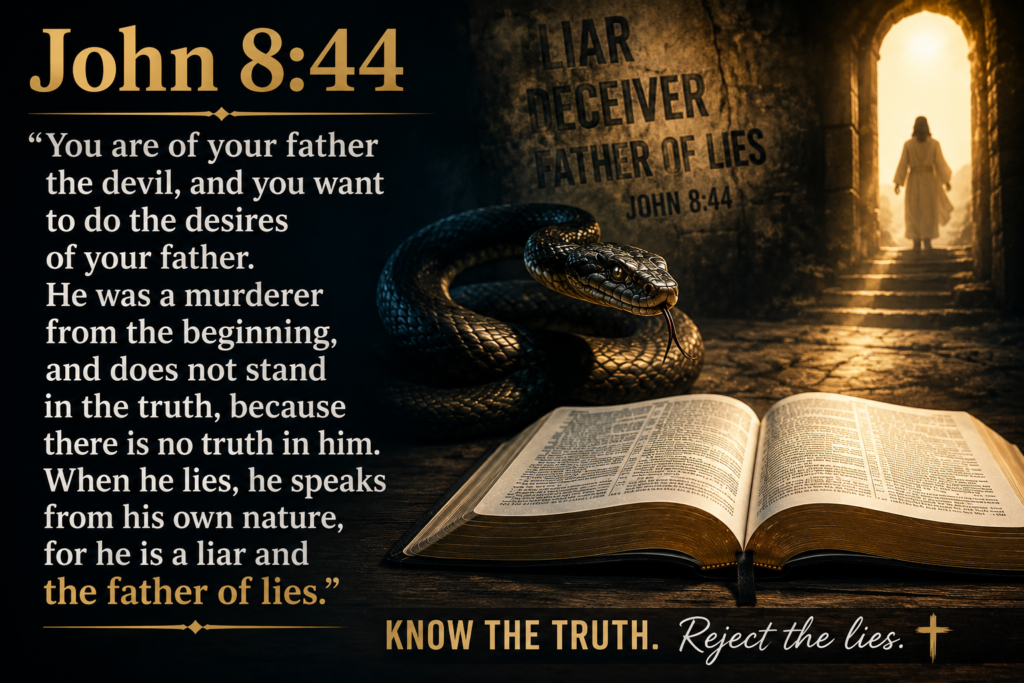
Satan is the originator of lies and deceit. He was the first to ever speak a falsehood, which is why he is known as the father of lies. When someone chooses to lie, they are imitating Satan’s example and, according to the Bible, are described as a “child of the devil.”
John 8:44 NKJV
- 44. You are of your father the devil, and the desires of your father you want to do. He was a murderer from the beginning, and does not stand in the truth, because there is no truth in him. When he speaks a lie, he speaks from his own resources, for he is a liar and the father of it.
On the other hand, God is the ultimate source of truth. Throughout Scripture, it is repeatedly affirmed that God is the God of truth.
Numbers 23:19 NKJV
- “God is not a man, that He should lie, Nor a son of man, that He should repent.
Has He said, and will He not do? Or has He spoken, and will He not make it good?
20 Behold, I have received a command to bless; He has blessed, and I cannot reverse it.
Deuteronomy 32:4 NKJV
- He is the Rock, His work is perfect; For all His ways are justice, A God of TRUTH and without injustice; Righteous and upright is He.
Titus 1:1-2 NKJV
- 1. Paul, a bondservant of God and an apostle of Jesus Christ, according to the faith of God’s elect and the acknowledgment of the truth which accords with godliness,
- in hope of eternal life which God, WHO CANNOT LIE, promised before time began,
There are others.
Because truth reflects God’s own character, dishonesty brings real damage wherever it takes root. Bearing false witness can destroy relationships, destabilize homes and organizations, and lead to painful consequences such as the following:
- divorce
- losing a job
- unemployment
- broken relationships
- emotional pain
- failure
- bankruptcy
- collapse of organizations or families
- acts of revenge
- retaliation
- abuse
- accidents
- suffering
- imprisonment
- even death
When considering honesty and how we communicate the truth, it is important to ask: Should truth always be delivered bluntly or without compassion?
In legal settings, truth must be presented clearly and directly. However, in our personal interactions, we should be careful not to inflict unnecessary pain, embarrassment, or shame. We are never called to use the truth as a weapon to hurt others. Instead, we should always express truth with kindness and love, not with harshness or cruelty.
Ephesians 4:15 (NKJV)
- but, speaking the truth in love, may grow up in all things into Him who is the head—Christ—
Blessings of Obedience
What are the rewards of obeying this commandment? Our word is our bond. When our word is trustworthy, it is reflected in our character. According to Scripture, those whose words can be relied upon will experience great blessings.
Someone who speaks honestly and embraces God’s wonderful gift of salvation will receive both blessings and righteousness from the Lord.
Psalm 24:4-5 NKJV
- He who has clean hands and a pure heart, Who has not lifted up his soul to an idol,
Nor sworn deceitfully.
- He shall receive blessing from the Lord, And righteousness from the God of his salvation.
A person who genuinely loves others will not spread falsehoods about anyone. When faced with a concern or a troubling rumor, he will approach the individual directly, aiming to help restore them in their faith. It’s important to remember that true love avoids harshness or belittling. Instead, it addresses others with compassion, gentleness, and strength, always guided by the Holy Spirit.
Galatians 6:1-2 NKJV
- Brethren, if a man is overtaken in any trespass, you who are spiritual restore such a one in a spirit of gentleness, considering yourself lest you also be tempted. 2 Bear one another’s burdens, and so fulfill the law of Christ.
Conclusion
I’m going to close with this Scripture: Romans 12:18 (NKJV).
- If it is possible, as much as depends on you, live peaceably with all men.
One clear way to fulfill this Scripture is to obey the ninth commandment: “You shall not bear false witness against your neighbor.”
Amen
Questions, comments, and concerns may be left below
Blessings!
👉Videos
Watch the full video presentation:
For the short version, click the link
https://youtube.com/shorts/fruS-BTrFnI
👉 Follow the complete Ten Commandments series:
- The Ten Commandments (Part 1): No Other Gods Before Me
- The Ten Commandments (Part 2): What Does the Second Commandment Mean?
- The Ten Commandments (Part 3): Do Not Take His Name in Vain
- The Ten Commandments (Part 4): Sabbath — Saturday or Sunday?
- The Ten Commandments (Part 5): Honor Your Father and Mother
- The Ten Commandments (Part 6): You Shall Not Kill
- The Ten Commandments (Part 7): What Is Adultery According to the Bible?
- The Ten Commandments (Part 8): What Does “You Shall Not Steal” Mean?
- The Ten Commandments (Part 9): What Does the Bible Say About Lying?[Present]