Spiritual Warfare: Conditions of the Mind 3

This is the fifth in a series of articles about spiritual warfare.  In the last article, SPIRITUAL WARFARE: CONDITIONS OF THE MIND 2, I covered the conditions: the doubtful and unbelieving mind, the anxious and worried mind.  In this article: Spiritual Warfare: Conditions of the Mind 3, I will be covering the judgmental, critical and suspicious mind, and the passive mind.

Much torment lands in people’s lives because of judgmental attitudes, criticism and suspicion.  Many relationships are destroyed by these enemies.  Once again, THE MIND IS THE BATTLEFIELD.  So we must keep in

All About Spiritual Warfare-the mind is the battlefield
The battle is for the mind

mind that our actions won’t change until we change our minds because it is up to us to control our thinking.

Being judgmental, opinionated, and critical are three sure ways to see relationships dissolve.  Satan of course, wants us to be isolated, so he attacks our minds in these areas.  So the goal of covering these conditions, is to help us recognize wrong thought patterns, as well as learn how to deal with suspicion.

So to begin we’re going to first look at judgment.  What is judgment?  Judgment according to Nelson’s Illustrated Bible Dictionary is:

Discernment or separation between good and evil.  It goes on to say: God judges among people and their actions according to the standards of His LAW.  Judgment can refer either to this process of discernment, or to the punishment meted out to those who fall under His wrath and condemnation (John 5:24).  In the Bible the most important judgment is the final judgment, the ultimate separation of good and evil at the end of history.

So from what I can see, God is the only one who has the right to condemn or sentence, therefore, when we pass judgment on another, we are, in a certain sense, setting ourselves up as God in their life.  I personally don’t want this responsibility.  God is the only perfect judge, so in my humanness—in our humanness, we can’t possible be qualified to judge another with much accuracy.

Criticism, opinions, and judgment, all seem to be related, and can easily be addressed as one big problem.

We all have different personalities that can range from one end of the spectrum to the other.  On one end we have the jovial personality, which care not to see anything but the happy or the fun things in life—to a fault, and pay little or no attention to anything that would interfere with their bliss.  On the other hand, we have the melancholy personality, or the controlling personality, who immediately sees what is wrong first.  This personality is being addressed at present.  These individuals usually have no problem expressing their negative opinions, and outlook with others.

Now we all know the Ten Commandments.  But in areas where there is no defined commandment in the scriptures, what is known as non absolutes, or as the scriptures states: doubtful disputations, [Rom. 14:1] it’s left up to an individual to determine in his own heart—his own conscience, what is right.  Let’s look at

Hebrews 9:13-14

13 For if the blood of bulls and of goats, and the ashes of an heifer sprinkling the unclean, sanctifieth to the purifying of the flesh:

14 How much more shall the blood of Christ, who through the eternal Spirit offered himself without spot to God, purge your conscience
from dead works to serve the living God?

Now basically what this passage tells us is that the Old Testament sacrifices cleansed the flesh.  But the sacrifice of Christ’s blood is much better because it transforms our lives and hearts and makes us clean on the inside, because it purges our consciences.  Christ’s blood cleanses his followers from dead works.

But because we are all on different levels in our walks, so are our consciences.  So there will be, differing of opinions.  Satan uses this, as one of his tools to produce havoc amongst the people of God.

But while the issue is doubtful things, the scriptures are clear as to how to handle such matters.  Let’s turn to Romans 14:1-4

1 Him that is weak in the faith receive ye, but not to doubtful disputations

Now in this verse we have the expression doubtful disputations (in the King James Version).  It renders
two Greek words that mean “judging” and “opinions,” “disputes,” or “doubts.”  (The NIV simply translates it disputable matters.)  [Gray areas]  What Paul is prohibiting here, is the apparent response to one who is weak in the faith, for the purpose of passing judgment based on his or her opinions.  The fact is: Christians who are Young and weak in the faith need love and acceptance, not criticism #1

2 For one believeth that he may eat all things: another, who is weak, eateth herbs.

At issue here is the matter of Christian liberty.  From the very beginning, Christians have had to make decisions about how their Christian faith applies in their culture.  To repeat what I said earlier: since Christians have not always come to the same conclusions about these differences, disagreements and even conflicts have followed.

The one whose faith is weak takes a narrow, limited view of freedom.  He or she interprets Scripture in such a way as to limit liberty.  This does not pose a problem as long as these limitations are applied only to one’s own life.  But when the person seeks to bind others to these restrictions, conflict is likely to follow.  I’m going to temporarily move to Galatians 5:13
13 For, brethren, ye have been called unto liberty; only use not liberty for an occasion to the flesh, but by love serve one another.

Let’s now look at 1 Peter 2:16

16 As free, and not using your liberty for a cloke of maliciousness, but as the servants of God.

So what we see here is that the scriptures address both issues of liberty; the over restrictive as well as the undisciplined use of our liberty.  We can either be too tight or too lose with liberty.

Now back to our passage in Romans 14

Paul illustrates his point with a specific example: the eating of meat.  Some people today choose a vegetarian diet for health reasons, but in Paul’s day the issue was religious.  Some Gentile Christians had come from pagan religions that involved animal sacrifices.  Much of the meat sold in the market, came from these sacrifices, and eating it seemed to these people to involve them in the paganism they had just left.  Jewish Christians, who had been taught to avoid eating meat from unclean animals, or from animals not killed according to the Law of Moses, often refused to eat meat also.

3 Let not him that eateth despise him that eateth not; and let not him which eateth not judge him that eateth: for God hath received him.

Looking at verse 3, Eating meat or not eating meat was not a moral issue, but a matter of opinion.  Since God accepts both groups, they are urged to accept one another.  The strong, those who ate, were not to look down on those who did not.  Those who did not eat were not to judge or condemn those who did.  What verses 2 and 3 bring out is:  Allowing minor despites to fester may manifest severed relationships in the church.

4 Who art thou that judgest another man’s servant?  to his own master he standeth or falleth.  Yea, he shall be holden up: for God is able to make him stand.

In this verse, Paul basically asks: who are you to judge?  Every believer will be judged by God alone [14:10] therefore, believers have no right to judge one another.  Each believer is someone else’s servant, that is, God’s servant.  And before God, he or she stands or falls.  Each person is accountable to Christ, not to others.  [Matt 7:3-5; Luke 6:37, 41-42; 1 Cor 4:3-5]  While the church must be uncompromising in its stand against activities that are expressly forbidden by Scripture (such as adultery; homosexuality, murder, theft, etc.), it should not create additional rules and regulations and give them equal standing with God’s law.  That’s not to say that the church shouldn’t have rules, but they must be kept in proper perspective.  Often Christians base their moral judgments on opinions, personal dislikes, or cultural bias, rather than on the Word of God.  When they do this, they show that their own faith is weak, and they demonstrate that they do not think God is powerful enough to guide each of his children.  When we stand before God’s judgment seat [14:10], we won’t be worried about what our Christian neighbor has done [2 Cor 5:10]

He will stand, for the Lord is able to make him stand.  No matter what one believer thinks of another believer’s sense of right and wrong in some matters, the Lord, as Judge, will oversee each person. What matters is each believer’s individual accountability before God.  So the moral to the story is: God is better able than we are to settle discord among His people.

Now to moving on: Judgment and criticism are fruit of a deeper problem – pride.  Let’s look at this also in Romans 12:3

3 For I say, through the grace given unto me, to every man that is among you, not to think of himself more highly than he ought to think; but to think soberly, according as God hath dealt to every man the measure of faith.

Whenever we excel in an area, it is only because God has given us a gift of grace for it.  If we are high-minded, or have an exaggerated opinion of ourselves, then it causes us to look down on others and value them as less than we are.  This type of attitude or thinking is extremely detestable to the Lord, and it opens many doors for the devil to enter into our lives.

Now it is important to know, that Scripture also reveals to us, how we are to respond to the weakness we observe in others.  It sets forth the mental attitude we are to maintain within ourselves.  We must have such a fear of the Lord with regard to pride, that we are very careful of judging others or of being critical of them.

One important point to remember regarding the faults and the judgment of others: while we aren’t to pass judgment, we are to recognize when our brothers and sisters are straying from the path of righteousness, in one way or another; and attempt to steer them back on track.  This applies especially spiritual leaders.  But it must be done in the proper way, according to the scriptures. [It’s not what we do, but how we do it]

Let’s look at this in Galatians 6:1-3

1 Brethren, if a man be overtaken in a fault, ye which are spiritual, restore such an one in the spirit of meekness; considering thyself, lest thou also be tempted.
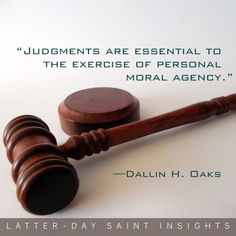
Judgment
Judgment, when constructive, is a benefit to the body of Christ.

The scripture reads: “ye which are spiritual.”  That is those who are mature, feeding on meat and not milk, must restore a fallen one with meekness—gently and lovingly.  They must not be heavy handed or domineering, but should watch out for their own lives, realizing that they also can be tempted to fall in the same direction.

2 Bear ye one another’s burdens, and so fulfil the law of Christ.

We are all engaged in spiritual warfare—individually and collectively.  So we must help each other when the going gets rough.  Therefore, we step in to carry each other burdens, whenever we see that the load has become more than a brother or sister can bear.  Not gloat, rejoice or judge.  As the scriptures read in Romans 15:1: “We then that are strong ought to bear the infirmities of the weak, and not to please ourselves.”  When we follow this, we are fulfilling the law of Christ as it states in the latter part of this verse 2.

3 For if a man think himself to be something, when he is nothing, he deceiveth himself.

Now here again, the issue of pride is addressed.  We are simply nothing.  The bible tells us why in 1 Corinthians 1:25.  It reads: “Because the [foolishness]
of God is [wiser] than men; and the [weakness] of God is [stronger]
than men.”
 
So in comparison we are in a word: nothing!

One of the areas that must be addressed when approaching the area of judging is: what about ourselves?  Are we as willing to be judged, as we are to judge?  In most cases no.  Matthew 7:1-6 contain some of the classic Scriptures on the subject of judgment and criticism.  Whenever we are having trouble in our minds in this area, it might be a good idea to read them through.  Let’s look at Matthew 7:1-6

1 Judge not, that ye be not judged.

2 For with what judgment ye judge, ye shall be judged: and with what measure ye mete, it shall be measured to you again.

Now these Scriptures tell us that we will reap what we sow.  The principal of sowing and reaping not only applies to the agricultural and financial realms, but it also applies to the mental realm.  Scripture tells us that if we sow to the flesh that we will of the flesh reap corruption.  When we sow to the flesh, it is manifested in our attitudes.  Therefore, we can sow and reap an attitude, as well as a crop, or an investment.  So when we hear of someone talking about us, we may ask ourselves: are they sowing, or are we reaping what we, have sown?

3 And why beholdest thou the mote that is in thy brother’s eye, but considerest not the beam that is in thine own eye?

Judgment
Make sure your house is clean before you clean someone else’s. Don’t be a hypocrite!

4 Or how wilt thou say to thy brother, Let me pull out the mote out of thine eye; and, behold, a beam is in thine own eye?

5 Thou hypocrite, first cast out the beam out of thine own eye; and then shalt thou see clearly to cast out the mote out of thy brother’s eye.

Now the observation here is that Satan loves to keep us busy mentally judging the faults of others.  His methodology is to keep us from seeing or dealing with what is wrong with ourselves.

What we must realize is that we cannot change others; only God can.  We can’t change ourselves either.  But we can cooperate with the Holy Spirit, and allow Him to do the work.

When our thoughts and conversations are dominated by what is wrong with everybody else, we are usually being deceived by our own conduct.  Therefore in this passage, Jesus commanded that we not concern ourselves with what is wrong with others, when we have so much wrong with ourselves.  So we must allow God to deal with us first, and then, we will learn the scriptural way of helping our brothers and sisters grow in their spiritual walk.  Let’s look at Ephesians 4:32

32 And be ye kind one to another, tenderhearted, forgiving one another, even as God for Christ’s sake hath forgiven you.

We all make mistakes.  We all have weaknesses.  This scripture says that we are not to have a hard-hearted, critical spirit toward each other, but instead to forgive one another, just as God for Christ’s sake, has done for us.

We’re now going to move into the last condition of the mind in this article: the Passive Mind.

The passive mind is a result of an activity called passivity.   Passivity is the opposite of activity.  It is a lack of feeling, lack of desire, general apathy, lukewarmness, and out right laziness.

Not only is passivity the opposite of activity, but it is also the opposite of what the scriptures instruct us.  In 1 Peter 5:8 we are instructed to be alert, cautious and active. [“Vigilant”]  In 2nd Timothy 1:6, we are instructed to fan the flame, and stir up the gifts within us.  Christianity is a belief of action, not non-action.  So since passivity is not condoned in the scriptures, it must [not be of God] and anything that is not of God is [of the Devil] Evil spirits are behind passivity.  The devil knows that inactivity, failure to exercise the will, will bring the believers ultimate defeat.

As long as a person is moving against the devil by using their will against him, the enemy will not win the war.  The bible says: resist the devil and he will flee from you.”  However, if an individual enters into a state of passivity, they are in serious trouble because they lack the motivation to resist.

It is extremely important for Christian believers to exercise their wills.  Because when we don’t, we operate exclusively on our feelings.  We praise & pray
if we feel like it; read the scriptures, if we feel like it;

Spiritual Warfare - Resist the Devil
Resist him!!


give, if we feel like it; keep our word, if we feel like it; and if we don’t feel like it, we don’t do it.  So we depend on external actions—something other than ourselves to motivate us.  If the music isn’t a certain way, we don’t want to praise; if the preacher isn’t doing acts of an acrobatic nature, we don’t receive the word.  Many believers are so emotionally led, that an absence of feeling is all that is needed to stop us from doing what we’ve been taught to do. This is extremely dangerous.  For the simple reason that, just because we don’t feel like doing something, doesn’t mean that it shouldn’t be done.  We must Press forward.  As Paul said: “I press toward the mark for the prize.”  [Phil 3:14]

There is a familiar expression which states: the devil enters an idle mind.  A passive mind is an idle mind.  It is empty, leaving it open as Satan’s playground, allowing him to fill it with all kinds of wrong thoughts.

In the natural, results rely on actions.  For example: it takes speed for a plane to remain in flight.  Once it begins to slow down, gravity takes over.  The slower it moves, the stronger the pull of gravity, to the point of stall and crash.  We must remember that what applies in the natural, applies in the spiritual.  So the way to avoid wrong thoughts from entering our minds is to fill our minds with right thoughts. Phil 4:8 reads: “Finally, brethren, whatsoever things are true, whatsoever things are honest, whatsoever things are just, whatsoever things are pure, whatsoever things are lovely, whatsoever things are of good report; if there be any virtue, and if there be any praise, think on these things.”

Once we become saved—once we accept salvation, crucifying our flesh, and removing old thoughts, they must be replaced with good thoughts.  Otherwise the old thoughts will return, greater than they were before.

The condition of passivity can be overcome.  So how do we overcome passivity?  The first step in overcoming passivity in actions is to overcome passivity in the mind.  The prescription is same as it has been throughout this series, and is found in Romans 12:2.  This time I’m taking it from the amplified translation: do not be conformed to this world (this age),
[fashioned after and adapted to its external, superficial customs], but be transformed (changed) by the [entire] renewal of your mind [by it’s new ideals and it’s new attitude] 

Notice that it said: the entire renewal of your mind.  Now what we see in this scripture, is a dynamic principal of God.  Which is: Right action follows right thinking.  Let’s look at the rest of the scripture: So that you may prove [for yourselves] what is the good and acceptable and perfect will of God, even the thing which is good and acceptable and perfect [in His sight for you].  Now here’s the blessing: the good, acceptable, and perfect will of God for our lives.  But only after our minds are renewed—our thinking is changed.

It is impossible to get from wrong behavior to right behavior
without first: changing our thoughts.  A passive person may want to do the
The Inspired Word of God

right thing, but will never do so unless he or she purposely activates their mind, and line it up with God’s Word and will.

So if we truly desire to have victory over our problems; if we truly want to live the resurrection life, we must have backbone and not just wishbone.  We must be active—not passive.  Keep in mind that right action begins with right thinking.

Let us not be passive in our minds, and start immediately choosing right thoughts.

AMEN!

The next article will cover the final condition of the mind which is a positive one—The Mind of Christ.

Please feel free to leave any question, comment or concern below

Blessings!


Spiritual Warfare: The Conditions of the Mind 2

With this article I am going to continue with the series on Spiritual Warfare.  Spiritual Warfare - The conditions of the mindThis is the fourth article in the series.  In the last article I began to address the conditions of the mind that are often manifested because of spiritual warfare.  The conditions covered were the wandering mind, the wondering mind, and the confused mind.  So now I’m going to move on and cover more of these conditions of the mind as is the title: Spiritual Warfare: the conditions of the Mind 2.  This is the second article on the conditions of the mind.
The first condition is, the doubtful and unbelieving mind.  Doubt and unbelief are two words that can be connected, but mean different things.  To doubt is to waiver between two opinions, to stand in two ways with uncertainty, as to which one to accept.  The result in a believer is small faith.  As Jesus said to Peter in Matthew 14:31 O thou of little faith, wherefore didst thou doubt?”

Unbelief on the other hand is not little faith, but none at all, and the result is always disobedience.  But the connection is: doubt can often lead to unbelief.

Let’s go back and take a look at doubt.  Doubt is not something that God puts in us.  The bible says that God gives every man a … “measure of faith.”  [Rom 12:3]

God has placed faith in our hearts, but Satan tries to negate our faith, by attacking us with doubt.  But once again I say: it’s very subtle!

Doubt comes in the form of thoughts that are in opposition to the Word of God.  That is why it is so important for us to know the Word of God.  If we Spiritual Warfare - Battle of the Mindknow the Word, then we can recognize when the devil is lying to us.  Be assured that he lies to us in order to steal what Jesus purchased for us on the cross.
You see, when God tells us something, or asks us to do something, the faith to believe it, or to obey it comes with the Word from God.  God wouldn’t expect us to do something, and not give us the ability to believe that we can do it.  Satan knows how dangerous we will be with absolute faith, so he attacks us with doubt and unbelief.  So it’s not that we don’t have faith, it’s simply Satan trying to destroy our faith with deception and lies.

Faith is a product of the spirit; it is a spiritual force.  Satan doesn’t want us to get our mind in agreement with the spirit.  He knows that if God places faith in us and we start to consistently exercise that faith,  we would do considerable damage to his kingdom.Spiritual Warfare - The battle of the mind

Satan brings storms into our lives to intimidate us.  But we must hold on to the fact, that all storms blow over, they don’t last forever.  So we must dig in with both heels, and be determined in the Holy Spirit.

We must remember during a storm that the mind is the battlefield.  We can’t make our decisions based on our thoughts or feelings, but tune into our spirits, which are led by the Holy Spirit (or at least supposed to be [Eph 3:16]).  When we do this, we will find that the same vision that God has given us, is still there after the storm.

One very important thing for us to remember is: doubt is a choice.  I’ve already mentioned that faith is the gift of God, so we know that we have faith, but let’s look at this in scripture so that you may refer to it later.  Romans 12:3

3 For I say, through the grace given unto me, to every man that is among you, not to think of himself more highly than he ought to think; but to think soberly, according as God hath dealt to every man the measure of faith.

So again, doubt is a choice.  It is Satan’s spiritual warfare tactic against our minds.  Now I’ve covered in an earlier article of this series, how we are in control of our thoughts, so we must learn to recognize it for what it is, cast it (doubt) out in the name of Jesus, and keep on believing.  The choice is ours

Now to look at unbelief:  Unbelief as I said earlier, leads to disobedience.  Let’s look at this in Matthew 17:14-20

14 And when they were come to the multitude, there came to him a certain man, kneeling down to him, and saying,

15 Lord, have mercy on my son: for he is lunatick, and sore vexed: for ofttimes he falleth into the fire, and oft into the water.

16 And I brought him to thy disciples, and they could not cure him.

17 Then Jesus answered and said, O faithless and perverse generation, how long shall I be with you? how long shall I suffer you? bring him hither to me.

18 And Jesus rebuked the devil; and he departed out of him: and the child was cured from that very hour.

19 Then came the disciples to Jesus apart, and said, Why could not we cast him out?

20 And Jesus said unto them, Because of your unbelief: for verily I say unto you, If ye have faith as a grain of mustard seed, ye shall say unto this mountain, Remove hence to yonder place; and it shall remove; and nothing shall be impossible unto you.

Now apparently Jesus had taught them certain things to do in these cases, but because of their unbelief, they weren’t able to obey Him.  Their unbelief caused them to disobey.  Therefore they were unsuccessful in carrying out God’s will.

Unbelief can also keep us from doing what God has called, and anointed us to accomplish in life.  It will also keep us from experiencing the sense of peace that He wants us to enjoy, as we find rest for our souls in Him.  Let’s look at this in Matthew 11:28-29

28 Come unto me, all ye that labour and are heavy laden, and I will give you rest.

29 Take my yoke upon you, and learn of me; for I am meek and lowly in heart: and ye shall find rest unto your souls.

Jesus commands all to have faith in Him, to trust Him, to believe in Him.  But if we have unbelief, we cannot follow this command in a word—disobedience.

The fourth chapter of Hebrews deals with the Sabbath rest that is available to God’s people.  Under the old covenant, the Sabbath was observed as a day of rest.  Under the New Covenant, this Sabbath spoken of  is a spiritual place of rest.  It is the privilege of every Christian believer to refuse to worry, or have anxiety.  As Christians, all of us can enter the rest of the Lord.  But it doesn’t happen by accident.  For example in verse 11 of Hebrews 4 [amplified] it reads: “Let us therefore be zealous and exert ourselves and strive diligently to enter that rest [of God, to know and experience it for ourselves], that no one may fall or perish by the same kind of unbelief and disobedience [into which those in the wilderness fell] 

Now those in the wilderness refer to the Israelites.  They fell because they disobeyed God, and refused to go into Canaan why?  Because of their unbelief.  So verse 11 of Hebrew 4 brings out the point that we will never enter our privileged rest unless we believe—diligently, laboriously.    Not only that, but we will forfeit our rest through unbelief and disobedience just as Israel did.  This is no game!  Unbelief will keep us living in the wilderness.  But Jesus has provided a permanent place of rest, one that can be inhabited only through living by faith.

Let’s look at what it says in Romans 1:17

17 For therein is the righteousness of God revealed from faith to faith: as it is written, The just shall live by faith.

Now faith to faith means, that faith is at the beginning of the salvation process; we receive Christ by faith; and faith is the goal as well.  When a person first exercises faith in Christ, that person is saved from the penalty of sin, and declared righteous.  (But) also, as the believer lives by faith, God continues to save him or her from the power of sin, to live righteously.  Now how does God do this?  Let’s look at the answer in Romans 15:13

13 Now the God of hope fill you with all joy and peace in believing, that ye may abound in hope, through the power of the Holy Ghost.

As we believe by faith and begin to exercise faith—living righteous lives, we receive the power of the Holy Spirit.

It is by the power of the Holy Spirit that God accomplishes his care for his people–giving us endurance, encouragement, unity (15:5), hope, joy, and peace. Hope comes as a by-product of the Holy Spirit’s work. It does not come from our own senses or experiences.

Now to wrap up this segment, the whole problem is doubt and unbelief—even for us Christians.  We make ourselves unhappy by believing the Devil’s lies; and we become negative because we have no peace, and no joy,
and end up living in unbelief.  Instead of living faith to faith as the scripture says, many of us are on a see saw.  We live a life of going from faith, to doubt, to disbelief.  Then back to faith, only to later go back to doubt and unbelief.  We end up being miserable roller-coaster Christians, allowing our faith to take swells and dips.  Many of us are double minded in our faith.  One day, we’re a child of God and a disciple of Christ, and the next day, we’re cursing people out.  The Scripture says: “from faith to faith.”  “that ye may abound in hope, through the power of the Holy Ghost.”  But if we have doubt and unbelief, we will quench the Holy Ghost, and will not receive from God.  The bible tell us in Hebrews 11:6: “but without faith it is impossible to please Him.”  If God is not pleased, we can’t receive from Him.  Now we’ve look at this in scripture from the front side—faith and hope, let’s now look at it with scripture from the back side—with wavering faith—doubt..  James 1:6-8

6 But let him ask in faith, nothing wavering. For he that wavereth is like a wave of the sea driven with the wind and tossed.

7 For let not that man think that he shall receive any thing of the Lord. 

We simply can’t receive from God when we approach him with doubt and unbelief.  Verse 8 goes on to say:

8 A double minded man is unstable in all his ways.

Now remember what Elijah asked Israel in 1 Kings 18:21: How long halt ye between two opinions? if the LORD be God, follow him: but if Baal, then follow him.

The point, we need to make up our minds that we will not live in a state of double mindedness.  We will not live in
disbelief and doubt; we will not walk in disobedience.  God has a plan for each and every one of us, and we can’t let the Devil steal it away from us with his lies.  We must rebuke him!  The bible says that we are to: cast down every high thing that exalts itself against the knowledge of God.
[2 Cor. 10:5]   The high things are in the spiritual realm where the battle of the mind is ongoing.

Now to move into our next condition, we’re going to look at the anxious and worried mind.

Anxiety and worry are both attacks on the mind, intended to distract us from serving the Lord.  Satan uses both of these torments to press our faith down, so that it cannot rise up, and help us live in victory.

Peace and worry are opposites of each other.  It is absolutely impossible to worry, and live in peace at the same time.  Peace is an ingredient of the fruit of the spirit, and fruit is the result of abiding in the vine(which in our case is Jesus).

Worry is definitely an attack from Satan upon the mind.  There are certain things the Christian is instructed to do with his or her mind, and the enemy wants to make certain that they are never accomplished.  So the devil attempts to keep the mental arena busy enough, with the wrong kinds of thinking, so that the mind never gets around to being used for the purpose for which God designed it.  There’s an expression that sums this up which states: “the devil enters an empty mind.”

In the Sermon on the Mount, there is a passage that we should read when we feel a spell of worry coming upon us.  Let’s look at Matthew 6:

25 Therefore I say unto you, Take no thought for your life, what ye shall eat, or what ye shall drink; nor yet for your body, what ye shall put on. Is not the life more than meat, and the body than raiment?

We are to enjoy life.  Jesus said in John 10:10: “The thief cometh not, but for to steal, and to kill, and to destroy: I am come that they might have life, and that they might have it more abundantly.”  But old Satan (the thief) attempts to steal that life from us in many ways—one of them being worry.  Back to Matthew 6:25, Jesus is teaching that there is nothing in life that we are to worry about—not any aspect of it.  The quality of life that God has provided for us, is great enough to include all of these other things, so we aren’t to worry about them.  But if we do, then we lose the life that He intended us to have.  Let’s look at verse 26:

26 Behold the fowls of the air: for they sow not, neither do they reap, nor gather into barns; yet your heavenly Father feedeth them. Are ye not much better than they?

Jesus used the birds as an example of His provision.  They don’t plant, so they don’t harvest.  Nor do they store any food.  They literally don’t know where there next meal is coming from.  But you never see them worrying, and God feeds them.  We are God’s highest creation; so Jesus asks: aren’t we much better than they are?  Of course we are.  So if He provides for the birds, He will certainly provide for us!  So for those of us who may be suffering from a poor self-image, can read this verse, and know just how valuable to God we are.  Looking at verse 27:

27 Which of you by taking thought can add one cubit unto his stature?

Taking thought means worrying and Jesus is asking: What do you gain by worrying?  The point: worry is useless!  It does not accomplish anything.  If that is so, then why worry and why be anxious.  Let’s move to verses 28-30:

28 And why take ye thought for raiment? Consider the lilies of the field, how they grow; they toil not, neither do they spin:

29 And yet I say unto you, That even Solomon in all his glory was not arrayed like one of these.

30 Wherefore, if God so clothe the grass of the field, which to day is, and to morrow is cast into the oven, shall he not much more clothe you, O ye of little faith?

Jesus asks: why worry about raiment or clothing, and again refers to one of His creations.  He makes the point that if a flower which does nothing, can look better than the great king Solomon in all of his splendor, surely we will be provided for as well.  Now the job of Satan and His demons, is to continuously pump into our minds the question: what are you going to do? What’s going to happen to me or any other difficult question pertaining to our present circumstances.  And we spend and waste precious time trying to answer them; in a word—worry.  Satan is constantly waging war on the battlefield—our minds, with the hopes of engaging us in a long drawn out, and costly combat.  It’s costly because it takes our minds off of God, and onto our circumstances. Now the rest of the passage contains Jesus’ solution.  Verse 31 reads:

31 Therefore take no thought, saying, What shall we eat? or, What shall we drink? or, Wherewithal shall we be clothed?

Now in this verse, Jesus again instructs us not to worry or be anxious about these things.  Let’s look at verses 32 & 33

32 (For after all these things do the Gentiles seek:) for your heavenly Father knoweth that ye have need of all these things.

33 But seek ye first the kingdom of God, and his righteousness; and all these things shall be added unto you.

Now we know that God’s children are not to be like the world!  The world seeks after things,
but we are to seek the Lord.  He has promised that if we will do that, He will add to us all these things He knows we need.  We must learn to seek God’s face,  and not His hand!  Our father delights in giving His children good things, but we must seek Him, and not them.

The bible tells us in Philippians 4:6  “Be careful for nothing; but in every thing by prayer and supplication with thanksgiving let your requests be made known Spiritual Warfare - Conditions of the mindunto God.”  God knows what we need before we ask.  If we will simply make our requests known to Him, He will bring them to pass in His own good timing.  Worry will not help our cause at all, but it will in fact hinder our progress.  Looking at verse 34

34 Take therefore no thought for the morrow: for the morrow shall take thought for the things of itself. Sufficient unto the day is the evil thereof.

Now one way to describe worry or anxiety is: spending today trying to figure out tomorrow.  Let’s learn to use the time God has given us, for what He intended: to Give glory and honor to Him! 

When Satan attacks and temp us with worry, anxiety, doubt or unbelief, we must remember what Jesus did.  He didn’t have a conversation with him, he countered his attack with scripture.  We must do the same: speak scripture out of our mouths.  Hebrews 4:12 says: “ For the word of God is quick, and powerful, and sharper than any twoedged sword,”  and Paul addressing spiritual warfare in Ephesians 6:17 wrote: And take the helmet of salvation, and the sword of the Spirit, which is the word of God:  But take note, a sword is no good in its sheath during an attack!  God has given us His word—use it! Just like Jesus did.  Remember when Jesus finished throwing God’s Word at Satan, he left him alone.  But it also says for only a season.  So we must be vigilant and ready to use the Word of God in an instant.

Now we went through the passage in Matthew 6.  That’s good to meditate on when needed.  But let’s look at some more scriptures that you may want to remember and keep on hand for attack.

Now we’ve already gone through Philippians 4:6.  Let’s look at 2 Corinthians 10:5

5 Casting down imaginations, and every high thing that exalteth itself against the knowledge of God, and bringing into captivity every thought to the obedience of Christ;

Let’s now look at 1 Peter 5:6-7

6 Humble yourselves therefore under the mighty hand of God, that he may exalt you in due time:

7 Casting all your care upon him; for he careth for you.

When Satan tries to give us a problem, we have the privilege of casting it upon God.  The word cast actually means to pitch or throw.  So we can pitch or throw our problems to God, and He will know what to do with them.

This passage lets us know that to humble ourselves is not to worry.  A person who worries still thinks that in some way, he can solve his own problem.  Worry is the mind racing around trying to find a solution to its situation.  The proud man is full of himself, while the humble man is full of God.  The proud man worries; the humble man waits.

Only God can deliver us, and he wants us to know that, so that in every situation our first response is to lean on Him and to enter His rest.

Speaking of rest:  There is a passage that clearly illustrates the principle of resting on God.  Let’s look at one final passage: 2 Chronicles 20:  This chapter contains the battle against Jehoshaphat and Moab.  This situation tested Jehoshaphat’s faith.  In verse 5 he begins to pray to God when confronted by the enemy, and in verse 12 it reads:

12 O our God, wilt thou not judge them? for we have no might against this great company that cometh against us; neither know we what to do: but our eyes are upon thee.

Now in this passage, we see that Jehoshaphat realized three things:

  1. The he and his army had no might against this enemy.
  2.  He did not know what to do.
  3.  That they needed to have their eyes focused on God.

Now in verses 15-17, we see what the Lord said to them, once they came to this realization, and freely acknowledged it to Him.

15 And he said, Hearken ye, all Judah, and ye inhabitants of Jerusalem, and thou king Jehoshaphat, Thus saith the LORD unto you, Be not afraid nor dismayed by reason of this great multitude; for the battle is not yours, but God’s. 

16 To morrow go ye down against them: behold, they come up by the cliff of Ziz; and ye shall find them at the end of the brook, before the wilderness of Jeruel. 

17 Ye shall not need to fight in this battle: set yourselves, stand ye still, and see the salvation of the LORD with you, O Judah and Jerusalem: fear not, nor be dismayed; to morrow go out against them: for the LORD will be with you. 

So  what is our position?  It is one of abiding in Jesus and entering the rest of God.  It is one of waiting on the Lord continually with our eyes focused on Him, doing what He directs us to do, and otherwise having a reverent fear of moving in the flesh.

So we are not to doubt, not believe or be anxious and worry.  We are to rest in the Lord, to trust Him, and as the scripture reads: be still and know that I am God.”  [Ps. 46:10]                           Amen!

The next article will address more conditions of the mind resulting from Spiritual Warfare.

Please leave any question, comment, or concern regarding spiritual warfare below.

Blessings!


Spiritual Warfare: The Conditions of the Mind

This is the third part of the series on Spiritual warfare. This segment is entitled “Spiritual Warfare: The Conditions of the Mind.”

For a brief review, I addressed the fact that we were all born with a sinful

All About Spiritual Warfare - The instant you accept Jesus as Lord and Savior, war is delcared against you. But all is not lost!
War is declared, but all is not lost!

nature, contrary to God—separated from God; that because of God’s mercy and grace, he established a way for us to be rejoined with Him, through His son Jesus. Therefore, making a way for us to have a spiritual renewal or rebirth: in other words, being born again. I also established that, because of our spiritual rebirth, we have been placed in a war—a spiritual war; a war that is ongoing and fierce. Also, we need to be aware of this war, who is at the helm of the opposing force, and how to fight and win this battle.

Review and Focus for Part 3

In the last article, The Mind is the Battlefield, I addressed the fact that Spiritual Warfare takes place in the mind. Satan attacks the mind—he sends his fiery darts, his evil-negative thoughts directly into our minds. But we must learn to dispel those thoughts—to cast them out, in the name of Jesus. One of the scriptures that I covered was what Jesus said in Matthew 12:33: “Either make the tree good, and his fruit good; or else make the tree corrupt, and his fruit corrupt: for the tree is known by his fruit.”  To repeat, He said: Make the tree good: How do we make the tree good? By feeding it with good fertilizer. We must feed our trees—our minds with good fertilizer—good thoughts in order to bear good fruit, or a positive life. So we must dispel Satan’s evil thoughts.

All About Spiritual Warfare-the mind is the battlefield

Why Mental “Conditions” Matter in Spiritual Warfare

Satan’s attacks, if allowed to nest in our minds, can manifest themselves in numerous ways, causing any number of conditions. In this article, I will begin by addressing the various conditions of the mind.

The Normal Christian Mind: Led by the Spirit

Let’s first look at the normal mind of a Christian. What makes a Christian’s mind tick? 1 Corinthians 2: 13-16

13 Which things also we speak, not in the words which man’s wisdom teacheth, but which the Holy Ghost teacheth; comparing spiritual things with spiritual.

14 But the natural man receiveth not the things of the Spirit of God: for they are foolishness unto him: neither can he know them, because they are spiritually discerned.

15 But he that is spiritual judgeth all things, yet he himself is judged of no man.

16 For who hath known the mind of the Lord, that he may instruct him? But we have the mind of Christ.

The normal mind of a Christian is one led by the Spirit of Christ.

Faith vs Doubt: The Double-Minded Man

Let’s review a passage that I covered in the last article. Romans 8:9

9 But ye are not in the flesh, but in the Spirit, if so be that the Spirit of God dwell in you. Now if any man have not the Spirit of Christ, he is none of his.

The scripture says that we are not to be in the flesh, but in the spirit. If we don’t have the spirit of Christ in us, then we aren’t his—we aren’t Christians. So again, the normal Christian mind is one that is led by the spirit of Christ.

How the Mind and Spirit Work Together

What we must understand regarding the mind of a Christian is that the mind and the spirit work together. Let’s look at this in 1 Corinthians 2:11

11 For what man knoweth the things of a man, save the spirit of man which is in him? even so the things of God knoweth no man, but the Spirit of God.

Now what this scripture is saying is that no one knows the thoughts and plans of man, other than himself—his spirit. The only way anyone else will know our thoughts is if we reveal them. By the same token, no one knows the things—the thoughts, the mind of God, other than His spirit. So the mind and the spirit work together. The spirit knows what in the mind.

Now, when a person receives Christ as His personal Savior, the Holy Spirit comes to dwell in him. As we have just seen in scripture, the Holy Spirit knows the mind of God.

Revelation and Understanding: The Eyes of the Mind

Now let’s take this a little further and look at Ephesians 1: verses 15-23 contain Paul’s prayer of revelation for the Ephesians, and in verses 17-18, it reads:

17 That the God of our Lord Jesus Christ, the Father of glory, may give unto you the spirit of wisdom and revelation in the knowledge of him:

Now Paul is praying that God would impart to them (the Ephesians) His Holy Spirit so that He would be revealed to them and they would know more of Him.  Continuing with verse 18:

18 The eyes of your understanding being enlightened; that ye may know what is the hope of his calling, and what the riches of the glory of his inheritance in the saints,

The eye of your understanding is the mind. The NIV translation actually reads, “the eyes of your Heart,” and as I mentioned in the last article, I mentioned that the word translated as heart and soul [leb] (labe)], is also translated as mind.

Since the Holy Spirit dwells in us and since He knows the mind of God, one of His purposes is to reveal to us God’s wisdom and revelation. That wisdom and revelation are imparted to our spirit, and our spirit then enlightens the eyes of our hearts—or our minds.

An Illustration: Power, Transmission, and Direction

Take a car, for example: you have the engine, the transmission, and the wheels. The power starts with the engine—that’s where the power is produced; the power then goes to the transmission; and from the transmission to the wheels, and the wheels move the car.

Now taking this divinely: the engine is God—that’s where the power comes

The Holy Spirit - Our power source
Our transmission

from; it then goes to the Holy Spirit—which is the transmission; and from the transmission, the power goes to the mind—which is the wheels, which move and control the body. The body reacts to the mind accordingly.

Now, if our power comes from God, then our transmission is the Holy Spirit, sending our wheels (our minds) in the right direction; but if our power comes from Satan, our transmission is the flesh, and will send our wheels spinning in the complete opposite direction.

As Born Again Christians, we are both spiritual and natural. As I mentioned during the introduction of the series, before we were born again, our flesh, our natural self, led the way. Whatever our flesh wanted, that’s what we set out to satisfy. Whether it was sex, drugs, alcohol, or any overindulgence to appease our flesh, we did it. But as Christians, our spirits, which are connected to the Holy Spirit, are to do the leading. But the natural doesn’t always understand the spiritual. So the mind often misses what the spirit is trying to reveal to us, because it’s too busy. A mind that is too occupied is not normal; it is abnormal. The mind is normal when it is at rest. That doesn’t mean we should have blank minds, but it does mean they should be at peace.

Mental Junk Food and the Overloaded Mind

Our minds should not be filled with what I call mental junk food. If we feed our bodies with a constant diet of junk food and fast food, our bodies will

All About Spiritual Warfare: The Conditions of our minds
WE must control the thoughts we allow to dwell in our minds!

eventually break down. But this also holds true of the mind. Junk food for the mind consists of excessive reasoning, worry, anxiety, fears, and so forth. The mind shouldn’t be filled with this junk food, but should be quiet, calm, and serene as much as possible. But if filled with mental junk food, the mind, just as the body, will break down. I’m sure that we’ve all heard of the condition: a nervous breakdown. A condition that results when the mind has had so much of a diet of mental junk food, it becomes so overloaded that it just snaps; breaks down—it simply can’t take anymore. Our minds simply become—a junk yard. Other conditions include: depression, anxiousness, and anguish.

In addition to being at peace, the mind of a Christian believer should also be alert. The Bible says, “Be sober, be vigilant.”  That doesn’t only mean don’t drink. It means be alert, clear-headed, on the lookout, and on the defensive.

Now this isn’t easy because Satan makes it difficult—on purpose—it’s his job. Satan is addressed by several names in the scriptures: For example,the Prince of this world, and the prince of the power of the air. [John 12:31, Ephesians 2:2]  But if there was such a thing as rewriting the bible, one of the names I would give Satan is The King of Junk. He is the King of Mental Junk Food—the chief distributor, clogging our minds. He attacks us, waging a war against our minds. He attacks us by attempting to overload and overwork our minds by filling them with every kind of wrong thought—junk, so they cannot be free and available to the Holy Spirit working through our own human spirit. And Christians are yielding. There are Christians claiming to walk in Christ’s spirit, when in fact they are walking in the flesh. Why? Simply because we’re feeding their minds with the junk of this world. [that’s future article]  This is why we hear so very little from God. The reason we hear so little from God is that we can’t receive His Spirit, which leaves us lacking in wisdom and revelation. Therefore, it is impossible to have a healthy mind when it is loaded down with things it was never intended to carry.

Perfect Peace: A Mind Stayed on God

To close on the normal mind, we’re going to look at one last scripture: Isaiah 26:3—Isaiah writes concerning the Lord:

3 Thou wilt keep him in perfect peace, whose mind is stayed on thee: because he trusteth in thee. In order to keep our minds at peace, we must keep our minds on God and trust God. We must visualize ourselves obeying God and being greatly blessed by Him.

The Abnormal Mind: When the Mind Becomes Clogged

All About Spiritual Warfare-the mind is the battlefield
The mind is the battlefield

Let’s now look at some conditions of the abnormal mind: minds that get clogged with mental junk food. This junk food manifests in ways that cause various mental illnesses. Much like junk food can do to our bodies.

Condition 1: A Wandering Mind

The first condition is a wandering [wandering] mind. To wander [waunder] is to move or go about aimlessly, without a plan or fixed destination. So, a wandering mind is one that doesn’t stay focused on a fixed topic or plan. Now, in childhood, this is one of the leading causes of learning disabilities. It causes a lack of concentration. The inability to stay focused on a topic or task. Now, to some this is involuntary—they can’t help themselves, while others do this voluntarily. I’m sure that most of us can remember daydreaming in class or even in a meeting. Not because we couldn’t help ourselves, we simply wanted to be somewhere else (I know I did). It was a means of escape to someplace or somewhere we wanted to be. But if we do anything long enough, it will become a habit—good or bad. If we allow ourselves to form a habit of this, it can reach near-uncontrollable levels when we should and want to concentrate but can’t.

If our minds are filled with enough anxiety, worry, and confusion—mental junk food, it becomes impossible to concentrate, leaving our minds to wander. Satan loves it! It prevents Christians from listening to sermons, teachings, and Bible studies and receiving from them. While our bodies may be in church, our minds have drifted to some far place or circumstance. It can also prevent us from reading and receiving from the Word. Unable to concentrate, we can just drift off to sleep, which can cause havoc in our jobs and places of business, affecting our communications and sound judgment.

This can be a very subtle process, like all of Satan’s destructive works. It can happen gradually with age. As we progress further into adulthood, our responsibilities increase, placing greater strain on our minds. And if we aren’t careful, we’ll become complete scatterbrains, unable to accomplish anything.

The Biblical Remedy: Gird Up the Loins of Your Mind

Now the scriptures instruct us on this issue of the wandering [wandering] mind.  Let’s look at 1 Peter 1:13

13 Wherefore gird up the loins of your mind, be sober, and hope to the end for the grace that is to be brought unto you at the revelation of Jesus Christ;

Now, the people in biblical times would gather up their long robes and tie them around their waists so that they could move more freely and quickly. We Christians today must also tie up the robes in our minds that can keep them from moving or operating freely. We need to do whatever it takes to focus our thoughts on those things that allow us to serve our God successfully, while eliminating any thoughts that would tie or bind us.

A Warning for Worship: Don’t Bring a Mindless Offering

Let’s look at another warning against a wandering mind:

Ecclesiastes 5:1

1 Keep thy foot when thou goest to the house of God, and be more ready to hear, than to give the sacrifice of fools: for they consider not that they do evil.

Now, to keep our feet means, in this case, to stay alert so as not to slip, lose our balance, or get off track when we go to God’s house. We are to do this, rather than give the sacrifice of a fool. When we sit in church and allow our minds to wander to the point that we receive nothing for being there, it’s useless to go. We may make the sacrifice to be there, but it is a useless sacrifice—we’re only taking up space. It is the sacrifice— of a fool.

Now a fool is an individual who has no good sense—to the point that they do evil, and don’t even know it. Now, for clarity, here is the same scripture from the New Living Translation. It reads:

1 As you enter the house of God, keep your ears open and your mouth shut! Don’t be a fool who doesn’t realize that mindless offerings to God are evil. Is that to the point or what?

Now, to not receive from God is evil. To be a mindless offering is evil. God has given us His Spirit, and we are to use it for our benefit. He has also given us free will, and we are to willfully keep our minds from wandering to the point of self-destruction.

Practical Discipline: Training the Mind to Focus

Now, how do we do this? How do we obey this Scripture? Only through prayer and discipline. If concentrating becomes difficult, we must make a greater effort to focus. If we’re reading and find that we’re not focusing and receiving, stop—go back and read it again. If we miss a space in a conversation, we apologize and ask the person to repeat themselves. By the end of the Sunday message, we know whether our minds have wandered and we missed what was said; so, buy the tape. Take a quiet moment to listen to it, and if we miss parts, rewind and play it back. Sometimes, when I have a lot on my mind, I have to reverse a segment of a video 2 or 3 times. I simply refuse to let Satan steal anything from me that I’m going to benefit from. The Bible says: “resist the devil and he will flee from you.” [James 4:7]

The Devil will give up if he sees that we won’t give in. But only for a season; he’s tenacious, so we must always be on guard. In addition, when we have numerous tasks to complete, prioritize them. This enables us to focus on what’s most important. Then, instead of having our minds aimlessly buzzing between numerous tasks, we can concentrate on one task to completion. Of course, it always helps to eat and rest properly.

Condition 2: A Wondering Mind

The next condition I want to address is the wondering mind. To wonder is to be filled with puzzlement and doubt. When one has a wondering mind they’re never really sure about anything—unstable. Anyone who has a wondering mind can’t pray properly, can’t get answers to their prayers because they have too much doubt in their minds—their hearts. Let’s review the familiar passage in James 1:5-8

5 If any of you lack wisdom, let him ask of God, that giveth to all men liberally, and upbraideth not; and it shall be given him.

6 But let him ask in faith, nothing wavering. For he that wavereth is like a wave of the sea driven with the wind and tossed.

7 For let not that man think that he shall receive any thing of the Lord.

8 A double minded man is unstable in all his ways.

We can’t approach God wondering whether He’ll answer our prayers. We are to approach him in faith, knowing that He will answer them.

Christians, who are walking in the Spirit of Christ, should never wonder, but walk victoriously. Remember what Jesus said in Mark 11:24: “Therefore I say unto you, What things soever ye desire, when ye pray, believe that ye receive them, and ye shall have them.”

Now with a promise like that from our Lord and Saviour, Jesus, whose spirit we’re to walk in, how can we allow Satan to give us a wandering [waundering]—wondering, mind? We must replace our doubtful thoughts with positive thoughts. Instead of asking, I wonder if God’s going to answer my prayer? We should be declaring: I know God is going to answer my prayer, and when He answers it, and how He answers it, is up to Him.  Period!

Condition 3: A Confused Mind

Looking at one more condition, next, we’re going to look at: the confused mind. Now the wondering mind and the confused mind are first cousins.  They are very closely related. James 1:5-8 covers both conditions. When we have a mind full of doubt—a wondering mind, we are confused about everything. From what we believe to what we’re going to wear. We want to live single but be married. We want to be saved, but we want to live like the world. We want to be secure, but the fact is, we’re very insecure. Do we see a pattern here? It’s a double mind. A wondering, confused mind is, in a word, a mess. Unstable in all it does.

When Reasoning Turns Dangerous

Now, in the case of the confused mind, here is where Satan can really strut his stuff. If you’ll remember back to my last article, I mentioned that one of the functions of the mind is to reason. Now, what does it mean to reason? It is the ability to think, form judgments, and draw
conclusions. This is a power that God gave man when he created him. Remember, in Genesis 1:26, God said

“Let us make man in our image, after our likeness:” God gave man the ability to think and reason, and create like Him, but on a much more limited basis. But remember, along came Satan, who twisted God’s words and confused
man’s reasoning.

Now the scriptures tell us that Jesus is the same yesterday, today, and forever. [Heb 13:8] But also, we must always remember that Satan is the same yesterday, today, and from now on, until his time is up. And he’s using the same schemes today that he used yesterday. He is still interfering with man’s reasoning today, leaving many Christians with confused minds. Now let’s examine how this works.

Reasoning is when a person tries to figure out the how and why behind

The Inspired Word of God

something like: an issue, event, or a situation, trying to figure out all of the intricate parts of it. If it is logical and makes sense, we accept it. If it doesn’t, we reject it. But reasoning must be grounded in the right spirit.

Satan often steals the will of God from a Christian because of reasoning. We can literally reason ourselves right out of God’s will. God may speak something to our spirits, but if it doesn’t make sense to us, we’ll reject it. What God leads us to do does not always make logical sense to our minds. While our spirits may affirm it, our minds will reject it.

Natural Reasoning vs Spiritual Discernment

For example, God’s Word in James 1:2 reads:” My brethren, count it all joy when ye fall into divers temptations.” [or various trails]  Now, to our reasoning mind, this makes absolutely no sense whatsoever. How can anybody possibly have joy when going through a trial? A trial involves some form of adversity; some form of resistance. There’s no such thing as a happy trial, or a joyous trial, and in our natural reasoning, a trial is something to be avoided at all costs.

But in the mind of God, a trial is a good thing. It proves us, and tests us, and He knows that when we come through the trial, that we are tried and true unto Him.  So we must turn our reasoning—our minds—our spirits over to God’s spirit, who knows the mind of God. So, for the Christian to encounter adversity is to undergo a trial in which his or her faith is proved either true or false before God, the highest judge. Since many positive things come about through such trials, Christians are urged in this scripture to rejoice at their occurrence. It’s the complete opposite of our natural reasoning. Another more literal example is what it says in Luke 4:1, which is: “And Jesus, being full of the Holy Ghost, returned from Jordan, and was led by the Spirit into the wilderness.”  Now in Matthew 4:1 it says: “Then was Jesus led up of the Spirit into the wilderness to be [tempted of the devil].  Now, natural reasoning may wonder: Why would God lead Jesus to the devil? It just doesn’t make sense to natural reasoning, and when we try to apply natural reasoning to spiritual things, it leads to confusion.

The same goes for tithing. Natural reasoning cannot comprehend the Tithingprinciples of tithing. It can never understand that a blessed 90%

is far better than an unblessed 100%. Natural reasoning will never comprehend the three T’s of Christianity: trials, tribulations, and tithes. Now this is Satan’s game!

That’s why if you look at the ways of the world, and the ways of God with the teachings of Christ, they are the complete opposite of one another.

It’s Satan’s objective to keep our reasoning in the natural, instead of the spiritual. Remember what Satan said to Eve: “Did God really say, ‘You must not eat from any tree in the garden’?”[Gen 3:1 NIV]  He interfered with her reasoning; turned it away from God—the spiritual, and switched it to the natural. She had already received the instructions from God and accepted them in the spirit. But after listening to Satan, she switched to the natural. The scriptures read: “And when the woman saw that the tree was good for food, and that it was pleasant to the eyes, and a tree to be desired to make one wise, she took of the fruit thereof, and did eat, and gave also unto her husband with her; and he did eat. [Genesis 3:6]

Once she switched to the natural reasoning, she saw all of the natural
benefits and totally forgot about the spiritual—what God said.

All About Spiritual Warfare - The Mind is the Battlefield
Keep Satan at bay!!

This is why one of the worst things we can ever do is have a conversation with Satan. Once we open a dialog with him, he has the opportunity to step in with his reasoning, unleashing havoc and confusion in our minds. However, the best thing we can ever do is give him the hand (to stop), and keep on walking in Christ’s spirit. We must recognize him for what he is: a deceiver and a liar.

Now again, reasoning is a natural, God-given ability. But Satan comes along with temptation. Now I’m going to cover temptation later on in this series. But temptation is when we are enticed to take our God given abilities beyond God’s boundaries. And this is what Satan does with our reasoning. This is a very serious component regarding the battle in the mind. This is a very serious aspect of Spiritual Warfare. So we need to look at some solutions, which of course are in the scriptures. Let’s first look back to 1 Corinthians 2:14

14 But the natural man receiveth not the things of the Spirit of God: for they are foolishness unto him: neither can he know them, because they are spiritually discerned. [separated]

You see, the natural man cannot receive from God’s spirit. The Scripture says that the natural man is spiritually separated. Why? Because he’s stuck in his own reasoning, therefore, the things of the spirit are simply foolishness, as far as he’s concerned. So he remains stuck in his own, limited wisdom. That’s why when addressing the ungodly, the bible says in Romans 1:22, “professing themselves to be wise, they became fools.” They are fools because they are stuck in the world’s wisdom, which is nothing in comparison to the wisdom of God. The bible confirms this by saying: “because the foolishness of God is wiser than men; and the weakness of God is stronger than men.” [1 Cor 1:25, cf. vss. 18-27]  So the natural man simply cannot receive any wisdom from God.

Why the World Can’t See: Blinded Minds

Now this is no accident:  Let’s look at this in 2 Corinthians 4:4

4 In whom the god of this world hath blinded the minds of them which believe not, lest the light of the glorious gospel of Christ, who is the image of God, should shine unto them.

The mind is the battlefield
Satan only wants your mind

The god of the world is Satan. Satan is blinding the mind of man today by causing confusion, just as he did in the Garden of Eden.

So this goes back to what I’ve been addressing all along. Walk in the spirit of God and Christ, and that will help us to understand God’s will for us. This is what renewing our minds is about, which was addressed in my article. It’s about hooking up—with the spirit of God. That’s why God said in His word:  Be still and know that I am God. [Ps. 46:10]  So we must learn not to always reason in our minds, but just obey the spirit.

The Path Forward: Obedience Over Argument

Let’s now go back to James 1:22

22 But be ye doers of the word, and not hearers only, deceiving your own selves.

The Inspired Word of God

We simply must obey God’s Word. Not just listen to it, but do what it says. If we listen to the Word, but don’t obey it, we’re only deceiving ourselves. This goes back to what I said earlier about sitting in church and not receiving. We may look like we’re listening and receiving, fooling others, but in essence, we’re only fooling ourselves. It’s like cheating on a test: in the long run, we’ve only cheated ourselves. We must not only listen to and study the Word, but also receive it and apply it to our lives. We can’t always reason and rationalize everything God says to us. We are to just obey. How many times have we heard bosses say: Just do it! And what happens? We do it!

You see, a leader—a boss, sees things from a different perspective, a bigger picture, and has to answer to somebody higher than he is. So we may not understand why they ask us to do, or not to do, certain things. But nevertheless, we must do what they tell us, and it’s biblical. [Eph 6:5-7]

In addition, we must always remember that what applies in the natural applies in the spiritual. God also sees the bigger picture—a much bigger picture. So we must just do what the spirit of God leads us to do.

Trust God, Not Your Own Understanding

Now we’re going to look at another scripture that deals with trusting God. Proverbs 3:5

5 Trust in the LORD with all thine heart; and lean not unto thine own understanding.

Again, trust God and not human reasoning. Reasoning opens the door for deception and brings much confusion, leading to a confused mind. So, girding up the loins of our minds and trusting God is the only way to win—The Battle of the Mind.

Please feel free to leave any questions, comments, or concerns regarding Spiritual Warfare below.

Blessings!

📺 Watch the Teaching Video

The battle for the mind is real—but so is God’s power to transform it.
Watch the full teaching below, and then the Short for a quick highlight.

Whatever Happened to Justice

Recently, I published an article: Postmodernism and the Church. That article explains the origins and doctrines of this movement. Postmodernism whatever happened to justicebrings into question every tradition and standard that we have come to know in the US; including the church and the Scriptures. It has basically led the way for people to feel that they can do whatever they want if it is right in their own minds. This movement has reached a crescendo under the 45th President of the United States. Today more than ever, people are asking: whatever happened to justice?

In my study of the Scriptures, I have observed that the Old Testament is the history of Israel. From inception to glory, to exile and post exile. History does indeed repeat itself.

The US has indeed been a blessed nation; not perfect but blessed non-the-less. It was a nation that honored God as best it knew how. But overtime there has been an eroding of this honor of God. Slowly but surely the nation has become more and more secular and instead of relying on and trusting in God, it has put more trust in man through the government.

New Testament Scripture state very clearly the result when this: taking God out of the equation exists.

Rom 1:18-32

18 The wrath of God is being revealed from heaven against all the Judgmentgodlessness and wickedness of men who suppress the truth by their wickedness, 19 since what may be known about God is plain to them, because God has made it plain to them. 20 For since the creation of the world God’s invisible qualities — his eternal power and divine nature — have been clearly seen, being understood from what has been made, so that men are without excuse.
21 For although they knew God, they neither glorified him as God nor gave thanks to him, but their thinking became futile and their foolish hearts were darkened. 22 Although they claimed to be wise, they became fools 23 and exchanged the glory of the immortal God for images made to look like mortal man and birds and animals and reptiles.

24 Therefore God gave them over in the sinful desires of their hearts to sexual impurity for the degrading of their bodies with one another. 25 They exchanged the truth of God for a lie, and worshiped and served created things rather than the Creator — who is forever praised. Amen.

26 Because of this, God gave them over to shameful lusts. Even their women exchanged natural relations for unnatural ones. 27 In the same way the men also abandoned natural relations with women and were inflamed with lust for one another. Men committed indecent acts with other men, and received in themselves the due penalty for their perversion.

28 Furthermore, since they did not think it worthwhile to retain the knowledge of God, he gave them over to a depraved mind, to do what ought not to be done. 29 They have become filled with every kind of wickedness, evil, greed and depravity. They are full of envy, murder, strife, deceit and malice. They are gossips, 30 slanderers, God-haters, insolent, arrogant and boastful; they invent ways of doing evil; they disobey their parents; 31 they are senseless, faithless, heartless, ruthless. 32 Although they know God’s righteous decree that those who do such things deserve death, they not only continue to do these very things but also approve of those who practice them. NIV—New International Version

We are all sinners by nature and desperately need the grace and mercy of God who sent His Son, Jesus, to redeem us. However, when worship and honor is taken off God, He has no choice but to give man over to his sinful lusts as part of judgment. If you pay any attention at all to the actions in the US, you can see them in this passage of Scripture.

Now mind you, we may not build idols of stone these days, but we have plenty of idols around. An idol is anything that removes our focus off God and onto itself. Today, money is the new religion and whatever it can buy. We’ve become increasingly corrupt and materialistic to the point that we neglect ourselves and families for the sake of earning a dollar. We have as the Scripture reads in verse 25: “…worshiped and served created things rather than the Creator.”

Next, sex: we’ve worshiped sex to the point that we’re committing “…indecent acts…” (Verse 27). We are embracing things that God has destroyed nations over. We’re not only committing these acts, but we’re condoning it, proud of it, and praising it as it mentions in verse 27. We do indeed have idols and we have to a large degree become idolaters turning this blessed nation into an idolatrous one.

Let’s look at Old Testament Scripture and see what happened in history.

Isaiah 59:1-9 contains some of the sins of Israel, verses 9-11 states the impact.

Isa. 59:9-11

9 So justice is far from us,and righteousness does not reach us. We look for Postmodernismlight, but all is darkness; for brightness, but we walk in deep shadows. 10 Like the blind we grope along the wall, feeling our way like men without eyes. At midday we stumble as if it were twilight;



among the strong, we are like the dead. 11 We all growl like bears; we moan mournfully like doves. We look for justice, but find none; for deliverance, but it is far away. NIV

There is simply no room for justice in a godless society. There is only darkness and the stumbling around in it seeking justice and deliverance.  But the only thing around is lawlessness.

Lawlessness and rebellion is becoming more and more apparent in society and there’s no sign of Retrieval.

In Jer. 25:2-11 we see what eventually happened to Israel as the result of their turn from God.

2 So Jeremiah the prophet said to all the people of Judah and to all those living in Jerusalem: *3 For twenty-three years — from the thirteenth year of Josiah son of Amon king of Judah until this very day — the word of the Lord has come to me and I have spoken to you again and again, but you have not listened.

4 And though the Lord has sent all his servants the prophets to you again and again, you have not listened or paid any attention. 5 They said, “Turn now, each of you, from your evil ways and your evil practices, and you can stay in the land the Lord gave to you and your fathers for ever and ever. 6 Do not follow other gods to serve and worship them; do not provoke me to anger with what your hands have made. Then I will not harm you.”

7 “But you did not listen to me,” declares the Lord, “and you have provoked me with what your hands have made, and you have brought harm to yourselves.”

8 Therefore the Lord Almighty says this: “Because you have not listened to my words, 9 I will summon all the peoples of the north and my servant Nebuchadnezzar king of Babylon,” declares the Lord, “and I will bring them against this land and its inhabitants and against all the surrounding nations. I will completely destroy them and make them an object of horror and scorn, and an everlasting ruin. 10 I will banish from them the sounds of joy and gladness, the voices of bride and bridegroom, the sound of millstones and the light of the lamp. 11 This whole country will become a desolate wasteland, and these nations will serve the king of Babylon seventy years. NIV

This is history and this is what happens to nations that turn away from God. This is a light indictment of their sins. There are other Scriptures that go into more detail. Because of Israel’s apostasy, God annihilated it as a nation and they were carried away to be exiled under the rulership of the wicked King of Babylon. God loves Israel but He makes no exceptions. He also has not changed since Israel’s demise [Malachi 3:6] and if the US and the world for that matter doesn’t wise up, there’s going to be a rude awakening. God is a God of justice.

Think about the laws and rights that are being passed; think about the behaviors that the society is condoning these days; think about the disregard for human life, decency, morality and truth. Think about the tearing down of tradition.

Think about the leader of the nation. We have recently witnessed the last of the traditional Republican Party in America with a leader who has trashed every principal that the Republican Party stood for:

  • Personal responsibility
  • Personal morality; out the window
  • Limited government
  • Limited states rights
  • Respect for traditional institutions
  • Pernicious doctrine (a president can do anything he wants to cheat in an election if he thinks it’s in his interest).

This is post modernism personified and this is part of the judgment forth coming.

Remember in verse 8 of the last passage of Jeremiah mentioned above, where God called the wicked King of Babylon: my servant Nebuchadnezzar king of Babylon. It is ultimately God who controls kings and leaders of nations—wicked and non-wicked.

For more confirmation: 1 Kings 10:9

9 Praise be to the Lord your God, who has delighted in you and placed you on the throne of Israel. Because of the Lord’s eternal love for Israel, he has made you king, to maintain justice and righteousness.” NIV

This was the Queen of Sheba’s acknowledgement and praise of King Solomon, the wisest King that ever lived. Notice her acknowledgment of God making the placement. This was during Israel’s glory days when they were firmly in God’s favor and He was God’s chosen man to maintain as the Scripture reads: “justice and righteousness in Israel. Unfortunately Solomon capitulated into idolatry because of his pagan wives and led Israel down the path of unrighteousness and as a result was subjected to God’s judgment.

If we pay close attention to the world’s events, we can see Biblical prophecy unfolding.

The point is: God places leadership as He wills and for His purpose. There is a reason why the US has the leadership that it has.

Whatever happened to justice? Wake-up America before it’s too late!

T he

R eason

U you

M ust

P ray!

1 Tim 2:1-3

2 (1) I urge, then, first of all, that requests, prayers, intercession and thanksgiving be made for everyone— (2) for kings and all those in authority, that we may live peaceful and quiet lives in all godliness and holiness. NIV

Amen!

Please feel free to leave any comment, question or concern below.

Blessings!


Transgenderism and the Bible

The arrival of postmodernism has opened a Pandora’s box of confusion. It has torn down absolutes, including truth itself, and replaced them with relativism—the idea that what one perceives in his or her own mind is reality. This shift has caused deep divisions, from individual citizens all the way to the U.S. government. Caught up in this cultural storm is gender identity, which has fueled the transgender movement. But Christians must ask the crucial question: What does the Bible say about transgenderism and the Bible?

What is Transgenderism

Transgenderism refers to the cultural movement that supports people who identify with a gender different from their biological sex at birth. A transgender person may identify as the opposite sex and often seeks to live accordingly.

Some experience gender dysphoria—clinically recognized distress caused by a mismatch between one’s internal sense of gender and biological sex. It is listed in the Diagnostic and Statistical Manual of Mental Disorders (DSM), the handbook used by psychiatrists to classify conditions. Prior to 2013, it was referred to as gender identity disorder. This is a serious condition, and those who suffer from it need wise, compassionate help.

Common adult treatments include:

  • Gender-affirming hormone therapy (estrogen or testosterone to produce secondary sex characteristics of the identified gender).

  • Gender-affirming surgeries (chest, genital, and facial procedures).

Treatments are personalized and often combined with psychological support.
However, from a biblical perspective, these interventions align a person with a self-chosen identity rather than with their God-given bodily reality, which leads away from God’s design.

It’s also important to note: not all who identify as transgender have gender dysphoria. Recent surveys report ~1%+ of U.S. adults identify as transgender, while a smaller share carries a clinical diagnosis. Many cases are driven more by cultural formation than medical distress—which is why Christians must ultimately ask: What does God say about gender and identity?

Treatments for Gender Dysphoria

Two main treatments for transgender adults are gender-affirming hormone therapy and surgery, both aimed at aligning physical traits with the desired gender identity.

  • Gender-Affirming Hormone Therapy: Involves administering estrogen or testosterone to create the secondary sex characteristics of the chosen gender, such as breast development, facial hair, voice changes, or shifts in fat and muscle distribution.

  • Gender-Affirming Surgery: Refers to procedures such as chest reconstruction, genital surgery, or facial alterations to better match one’s perceived gender identity.

These treatments are highly personalized, sometimes combined, and often accompanied by psychological support.

From a biblical perspective, however, these interventions attempt to resolve distress by reshaping the body to match inner feelings—rather than aligning inner feelings with God’s created design. This not only fails to bring lasting peace but also deepens confusion, since it works against the truth of God’s creation.

The Influence of Postmodernism

Although transgender identities have existed in various forms throughout history, what makes today different is widespread cultural acceptance—and that acceptance is being fueled by the postmodern movement.

Postmodernism rejects absolutes and redefines truth as subjective. This mindset has opened the door for society to redefine even the most basic realities, including male and female. As a result, what was once rare and discouraged is now promoted as inclusive and even celebrated.

From a biblical perspective, this shift is not progress but deception. Postmodernism has become one of Satan’s greatest tools, introducing ungodly doctrines and fueling movements like the sexual revolution, abortion rights, same-sex marriage, and now transgender ideology. Its goal is to reshape culture to reflect man’s will instead of God’s.

Movies, television, and social media all push the message that “you are whoever you feel you are.”

Nowhere is this rebellion clearer than in the attempt to overturn God’s original creation of male and female.

What Does the Bible Say About Transgenderism?

The word transgender does not appear in Scripture, but as with many topics (e.g., Trinity, abortion), God’s Word gives us clear principles.

So let’s look at Scripture: Gen 1:26-28

Creation Order —

The Inspired Word of God

26 And God said, Let us make man in our image, after our
likeness: and let them have dominion over the fish of the sea, and over
the fowl of the air, and over the cattle, and over all the earth, and
over every creeping thing that creepeth upon the earth.

27 So God created man in his own image, in the image of God created he him; male and female created he them.

28 And God blessed them, and God said unto them, Be
fruitful, and multiply, and replenish the earth, and subdue it: and have
dominion over the fish of the sea, and over the fowl of the air, and
over every living thing that moveth upon the earth.
KJV

From the very beginning, God established His design: male and female, and blessed to multiply. There is no room for gender confusion here. If Adam had identified as Eve, or Eve as Adam, they could not have fulfilled God’s command.

Next, the New Testament: Matt 19:4-6

Jesus Affirms God’s Design —

4 …Have ye not read, that he which made them at the beginning made them male and female,

5 And said, For this cause shall a man leave father and mother, and shall cleave to his wife: and they twain shall be one flesh?

6 Wherefore they are no more twain, but one flesh. What therefore God hath joined together, let not man put asunder. KJV

Jesus confirms God’s creation order: male and female, joined in marriage. Again, no space for transgender identity.

Next, Leviticus 18:22

Boundaries Against Sexual Confusion

22 Do not lie with a man as one lies with a woman; that is detestable [cf. 20:15]. NIV

Next, the New Testament: 1 Cor 6:9-10

9 Do you not know that the wicked will not inherit the
kingdom of God? Do not be deceived: Neither the sexually immoral nor
idolaters nor adulterers nor male prostitutes nor homosexual offenders 10 nor thieves nor the greedy nor drunkards nor slanderers nor swindlers will inherit the kingdom of God.
NIV

Scripture is clear: sexual confusion and same-sex relations are outside of God’s will. Transgenderism falls within this rebellion against God’s design.

Deut 22:5

God’s Order in Appearance

5. A woman must not wear men’s clothing, nor a man wear women’s clothing, for the Lord your God detests anyone who does this. NIV

Even in dress, God distinguishes male from female. To blur those lines is to reject His order.

This is a black and white issue—there’s no gray area here. We’re either male or female. The actions of cross-dressing, drag queens, and identifying ourselves with the opposite sex are simply sinful behavior. The Scripture says, “…the Lord your God detests anyone who does this!”

Our Bodies Belong to God

1 Corinthians 6:19-20 NIV

…you are not your own; you were bought at a price. Therefore honor God with your bodies.”

Living by God’s Design

So we see clearly in the Bible that men are not to perform sexually as women, nor adorn themselves as women, and women are not to take on the role or appearance of men. When men and women engage in other-gendered expressions of identity, it is simply a disgrace.

We do not have an unchallengeable right to do whatever we want with our physical selves.

And here is where the confusion deepens. I will admit: I do not understand how professing Christians can be divided on this topic. Either we follow God and Christ and accept the Scriptures as God’s Word, or we do not. Being “true to oneself” is one thing — but going against God’s Word is another.

Christians are called to be the light on the hill, not to be lost in the darkness:

“You are the light of the world. A city set on a hill cannot be hidden.” (Matthew 5:14 NIV)

Yet sadly, the church is being infiltrated with modernistic views that compromise the Scriptures, leading to untold division.

Today’s Church


Today’s Church

Things would go much smoother if we returned to the Word of God. (For more on this, see my article on Postmodernism and the Church.)

The same divisions we see in the church are now mirrored in society at large. Even governments are embroiled in debates over something as basic as bathrooms — should biological men be permitted to use women’s restrooms?

But let’s be clear: equating civil rights with transgender rights is a false comparison. Civil rights were designed to ensure equal treatment under the law — not to promote sinful and immoral behaviors.

Things will go much smoother when we get back to the Word of God. More on postmodernism in the article: https://TheChristianAdvocate.org/postmodernism-and-the-church

Let’s look at what the Scripture reads in Galatians 5:13 NIV, it says:

13. “You, my brothers were called to be free. But do not use your freedom to indulge the sinful nature; rather, serve one another in love.”

And in the end, the question is the same: What does God say about gender and identity?

So we must ask ourselves, is this really progress? We are embracing behaviors that God has previously destroyed nations for—will ours be any different?

Closing thoughts

God’s plan was never about confusion — it was about clarity, blessing, and life.

This is not a call to condemn transgender people. Scripture reminds us:

“…for all have sinned and fall short of the glory of God.” (Romans 3:23 NKJV)

We are called to restore gently, not to shame:

“Brothers, if someone is caught in a sin, you who are spiritual should restore him gently. But watch yourself, or you also may be tempted. Carry each other’s burdens, and in this way you will fulfill the law of Christ.” (Galatians 6:1–2 NIV)

The law of Christ is love. That means truth must be spoken in love, and love must never compromise truth. We are not to ignore the issue but to help people embrace the way God created them — male and female.

Our bodies are a gift from God, not to be altered at will. The deeper issue at stake is spiritual: confusion, deception, and rebellion against God’s design. Transgender people, like all of us, need healing and deliverance that only Christ can provide.

Transgender people need deliverance from the grips of mental confusion so that their minds can be relieved from the burden of the desire to be a gender other than the one God created them to be physically. They need much prayer!

Transgender people are in a state of confusion and need to be embraced and healed, as do all sinnersTHAT IS EQUAL RIGHTS!

And here is the good news:

“You are the light of the world. A city set on a hill cannot be hidden.” (Matthew 5:14 NKJV)

Christians are called to shine — not to dim our light to blend into culture. The hope for every sinner, every broken heart, and every confused soul is found in Jesus Christ.

The cross is big enough for every sin, every confusion, every struggle – including gender identity. God’s grace reaches farther than any identity crisis. The question for us is: are we standing with the shifting winds of culture, or with the unchanging Word of God?

As Joshua declared:

“…choose for yourselves this day whom you will serve… But as for me and my house, we will serve the Lord.” (Joshua 24:15 NKJV)

Amen.

Blessings!

Our body is a gift from God and should not be altered or changed.

Amen!

Blessings!


This article only scratches the surface of a complex and deeply spiritual issue. For a fuller exploration, I invite you to watch my recent teaching on Transgenderism and the Bible. In this message, I walk through the Scriptures in greater depth and share practical insights for Christians navigating today’s culture.

And if you’re pressed for time, here’s a one-minute summary that highlights the key points from the same teaching:

However you engage — by reading, watching the full teaching, or catching the one-minute summary — my prayer is that God’s Word will bring clarity, truth, and hope. May we stand firm in His design and shine as lights in a confused world. Amen.

What is an Evangelical Christian

There has been a lot of mention these days about Christians; specifically, Evangelical Christians. But what is an Evangelical Christian? Hopefully by the end of this article, it will be made clear.

What is an Evangelical Christian

For starters, an Evangelical Christian is a Christian. However, they stand in difference from the general Christian population in that their emphasis in

The Inspired, inerrant Word of God
The Inspired the Inerrant,Word of God

on being born-again according to the teachings in John 3:3-7

3 Jesus answered and said unto him, Verily, verily, I say unto thee, Except a man be born again, he cannot see the kingdom of God.

4 Nicodemus saith unto him, How can a man be born when he is old? can he enter the second time into his mother’s womb, and be born?

5 Jesus answered, Verily, verily, I say unto thee, Except a man be born of water and of the Spirit, he cannot enter into the kingdom of God.

6 That which is born of the flesh is flesh; and that which is born of the Spirit is spirit.

7 Marvel not that I said unto thee, Ye must be born again. KJV

Evangelicals take this passage very seriously and put a distinguishing and sole importance on the need for all people to experience the transformation of the new birth. This was what the Great Awakening of the 1740s was about when the modern Evangelical movement was born.

Evangelicals also believe the Bible to be the inerrant, absolute authoritative Word of God and after having a conversion experience maintaining a relationship with God through His Son Jesus Christ. This relationship is established and maintained with the assistance of the Holy Spirit which was released after Christ’s ascension.

Lastly, evangelicals for the most part, are fully involved in proselytizing (conversion). They are active in engaging the conversion experience. To sum up, Evangelical Christians take their Christianity very serious and to a large degree more than their counterparts—mainline Christians

What is the difference between Evangelical and Mainline Christians

The two factions of Christianity are not as completely distinct as some might argue. But there are clear differences at the center of each tradition, which allows us to identify them as different approaches to Protestantism.

These two groups of Christians have very similar basic beliefs and doctrines. But what distinguishes the evangelicals from other Protestants and other Christians are four central beliefs that keeps them distinctive.

Mainline Protestants have a different perspective. They have a more modernist contemporary theology. So, for example, they will read the Bible, however not as the inerrant word of God, but as a historical document, which contains God’s word and a lot of very important truths, but truths that needs to be interpreted in every age by persons of that time and that place.

Mainline Protestants are inclined to also believe that Jesus is the way to salvation. However, many mainline Protestants believe that perhaps there are other ways to salvation as well. This includes people in other religious traditions that are even outside of Christianity who may have access to God’s grace and salvation, as well as on their own terms, and through their own way.

Mainline Protestants are much less concerned with personal conversion. Although they do confer about spiritual transformation, they’ll often discuss a spiritual journey from one’s youth to senior adulthood, leading on into eternity. So while there is a sense of transformation, there isn’t that emphasis on conversion; on that one moment or series of moments in which one’s life is dramatically changed.

Lastly, mainline Protestants are somewhat less concerned with proselytizing than evangelicals. Certainly proselytizing is something they believe in. They believe in sharing their beliefs with others, however not necessarily for the purposes of conversion. The idea of spreading the word within the mainline tradition is far wider than simply preaching the good news. It additionally involves economic development. It also involves personal assistance, charity, a whole number of other activities.

Evangelicals Christians and politics

President Donald J. Trump

The political position of Evangelicals is somewhat misrepresented. The consensus is that Evangelicals position is in favor of the Republican Party because the Democrats of previous administrations didn’t support them. In fact, they supported and continue to support many of the issues that are against the beliefs and convictions of Evangelicals such as abortion, same-sex marriages, transgender rights, etc. and their concern is about losing control of their movement. Because of this, there is strong evangelical support for the present Republican President, Donald J. Trump, in spite of his immoral speech and behavior. This gives the impression that Evangelicals are simply a branch of the Republican Party and will support any Republican regardless. However, what the polls really indicate is that it is a majority of white Evangelicals voters that support the President. However, there is a significant percentage of white Evangelicals that don’t vote and there isn’t much mention of non-white Evangelicals. This can lead one to believe that Evangelical support is stronger than it really is.

There are certainly Hispanics, Asians, and African Americans who identify as Evangelicals. There are some from these groups that do not declare themselves specifically as Evangelical because of the political implications but will however identify with evangelical doctrines. For example, African Americans certainly will identify themselves as born again. Many from these groups voted against Donald Trump, a lot of them don’t participate in politics at all, just as many white Evangelicals don’t participate in politics. But for some reason white Evangelical voters that vote Republican are taken to represent the whole American evangelical community.

Recently, Mark Galli, editor in chief of Christianity Today magazine, published a scathing article against President Trump and his immoral behavior—that he should be removed from office. To that I say: it’s about time! It is high time for the Christian community to speak out against the immorality that has been spreading through our nation and I pray that it continues.

The modernistic mindsets of the main line Protestants I mentioned earlier leaves the door open for compromise. It appears that the Christians that support the current administration are of this branch rather than the evangelical branch to the danger of the church and the nation.

In the article https://thechristianadvocate.org/postmodernism-and-the-church/
more detail is given on the effects of modernism on the church.

Closing

I am an Evangelical Christian and I acknowledge the position that Mr. Trump has taken against abortion, for religious freedom, and the appointing of conservative judges—more than previous administrations—I get that. But abuse of office and obstruction of congress, and the threat to our national security tips the scale in the wrong direction. There are two sides to every coin. If we become influenced by the wrong country as a result, what happens to our religious freedom then? We can kiss it good-bye! As Jesus is quoted in the Scriptures as saying: Take heed that ye be not deceived… Luke 21:8 KJV

Billy Graham founder of CT-Christianity Today
Would Billy Graham vote for Trump today?

Billy Graham may have voted for Trump in 2016, but I sincerely wonder if he would have voted for him today.

Question is: if Trump were removed, that would put Vice-President pence in control who is an evangelical and is a member of the first White House Bible study in one hundred years.  So…

To quote Mark Galli: That he [President Trump] should be removed, we believe, is not a matter of partisan loyalties but loyalty to the Creator of the Ten Commandments.”

To my fellow Christians, let us remember who
we serve and act accordingly!

Amen

I welcome any comment, question or concern. Please feel free to them leave below.


The Truth Behind Thanksgiving Day

Here in the US, we recently celebrated Thanksgiving Day.

When you hear the word thanksgiving what comes to your mind? When you hear the word Thanksgiving Day, what comes to your mind? Chances are when we think of Thanksgiving Day, for most, our thoughts are a far cry from its origins and its true meaning. The intent of this article is to enlighten the truth behind Thanksgiving Day.

Thoughts of Thanksgiving Day include: turkey, Thanksgiving dinner with

The Truth Behind Thanksgiving Day
Traditional Thanksgiving!

family and friends, the pilgrims, the Thanksgiving Day parade ((US) etc… Some of us are thankful and some of us are more thankful than others and some just like to eat. Eating is the strongest of these when we traditionally stuff ourselves at the Thanksgiving dinner table.

What is thanksgiving all about

But, what is thanksgiving really about? What does the Bible say about thanksgiving? In the King James translation, thanksgiving is mentioned 28 times covering the Old and New Testaments. I won’t expound on all of them but let’s look at three (3) of them

In the Old Testament, the book of Leviticus contained the law which included sacrifices that were to be made unto God for various reasons. One category was peace offerings which included thanksgiving.

Lev 7:11-13 reads:

11 And this is the law of the sacrifice of peace offerings, which he shall offer unto the Lord.

The Inspired Word of God

12 If he offer it for a thanksgiving, then he shall offer with the sacrifice of thanksgiving
unleavened cakes mingled with oil, and unleavened wafers anointed with oil, and cakes mingled with oil, of fine flour, fried.

13 Besides the cakes, he shall offer for his offering leavened bread with the sacrifice of thanksgiving of his peace offerings. KJV

This is the first mention of thanksgiving in the Scriptures. Thanksgiving offerings were given in gratitude for deliverance from sickness, trouble, or death, or for a blessing received.

Ps 100:1-4 reads:

1 Make a joyful noise unto the Lord, all ye lands.

2 Serve the Lord with gladness: come before his presence with singing.

3 Know ye that the Lord he is God: it is he that hath made us, and not we ourselves; we are his people, and the sheep of his pasture.

4 Enter into his gates with thanksgiving, and into his courts with praise: be thankful unto him, and bless his name. KJV

This is clearly a passage of praise. Within this praise is the acknowledgment of thanksgiving for creating us and providing us with His blessed provision as we are called: “the sheep of his pasture.”

Now the New Testament: Phil 4:6-7

6 Do not be anxious about anything, but in everything, by prayer and petition, with thanksgiving, present your requests to God. 7 And the peace

Christians and Prayer
Pray diligently!

of God, which transcends all understanding, will guard your hearts and your minds in Christ Jesus. NIV

Christians are not to be consumed with anxiousness concerning self-centered, counterproductive worry, but with
thanksgiving take all of our requests to God. So while we are making our requests, we are to be thankful for the current blessings, give credit and praise to God for what he has already done. We can also, by faith, thank Him for answering our prayer request.

We are to be thankful even when things aren’t going the way we think they should. Scripture further says: “In every thing give thanks: for this is the will of God in Christ Jesus concerning you.” [1 Thess 5:18 KJV] God has a purpose and a plan for all of us and it includes all things. For “all things work together for good to them that love God” [Romans 8:28]

This spirit of thanksgiving is a year-round activity; not only one day. God blesses 24/7/365. Having said that, the day of Thanksgiving that’s celebrated is a far cry from its original inception.

Let’s move ahead in history to the beginning of Thanksgiving Day as a holiday.

Abraham Lincoln the sixteenth President of the United States declared The Truth behind Thanksgiving DayThanksgiving Day a national Holiday on October 3, 1863, during the Civil War. Below is a segment of the proclamation.

“No human counsel hath devised nor hath any mortal hand worked out these great things.[He’s referring to the blessing of the nation] They are

the gracious gifts of the Most High God, who, while dealing with us in anger for our sins, hath nevertheless remembered mercy. It has seemed to me fit and proper that they should be solemnly, reverently and gratefully acknowledged as with one heart and one voice by the whole American People. I do therefore invite my fellow citizens in every part of the United States, and also those who are at sea and those who are sojourning in foreign lands, to set apart and observe the last Thursday of November next, as a day of Thanksgiving and Praise to our beneficent Father who dwelleth in the Heavens. And I recommend to them that while offering up the ascriptions justly due to Him for such singular deliverances

The truth behind Thanksgiving Day
Lincoln’s Proclamation

and blessings, they do also, with humble penitence for our national perverseness and disobedience, commend to His tender care all those who have become widows, orphans, mourners or sufferers in the lamentable civil strife in which we are unavoidably engaged, and fervently implore the interposition of the Almighty Hand to heal the wounds of the nation and to restore it as soon as may be consistent with the Divine purposes to the full enjoyment of peace, harmony, tranquillity and Union.”

Notice the word: “with humble penitence.” Thanksgiving Day was intended as a day of humbleness, contrition and praying—not gluttony. Another example of how we have taken the focus off of the creator and onto the creation. This is nothing short of idolatry.

Now, I have been to thanksgiving dinners where the emphasis was on “a short prayer” we dare not pray too long, the turkey is waiting, AND I have attended thanksgiving dinners where there was no prayer and all! Ironically, this is one of the days when we should pray the longest!!

It is interesting to hear the Israelites criticized for their foolish slide into apostasy when we’re falling into the same state. We seem to be forgetting just how blessed we are and more importantly where the blessings have come from. Instead of criticizing Israel, we would be wise to learn from their mistakes and act accordingly.

However, our culture is following the ways of Israel by turning further and further away from God. We are adopting attitudes and behaviors that are extremely contrary to the will of God and more sadly, it is infiltrating the church. More and more are we becoming a secular nation and the churches are following down the same slippery slope. In my article https://thechristianadvocate.org/postmodernism-and-the-church/ more detail is given.

This can’t be stopped as it is prophesied in Scripture of the coming apostasy. In the article https://thechristianadvocate.org/the-bible-and-end-times/
detail is given on this scenario.

In spite of this, Scriptures indicate that there is always a remnant of Christians that hold true to their profession. To them I say: “hold on!” Scripture reads in 1 Peter 1:13-16:

13 Wherefore gird up the loins of your mind, be sober, and hope to the end for the grace that is to be brought unto you at the revelation of Jesus Christ;

14 As obedient children, not fashioning yourselves according to the former lusts in your ignorance:

15 But as he which hath called you is holy, so be ye holy in all manner of conversation;

16 Because it is written, Be ye holy; for I am holy. KJV

So we are to think clearly, exercise self-control and look forward to the salvation that will come to us when Jesus Christ is revealed to the world. Therefore, we must live as God’s obedient children and not slip back into our old ways of living to satisfy our own desires when we didn’t know any better. We must be holy in everything we do, just as God is holy. For the Scriptures say, For I am the Lord your God: ye shall therefore sanctify yourselves, and ye shall be holy; for I am holy: neither shall ye defile yourselves with any manner of creeping thing that creepeth upon the earth.” Lev 11:44 KJV

So brothers and sisters, let us be thankful always, year-round and on that special day of thanks, let us have the proper attitude of thanksgiving as children of almighty God.

We need to take the focus off of the turkey and onto God!

Amen

Please, feel free to leave any question, comment, or concern below.

Blessings!

The Cross of Jesus Christ


The Danger of Sin

Sin is the breaking or transgression of God’s law. 1 John 3:4 reads:

The Inspired Word of God

“Everyone who sins breaks the law; in fact, sin is lawlessness. NIV

Therefore, anytime we break God’s law, we sin. In my article: Repentance and sin, I explain more about the description of sin and the value of repentance from sin. But, why should we repent? Because there are end results:—consequences of sin. This article, addresses The Danger of Sin.

In the US, sin is a word that has become increasingly ignored these days. More and more this nation is embracing and condoning sinful actions and behaviors in alarming ways. We are adopting behaviors that God has destroyed nations for. A society that is becoming more and more secular with sin simply being ignored. Therefore, sin has become ubiquitous throughout the land.

Does sin have consequences

It is important to realize that sin doesn’t only have negative consequences for individuals, but for nations as well. So what happens when a nation sins against God?

For the answer to questions from a spiritual perspective, the only place to turn is to the Scriptures. Let’s take a look at Prov. 14:34, “Righteousness exalteth a nation: but sin is a reproach to any people.” In other words, Godliness makes a nation celebrated—great, but sin is a dishonor to its citizens.

For the most part, politicians and rulers at every level of government—whether it be kings, governors, presidents, prime ministers, or officials—are to seek what will best prosper and exalt their nations. In the end, however, only one factor determines whether a nation rises or falls: righteousness. The nations that follow God’s standards and are governed by His Holy Word are great nations. Countries that embrace selfishness and sin over righteousness suffer disgrace and shame. World history repeatedly proves this to be true. The most obvious illustration is Old Testament Israel. When Israel obeyed and followed God, it became the greatest nation on the face of the earth. But when it forsook God for idols and all manner of sins, it fell. To this day, Israel has yet to be restored to its former glory. And, sadly, Solomon, the king who wrote this very proverb, actually set Israel’s decline in motion.

Israel had reached its peak of greatness during Solomon’s reign, but then began its downward slide when the king stooped to living in brazen and unrestrained immorality with 1,000 women.

To make matters even worse, Solomon exposed his nation to the false gods of all these foreign women.

This emphasizes the critical importance of individual righteousness and responsibility and the importance of righteous leadership.

This is why for those of us who live in a society that allows us to vote for leadership must take that responsibility very seriously. As the leader goes, so goes the nation. Let’s look at this in Scripture. 1 Kings 11:1-13

11:1 But king Solomon loved many strange women, together with the daughter of Pharaoh, women of the Moabites, Ammonites, Edomites, Zidonians, and Hittites;

2 Of the nations concerning which the Lord said unto the children of Israel, Ye shall not go in to them, neither shall they come in unto you: for surely they will turn away your heart after their gods: Solomon clave unto these in love.

3 And he had seven hundred wives, princesses, and three hundred concubines: and his wives turned away his heart.

4 For it came to pass, when Solomon was old, that his wives turned away his heart after other gods: and his heart was not perfect with the Lord his God, as was the heart of David his father.

5 For Solomon went after Ashtoreth the goddess of the Zidonians, and after Milcom the abomination of the Ammonites.

6 And Solomon did evil in the sight of the Lord, and went not fully after the Lord, as did David his father.

7 Then did Solomon build an high place for Chemosh, the abomination of Moab, in the hill that is before Jerusalem, and for Molech, the abomination of the children of Ammon.

8 And likewise did he for all his strange wives, which burnt incense and sacrificed unto their gods.

9 And the Lord was angry with Solomon, because his heart was turned from the Lord God of Israel, which had appeared unto him twice,

10 And had commanded him concerning this thing, that he should not go after other gods: but he kept not that which the Lord commanded.

11 Wherefore the Lord said unto Solomon, Forasmuch as this is done of thee, and thou hast not kept my covenant and my statutes, which I have commanded thee, I will surely rend the kingdom from thee, and will give it to thy servant.

12 Notwithstanding in thy days I will not do it for David thy father’s sake: but I will rend it out of the hand of thy son.

13 Howbeit I will not rend away all the kingdom; but will give one tribe to thy son for David my servant’s sake, and for Jerusalem’s sake which I have chosen. KJV

So again, this was the beginning of Israel’s spiritual decline. Because their leader disobeyed, sinned against God and the nation has paid dearly. This begun with the dividing of the kingdom. Because God promised David an everlasting kingdom He split the kingdom and gave one tribe to Solomon’s son to continue David’s throne (vs. 13).

The next passage of Scripture contains the manifestation of this leader’s sin for the nation of Israel.

Jeremiah 25:4-12

4 And the Lord hath sent unto you all his servants the prophets, rising early and sending them; but ye have not hearkened, nor inclined your ear to hear.

5 They said, Turn ye again now every one from his evil way, and from the evil of your doings, and dwell in the land that the Lord hath given unto you and to your fathers for ever and ever:

6 And go not after other gods to serve them, and to worship them, and provoke me not to anger with the works of your hands; and I will do you no hurt.

7 Yet ye have not hearkened unto me, saith the Lord; that ye might provoke me to anger with the works of your hands to your own hurt.

8 Therefore thus saith the Lord of hosts; Because ye have not heard my words,

9 Behold, I will send and take all the families of the north, saith the Lord, and Nebuchadrezzar the king of Babylon, my servant, and will bring them against this land, and against the inhabitants thereof, and against all these nations round about, and will utterly destroy them, and make them an astonishment, and an hissing, and perpetual desolations.

10 Moreover I will take from them the voice of mirth, and the voice of gladness, the voice of the bridegroom, and the voice of the bride, the sound of the millstones, and the light of the candle.

11 And this whole land shall be a desolation, and an astonishment; and these nations shall serve the king of Babylon seventy years.

12 And it shall come to pass, when seventy years are accomplished, that I will punish the king of Babylon, and that nation, saith the Lord, for their iniquity, and the land of the Chaldeans, and will make it perpetual desolations. KJV

Now some 356 years later, Israel is stepped in sin. God sent out numerous prophets asking Israel to turn from their wicked ways and return to Him in righteousness. But they refused (vss. 4-7).

As a result, a price had to be paid (vss. 8-12).

Down through the years, three separate indictments and warnings were issued to the people of Judah (the southern kingdom of Israel).

The first indictment—was issued by Jeremiah. He had been faithfully preaching the Word of God to the people for twenty-three long years, nineteen years during the reign of Josiah and four years during the evil, brutal rule of Jehoiakim. Nevertheless, the people refused to listen to the Word of God. They rejected His Word and shut their ears to His demand for righteousness. Wanting nothing to do with God’s holy commandments, they rejected the warnings of His Word and denied the fact of coming judgment. Time and again Jeremiah issued his warning, but the people would not listen.

The second indictment—was issued by true prophets down through the years (vss.4-6). Time and again the Lord sent prophet after prophet to the people. But the people refused to listen to God’s servants. The prophets’ message was one of repentance, a message that offered great hope to the people. If they would turn away from evil, the Lord would allow them to stay in the Promised Land (vs.5). If they would turn away from their idol worship—the creations of their own imaginations—God would not judge or harm them (vs.6). Yet despite this wonderful offer of salvation and deliverance, the people shut their ears. They would not listen and paid no attention whatsoever to God’s Word

The third indictment— was issued by the Lord Himself (vs.7). He leveled three strong charges against the people:

⇒ No matter what He offered them, they did not listen to His Word. They stubbornly closed their ears and became hard-hearted against Him.

⇒ They provoked Him by turning away and worshipping false gods. Instead of worshipping Him, the only living and true God, they turned to the idols of the world, the so-called gods created in their own minds and imaginations.

⇒ They brought judgment upon themselves. Because of their stubbornness and their refusal to listen to God’s Word, they had no one to blame but themselves. They had to accept the blame and bear the burden for the coming judgment of God.

In the balance of the chapter, devastating judgment was the consequence of not listening to God’s Word. Due to the people’s intentional spiritual deafness, God’s hand of judgment would fall heavily upon them. They would be conquered by Babylon, exiled throughout the Babylonian Empire, and suffer a seventy-year captivity. The Lord would use King Nebuchadnezzar as His agent of judgment (vv.8-14).

Notice that the Lord referred to Nebuchadnezzar as, “My servant” (27:6; 43:10). This does not mean that Nebuchadnezzar was a righteous man, but rather that God was using him as a servant to execute His justice and judgment on earth. God was appointing Nebuchadnezzar to destroy Judah and all the surrounding nations (v.9). It is important to take note that God uses the righteous and the unrighteous as He wills.

Once Judah and the other nations were completely demolished, they would become objects of horror and scorn. All activities of life would cease. No longer would there be the joyful occasions associated with marriage, work, and home life (v.10). Judah and the other nations would be utterly devastated and become a wasteland (v.11a). Again, note a significant time frame: they would be held in captivity for seventy years (29:10; 2 Chr. 36:21; Dan. 9:1-2). Most likely, the seventy years began at the time of the first deportation of exiles in 605 B.C., the year Daniel was deported to Babylon (Dan. 1:1ff; 9:1-2). This means that the seventy years ended with the first return of exiles in 536 B.C. (Dan. 9:1-2).

But that wasn’t the end of the story the judicial judgment of God had to be executed against Babylon as well. Babylon was guilty of the most horrendous evil, injustice, and cruelty toward other people. The Lord would rise up another nation (Persia) as His agent to execute judgment against the wicked, brutal Babylonians. Just as they had enslaved other nations, so the nations and kings of the Media-Persian Empire would enslave them (v.14).

God leaves no stone unturned regarding His blessings or judgments. He is just in all He does according to our works (vss. 13-14).

Now applying this to today, there Bible contenders who will dismiss this as Old Testament and inapplicable to today. Therefore I would like to direct to a New Testament Scripture,

1 Corinthians 10: the first five verses (vss. 1-5) contain a summary of Israel’s blessings, and their subsequent demise as a result of their unfaithfulness. Out of the over the two million original Israelites that left Egypt, only two entered the Promised Land—Caleb and Joshua.

Verses 6-10 contain a warning:

6 Now these things were our examples, to the intent we should not lust after evil things, as they also lusted.

7 Neither be ye idolaters, as were some of them; as it is written, The people sat down to eat and drink, and rose up to play. [cf. Exod. 32:6]

8 Neither let us commit fornication, as some of them committed, and fell in one day three and twenty thousand.

9 Neither let us tempt Christ, as some of them also tempted, and were destroyed of serpents.

10 Neither murmur ye, as some of them also murmured, and were destroyed of the destroyer.

11 Now all these things happened unto them for ensamples: and they are written for our admonition, upon whom the ends of the world are come.

12 Wherefore let him that thinketh he standeth take heed lest he fall. KJV

Two points:

  1. 1. Here we have New Testament Scripture confirming the Old Testament. Stating that the things of the Old Testament, namely Israel’s history was written and given to us as an example as well as a warning so that we would not repeat them and experience the same tragic consequences (vss.6, 11). These examples and warning has been handed down to us for our admonition; our cautious warning.

The Scripture is very specific regarding the sins: lust, idolatry, fornication (sexual sins), and temptation of God, murmuring and complaining.

  1. 2. Note that this warning was written to the Corinthian church by the Apostle Paul. It applies to the church today. The church of today is experiencing the same situation as the Corinthian church experienced.

The security of the Christian believer is one of the great doctrines of the Scriptures. Unfortunately, the doctrine has too often been preached and taught with an inadequate understanding of the doctrine and to the neglect of the warnings of Scripture.

As a result, two of the greatest problems facing the church today are those of false security and over-confidence. But Scripture is clear…if interpreted and taught correctly.

The result has been tragic, for it has brought multitudes into the church who has not been genuinely converted to Christ, and it has given them a sense of false security and over-confidence. Multitudes think they are Christians and followers of Christ, but their lives do not match their profession. The very sins listed in this passage were entrenched in the Corinthian church and they are entrenched in the church and lives of Christians today. It behooves us to learn from the mistakes of others—namely Israel.

We may not bow down to physical idols and statues today, but we certainly have our idols. Sin itself with the lack of repentance is an idol. [Ephesians 5:5] Money and material possessions have become the new religion; societies are increasingly embracing extremely immoral acts ignoring God and His Word—just as Israel did. The moral fiber is in serious decay, and the results are beginning to show. Societies and governments are becoming more and more corrupt and dysfunctional. The slippery slide has begun.

Because God moves in His own time, we don’t see the consequences of national sin right away, in some cases not in one’s life time. Remember as I mentioned earlier, it was 356 years for the pronouncement of judgment came down on Israel. But because the consequences aren’t immediate, doesn’t mean that God is sleeping. He patiently waits for the turn around, the repentance. [2 Pet. 3:9] His goodness is to bring us to repentance. [Rom. 2:4] He’s waiting patiently for us to turn around.

We face danger, great danger: what happened to the believers of Israel can happen to us. If it does, then the doom that fell upon the believers of Israel will fall upon us. It is critical, therefore, to pay attention and know what caused the people of Israel to be destroyed and what kept them from entering the Promised Land and adjust ourselves accordingly.

In my article, https://thechristianadvocate.org/postmodernism-and-the-church/ one of the issues addressed is how it has affected the church. In this age of relativism truth is according to the individual’s belief in his or hers own mind. This in essence kicks absolutes and the Bible to the curb. But it doesn’t matter what we believe the truth to be in our own minds, the real truth always prevails. Because we choose to ignore sin and go our own way, doesn’t erase it and God doesn’t wink at sin. The Scripture is clear: “the wages of sin is death…” [Rom.6:23]

We are promised a Promised Land also but in order to enter it, we will have to acknowledge and accept the truth— and act accordingly or bear the dire consequences. This applies individually and nationally.

Does sin have consequences? You bet it does—dire ones.

Please feel free to leave any comment, question, or concern below.

Blessings!


Christians and Prayer

The foremost activity a Christian engages in is prayer. Christians and prayer go hand in hand. A Christian without prayer is the same as a fish out of water. There is simply no existence to a Christian without prayer. A professing Christian that doesn’t pray is simply a fraud.

What is prayer

Prayer is communication with God. It is the life line in which all spiritual activity transpires. Prayer is the means by which a sinner confesses their sinfulness and sins and accepts Christ as their Lord and Savior. This is known as the sinner’s prayer. It literally puts one on the path to salvation. However, it doesn’t end there. Prayer is an activity that continues throughout the life of a Christian fueling their growth.

What is the purpose of prayer

Christianity isn’t only about following commands and rules, but a relationship with God through His Son Jesus. If we want to receive all the fruits from a relationship, communication is vital. All relationships thrive on communication and a relationship with God is no exception. Therefore, the main purpose of prayer is to perpetuate a relationship with God. This doesn’t only involve praying for our needs, but communicating perpetually. God communicates with us through the Spirit. Many individuals to comprehend that prayer is a two-way activity not merely a means of requesting wants and needs.

Prayer is the acknowledgment of the presence of God. It is where pride is deserted and humility is adopted, hope is raised, and requests are made. Prayer is the act of admitting our need for God—our dependence on Him, and expressing and illustrating faith upon God. Prayer is a most essential practice for the Christian. Prayer is the privilege of touching the center of the heart of the Father through the Son of God, Jesus our Lord.

There is yet one more benefit of prayer: peace. Scripture says in Philippians 4:6-7: “Be anxious for nothing, but in everything by prayer and supplication with thanksgiving let your requests be made known to God. (7) And the peace of God, which surpasses all understanding, shall guard your hearts and your minds in Christ Jesus,”

Peace is invaluable. It is a state that that compares to nothing else. It is beyond being happy. One can be unhappy but have peace. When you have peace, you have everything—you’re at rest no matter what is going on around you—to the point that it, as the Scripture reads: “surpasses all understanding.” No one can understand your peace in the midst of a storm. We ought to take “everything”
to God “by prayer and supplication.”

What are the different kinds of prayers

The basic kinds of prayer are praise, petition (supplication), intercession, and thanksgiving.

Prayer is a work of worship that exalts God and emphasizes the need for Him. Living a life of prayer is a response to Christ’s work of salvation and communication with the very source of and purpose for our existence.

PraisePraise is the form of prayer that highly recognizes that God is God and lets Him know it. It gives Him glory for what He does, but also beyond what He does, but for simply who He is and because He IS. It bestows blessing and adoration upon God the creator. It acclaims the greatness of the Lord who created us and the colossal power of the Savior who sets us free from evil.

It highly expresses the happiness of the pure of heart who love God in faith before seeing him in glory. Christianity is a based on Faith. More on faith in the article: What is Faith About.

By praise, the Holy Spirit is united with our spirits to bear witness that Christians are children of God and testifying that we glorify the Father. Praise embraces the other forms of prayer and carries them toward Him who is the One God, the Father.

Petition—a prayer of petition is a formal request. The first act of the prayer of petition is asking for forgiveness… it is a prerequisite for righteous and pure prayer. When Christians share in God’s saving love, they understand that every need can become the object of petition. They also understand what Jesus said … in John 15:16 …”that whatsoever ye shall ask of the Father in my name, he may give it you.” Christ is glorified by what we ask of the Father in His name.

Intercession—intercessory prayer is prayer on behalf of another. Intercession is a prayer of petition which guides us to pray as Jesus did. He is the one intercessor and mediator with the Father on behalf of all men, especially sinners. The Holy Spirit Himself intercedes for Christians when they don’t know what they should pray for.[Rom 8:26] Christians can also intercede for others for any reason deemed necessary. Two praying in agreement can be stronger than one. [Matt. 18:19-20]

Thanksgiving—prayers of Thanksgiving encompasses the giving of thanks for blessing—both spiritually as well as materially. Humanity has so much to be thankful for—especially Christians. Non-believers because of the kindness and goodness bestowed upon them in spite of their spiritual condition or the lack thereof. Scripture is clear that God’s goodness is to bring repentance. [Rom. 2:4]

God in His kindness provided a way through His Son, Jesus Christ, for all mankind to be redeemed. All we’ve to try and do is accept this gift. That in itself warrants praise and Thanksgiving. But on a daily basis we all
have much to be thankful for.

Means of Prayer

Just as there are different kinds of prayer, there are different avenues or ways of prayer.

  • Vocal—verbal prayer openly expresses the heart. What is within the heart comes out of the mouth. [Mark 7:21] Whether individually or in the presence of others, verbal prayer connects the body with the internal prayer of the heart. By words, mental or vocal, our prayers take root.
  •  Meditative—meditation totally involves the mind and allows a full concerted effort to focus on Christ and God. Meditation employs thought, imagination, emotion, and desire. This form of prayerful reflection is a great value. Scripture reads in Isa 26:3:

“Thou wilt keep him in perfect peace, whose mind is stayed on thee: because he trusteth in thee.” Keeping our minds on God and the things of God will keep us in peace. Peace that we desperately need in this divisive and troubled world.

  • Contemplative Prayer—involves being prayerfully deep in thought as opposed to praying in the mind. It is a gaze of faith fixed on Jesus, God, and the Word of God, a silent love. It is a rewarding spiritual mental exercise.

The best test our prayer life and dependence upon God is by the presence of peace or the lack thereof in our hearts. In all things in life, we are to seek the Lord and in His continued presence.

Peace will surely be our gain. Amen.

Please feel free to leave any question, comment or concern below.

Blessings!


All about the Holy Spirit

To some the Holy Spirit is a mystery. To others, it is a powerful source.

The Cross of Jesus Christ

Which one is it for you? Find out by reading this article: All about the Holy Spirit.  It is descriptive of what the Holy Spirit is and the role it plays in a Christian’s life.

What is the Holy Spirit

It isn’t so much of what but who is the Holy Spirit. The Holy Spirit is the third person in the Trinity (God the Father, God the Son, God the Holy Spirit). For more detail on the Trinity, see the article on this site: all About the Trinity.

One of the ways God exercises His power is through the Holy Spirit, which was promised by Jesus to the disciples as He was preparing for His departure from earth. His first mention was in John 15:26-27

26 But when the Comforter is come, whom I will send unto you from the Father, even the Spirit of truth, which proceedeth from the Father, he shall testify of me:

27 And ye also shall bear witness, because ye have been with me from the beginning.

Here Jesus refers to the Spirit as “Comforter.” The word Comforter conveys the helping, encouraging, and strengthening work of the Spirit as He represents Christ. “The Spirit of truth” refers to the teaching, illuminating, and reminding work of the Spirit. The Holy Spirit ministers to both the head and the heart, and both components are important.

In verse 27, Jesus stated that the disciples will bear witness of Jesus’ authenticity—that He is the Messiah and the Son of God since they were with Him since the very beginning of His ministry. The disciples were the crucial link between Jesus Christ and all resultant believers. The Holy Spirit would be needed to remind them so that when they preached, taught, and wrote, they would spread the truth of the gospel. The Holy Spirit would make certain that their witness would not be impaired by persecution. Jesus had already warned these men about the persecution to come so that they would not be surprised in previous verses 18-25.

This is why Jesus is recorded as telling the disciples in Luke 24:49: “And, behold, I send the promise of my Father upon you: but tarry ye in the city of Jerusalem, until ye be endued with power from on high.” They were instructed to wait until they were empowered by the Holy Spirit, promised by the Father, before enforcing His commission to them. They would need His help to overcome the resistance that awaited them.

In the next chapter, Jesus went on to explain more about the Holy Spirit-the Comforter. In chapter, John 16:7-16

7 Nevertheless I tell you the truth; It is expedient for you that I go away: for if I go not away, the Comforter will not come unto you; but if I depart, I will send him unto you.

The Inspired Word of God

8 And when he is come, he will reprove the world of sin, and of righteousness, and of judgment:

9 Of sin, because they believe not on me;

10 Of righteousness, because I go to my Father, and ye see me no more;

11 Of judgment, because the prince of this world is judged.

12 I have yet many things to say unto you, but ye cannot bear them now.

13 Howbeit when he, the Spirit of truth, is come, he will guide you into all truth: for he shall not speak of himself; but whatsoever he shall hear, that shall he speak: and he will shew you things to come.

14 He shall glorify me: for he shall receive of mine, and shall shew it unto you.

15 All things that the Father hath are mine: therefore said I, that he shall take of mine, and shall shew it unto you.

Without the death of Jesus and His resurrection we could not be saved. His death made it possible for the removal our sins. Before Jesus could overcome death by his resurrection, He had to submit to death. And if He hadn’t gone back to the Father, the Holy Spirit would not have arrived in the way God had planned. The Spirit could not arrive until Jesus was glorified.

After his glorification — through the process of crucifixion, resurrection, and ascension — Jesus could send the Spirit to the believers. While Christ was on earth, He was limited to one place at a time (being in human flesh). His leaving meant he could live, through the Holy Spirit, in every Christian in the whole world. Therefore, it was for their good that he had to go away. The Spirit carried Jesus’ work to a more intense level during the history of the church. By the Spirit the gospel would go out to the entire world.

In verse 8, Jesus started to go into detail of the Spirit’s work: he will reprove the world of sin. To reprove is to condemn and convict. The Holy Spirit carries out his convicting work in at least three ways:

1. The Holy Spirit proves the world wrong by exposing the world’s error and convincing people they are sinners. This includes general admittance of guilt as evidence of the Spirit’s work.

2. The Holy Spirit convicts people of their sins, representing the righteous judgment of God.

3. The Holy Spirit makes sin personally known to individuals in order to bring them to repentance. He personalizes God’s accusation from all are guilty to you are guilty. He breaks through our defenses and rationalizations and confronts us with at least a glimpse of our true selves in relation to God’s standards.

The third way that the Spirit works is the one that matters. Alone by themselves, the first two communicate not much more than a strong sense of the justice of God. But the third explanation not only includes the first two, but it also brings to bear God’s mercy. God graciously makes us aware of our sin that he might make us open to his grace. The Holy Spirit prepares the human heart and then applies the healing work of Jesus Christ to that person’s heart.

In verse 9, Jesus specifically mentioned the greatest sin. The greatest sin is the rejection of Jesus (Jn. 3:18). Those who deny Jesus are in danger of eternal separation from God.

In verse 10, Jesus makes the point that the Spirit’s function is to show all people that Christ alone provides the standard of God’s righteousness. The Holy Spirit is to attempt to make unbelievers recognize God’s perfect standard before they will admit their own deficiency. It is up to the individual to accept.

In verse 11, Jesus stated that the Spirit will show that, through Jesus’ death and resurrection, the prince of this world, Satan, has already been judged and condemned. Although Satan still actively attempts to deceive, harden, and threaten those in this world (1 Peter 5:8), it is only a matter of time, for God has determined the time of his execution (Rev 20:2, 7-10).

In verse 13, Jesus made the point that the prominent role of the Spirit of truth is to guide the believers into all truth. By truth Jesus meant the truth about his identity, the truth of his words and actions, and the truth about all that to happened to him.

In time disciples would fully understand that he was the Son that came from the Father, sent to save people from their sins. But only after these events occurred, and only through the Holy Spirit’s guidance would the disciples be able to understand. The Holy Spirit is the true guide for all believers; his primary task is to instruct us about the truth (1 John 2:20).

In verse 14 we see that the Spirit does not glorify his own personality; instead, He glorifies the Son’s. The Spirit takes what the Son is and makes it known to believers. In that way, He individualizes the teaching of Christ and calls people to obey. The Holy Spirit encourages us to apply, instructs us to apply, and then helps us apply Christ’s words!

In verse 15 we see the complete unity of the Trinity.

What we refer to as the doctrine of the Trinity is a summary of what Jesus taught about his relationship to the Father and the Spirit. Without in any way retreating from the awesome revelation of God as One, Jesus demonstrated that God’s oneness is at the same time a threefold godhead: Father, Son, and Holy Spirit. God exists in perfect, complete harmony while at the same time functioning in the person of the Father, the Son, and the Holy Spirit. They are one; yet they relate to one another. They are beyond our complete comprehension; yet they have graciously exposed themselves to us so that we may trust and be saved!

When a person hears the Word and accepts Christ as Lord and Savior, the Holy Spirit is received. From that point on, it is the Holy Spirit that prompts the teaching, the learning, and the subsequent growth in a Christian’s life. It is the Holy Spirit that enables one to live the Christian life in a world with so many distractions and temptations.

It therefore behooves Christians to constantly listen to the “still small voice” of the Holy Spirit. Amen.

Blessings!

Please feel free to leave any question, comment, or concern below.

Watch the Message

⏱️ Short Version (under 60 seconds)

If you watched the brief message above and want to go deeper, the full version below walks through key Scriptures and teachings on the Holy Spirit’s role in our lives.

? Full Message (approx. 25 mins)

error

Enjoying this blog? Please spread the word :)