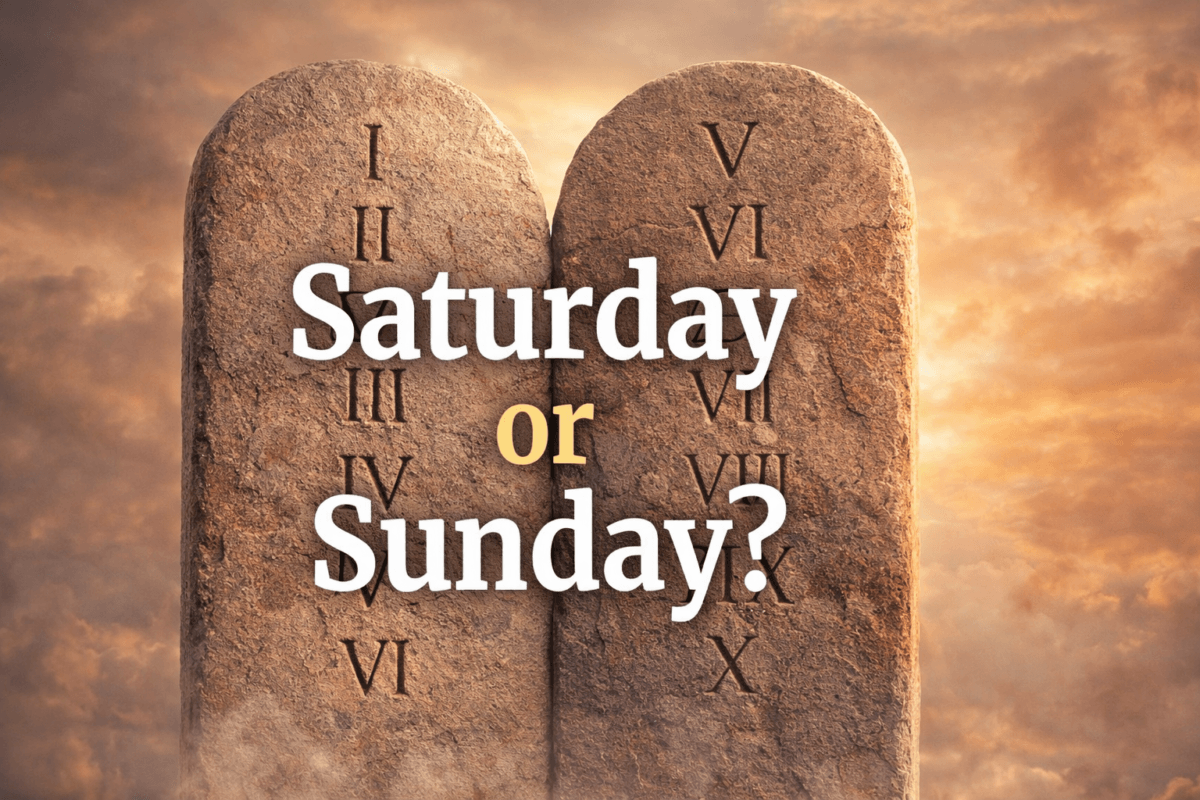
The Sabbath Saturday or Sunday question is one many Christians are asking today: Are we worshipping God according to His command, or according to tradition?
Did you know that most Christians today are worshipping on a day the Bible never commanded?
The Sabbath: Saturday or Sunday?
Is the Sabbath Saturday—or Sunday? Does it really matter?
## 📖 The Ten Commandments Series
– Part 1: No Other Gods
– Part 2: No Idols
– Part 3: The Meaning of God’s Name in Vain
– Part 4: The Truth About the Sabbath (Saturday or Sunday?) (current)
Today, we continue with the series on the Ten Commandments as we look at the fourth Commandment. The title of this presentation is, The Ten Commandments Part 4: The truth about the Sabbath (Saturday or Sunday?)
The Fourth Commandment
So, let us first look at this fourth Commandment, found in Exodus 20:8-11 NKJV
8.“Remember the Sabbath day, to keep it holy.
- Six days you shall labor and do all your work,
- but the seventh day is the Sabbath of the Lord your God. In it you shall do no work: you, nor your son, nor your daughter, nor your male servant, nor your female servant, nor your cattle, nor your stranger who is within your gates.
- For in six days the Lord made the heavens and the earth, the sea, and all that is in them, and rested the seventh day. Therefore the Lord blessed the Sabbath day and hallowed it.
What Is the Sabbath?
The Commandment begins by stating, “Remember the Sabbath day…” So let’s begin by addressing what the Sabbath day is.
The Hebrew word translated as Sabbath is shabbath, which means “rest.” Another accurate translation is “ceasing [from work].
The Origin of the Sabbath
Its origin goes back to creation when God rested upon its completion. Let’s take a look at that account in Genesis 2:1-3 NKJV
- Thus the heavens and the earth, and all the host of them, were finished.
- And on the seventh day God ended His work which He had done, and He rested on the seventh day from all His work which He had done.
- Then God blessed the seventh day and sanctified it, because in it He rested from all His work which God had created and made.
This is the origin of the Sabbath rest. It is the celebration of God’s creation. Additionally, with the advent of Christ to save mankind from his sins, it is also a celebration of our salvation.
This connects directly to what we saw in Part 1: No Other Gods and Part 2: No Idols, where God established that He alone defines how He is to be worshiped.
God’s Command further states: “to keep it holy.” That means keeping it as a day consecrated, sanctified, and dedicated to God. The Sabbath day is intended for rest, offering renewal for both body and spirit. We experience physical rest by taking a break from work, while spiritual rest is achieved through worship that rejuvenates the soul.
Moving on, the verse states, “six days you shall labor and do all your work.” Now this is based on the fact that, as the Scripture reads, “six days the Lord made the heaven and the earth … and rested the seventh day.”
We also see that this includes everybody: father, son, daughter, male servant, female servant, the stranger/visitor, and even the cattle. Everything and everybody is to honor the Sabbath. It is the fourth of the Ten Commandments.
Has the Sabbath Changed?
Now, how does this apply to today? Well, for starters, let me just say, we have swayed far, far away from this Commandment.
Today, roughly 90–95% of Christians worship on Sunday, the first day of the week. Yet surveys show that only about 70% of Christians actually treat Sunday as a day of rest. While many Christians attend church on Sunday, they do not treat it as a true Sabbath. They attend church, then go shopping at the mall, travel, and seek entertainment as they do on any other day. So, they worship on Sunday but do not consciously observe a “day of rest.”
This is in violation of the fourth Commandment. Only 1-3% of Christians observe the Saturday Sabbath. That is a true remnant!
Somewhere along the way, we stopped taking this Commandment seriously. Because this is one of the most overlooked Commandments today!
Why is this? Well, there are all kinds of doctrines and reasonings as to why, and we’re going to look at some of them today.
The Sabbath Saturday or Sunday debate is not new—it has been discussed for centuries.
Common Objection: The Sabbath Was Only for the Jews
The first: we are no longer under the Law: the Sabbath is for the Jews. Now that is grossly inaccurate! Contrary to common belief, this command was not exclusive to the Jews. The Sabbath existed even before it became part of the Ten Commandments—the Law. As we see in Genesis, it was established at the conclusion of creation. It predated sin.
Adam and Eve were not Jewish! But they were intended to be consecrated unto God, and God gave them the Law. But after they chose to sin by violating the Law, that was no longer the case. Fast forward, when God chose the nation of Israel to be His chosen—consecrated people, He gave them the Law—the Mosaic Law to keep them holy unto Him.
Now that takes care of the Old Testament. The Old Testament is basically the history of Israel. As the New Testament Scripture states in 1 Corinthians 10:11 NKJV
Early in the chapter, the Israelites’ trials and triumphs are addressed. In verse 11 it reads:
- Now all these things happened to them as examples, and they were written for our admonition (warning), upon whom the ends of the ages have come.
The Old Testament is the foundation and was provided to give us warnings not to follow the footsteps of the forefathers. The question is, are we heeding the warnings?
Now moving to the New Testament, this is where the Scripture twisting comes into play.
But first, let me say this: there is not one Scripture in the New Testament declaring the cessation of keeping the seventh-day Sabbath—not one!
But let’s look at some objections and the Scriptures cited.
First, many focus on Scriptures that mention “the first day of the week.” The proponents of this focus are that the Sabbath changed from Saturday to Sunday because Jesus was resurrected on Sunday, the first day of the week.
Does the New Testament Change the Sabbath?
John 20:1 NKJV
- Now on the first day of the week Mary Magdalene went to the tomb early, while it was still dark, and saw that the stone had been taken away from the tomb.
John 20:19 NKJV
- Then, the same day at evening, being the first day of the week, when the doors were shut where the disciples were assembled, for fear of the Jews, Jesus came and stood in the midst, and said to them, “Peace be with you.”
While Scripture confirms that Jesus appeared on the first day of the week, it nowhere confirms that Jesus ended the Sabbath to celebrate His resurrection.
Let’s look at what He did say regarding the Sabbath. Luke 6:5 NKJV
- And He said to them, “The Son of Man is also Lord of the Sabbath.”
Here, Jesus sanctioned the Sabbath and declared His authority over it, putting the Pharisees in their place. He was the Son of Man, and He was the Lord of the Sabbath. He did not change the day of the Sabbath, nor did he cancel it.
Mark 2:27 NKJV
- And He said to them, “The Sabbath was made for man, and not man for the Sabbath.
Here again, Jesus asserted His authority over the Sabbath. There is no sign of Christ abolishing the Sabbath. Also, notice that He said, “The sabbath was made for MAN,” not the Jews.
Now, back to those who focus on gatherings on the first day of the week. Let’s continue to look at the Scriptures they focus on. Acts 20:7 NKJV
- Now on the first day of the week, when the disciples came together to break bread, Paul, ready to depart the next day, spoke to them and continued his message until midnight.
If Paul’s gathering with the disciples at Troas started on the evening of the first day of the week (after Saturday sunset), it likely continued throughout the night into Sunday morning. The worship activity happened late Saturday night, making Sunday Paul’s travel day (see v. 13). This passage does not provide evidence for regular worship services occurring on Sundays or any other specific day. It also does not describe the first day of the week as sacred time, nor does it suggest that such a meeting should recur every Sunday.
1 Corinthians 16:2 NKJV
- On the first day of the week let each one of you lay something aside, storing up as he may prosper, that there be no collections when I come.
This passage does not mandate or imply the holding of a religious service. The text suggests no assembly; instead, it states, “let each one of you lay something aside, storing up as he may prosper.” There is no mention of prayer, singing, or preaching, nor any indication that Paul’s instructions were to be carried out within a meeting or worship context. Additionally, Paul’s instruction—“that there be no collections when I come”—does not establish a precedent for activities typically associated with regular gatherings.
A straightforward reading of Paul’s directions indicates that he intended for individual believers to set aside their contributions in advance of his arrival, with his instructions being fulfilled once these gifts were delivered to Jerusalem.
Now these Scriptures have nothing to do with worship. Upon examining these texts, it becomes clear that there is no scriptural basis for the idea that Sunday has replaced the Sabbath as the Bible’s designated day of rest and worship. In fact, the references to the “first day” simply note when events occurred, without assigning them any specific theological importance.
Sabbath Observance in the Early Church
New Testament Scripture clearly indicates that the Sabbath was recognized and celebrated in the early church. Let’s look at some Scripture, Acts 13:13-16 NKJV
- Now when Paul and his party set sail from Paphos, they came to Perga in Pamphylia; and John, departing from them, returned to Jerusalem.
- But when they departed from Perga, they came to Antioch in Pisidia, and went into the synagogue on the Sabbath day and sat down.
- And after the reading of the Law and the Prophets, the rulers of the synagogue sent to them, saying, “Men and brethren, if you have any word of exhortation for the people, say on.”
- Then Paul stood up, and motioning with his hand said, “Men of Israel, and you who fear God, listen: And Paul began to address the congregation.
Acts 17:1-4 NKJV
- Now when they had passed through Amphipolis and Apollonia, they came to Thessalonica, where there was a synagogue of the Jews.
- Then Paul, as his custom was, went in to them, and for three Sabbaths reasoned with them from the Scriptures,
- explaining and demonstrating that the Christ had to suffer and rise again from the dead, and saying, “This Jesus whom I preach to you is the Christ.”
- And some of them were persuaded; and a great multitude of the devout Greeks, and not a few of the leading women, joined Paul and Silas.
Acts 18:1-4 NKJV
1.After these things Paul departed from Athens and went to Corinth.
- And he found a certain Jew named Aquila, born in Pontus, who had recently come from Italy with his wife Priscilla (because Claudius had commanded all the Jews to depart from Rome); and he came to them.
- So, because he was of the same trade, he stayed with them and worked; for by occupation they were tentmakers.
- And he reasoned in the synagogue every Sabbath, and persuaded both Jews and Greeks.
Take notice that these passages address worship. Paul ministered to both Jews and Greeks—Jews and Gentiles. And he did it on the Sabbath.
Were going to look at one more in Acts 13:42 NKJV
- So when the Jews went out of the synagogue, the Gentiles begged that these words might be preached to them the next Sabbath.
Now this scene takes place at the close of worship on the sabbath. The gospel that Paul preached was so powerful that the Gentiles begged to hear more on the next SABBATH.
It doesn’t appear that the Sabbath was for Jews only.
Misunderstanding Hebrews 4
Moving on, there are those who say, Jesus is our Sabbath rest, and there’s no need to keep the seventh-day Sabbath under the Law. They use Hebrews 4:9-11 NKJV
9 .There remains therefore a rest for the people of God.
- For he who has entered His rest has himself also ceased from his works as God did from His.
- Let us therefore be diligent to enter that rest, lest anyone fall according to the same example of disobedience.
Hebrews 4 is a meaty chapter. But let me just say, this passage, verses 9-11, has nothing to do with the Sabbath day.
So, what is this “rest” of which the writer of Hebrews speaks, which should be an object of concern for the Christian community? The “rest” is something a Christian believer enters (and thus experiences) now, but this rest in its fullness remains a promised destination for the future. The Scripture says in verse 9, “There remains therefore a rest for the people of God.” In this context, the Sabbath is a new-covenant Day of Atonement, in which God’s people are cleansed from their sins.
This rest does not replace the seventh-day Sabbath rest.
Jesus offers the ultimate source for true rest, for true rest is found only in a right relationship with God. The rest is His rest, for His people, found by obeying His word.
In the wake of a culture leaving the fragmented, fragile, and fatigued in its wake, the church has a phenomenal opportunity to point people to the ultimate land of promise and spiritual well-being.
In summary, what does the writer of Hebrews mean by “rest,” and why should it matter to Christians? This ‘rest’ is both present and future… found in relationship with God through Christ.
As Jesus said in Matthew 11:28
- “Come to Me, all you who labor and are heavy laden, and I will give you rest.”
Jesus is the source of genuine rest, which comes only from being in right relationship with God.
1 John 3:24 NLT
- Those who obey God’s commandments remain in fellowship with him, and he with them. And we know he lives in us because the Spirit he gave us lives in us.
We maintain our relationship with God by keeping His Commandments—all of them. Does that mean omitting the 4th one? Hardly!
My friends, this is about salvation in Christ. It has nothing to do with keeping the seventh “day Sabbath. This does not remove the obligation to keep the Sabbath.
Understanding Colossians 2:16
There are many more examples of Scripture twisting regarding the Sabbath. But to address one more, the Scripture used for this one is Colossians 2:16 NKJV
- So let no one judge you in food or in drink, or regarding a festival or a new moon or sabbaths,
First of all, notice that it reads “sabbaths” (plural), not the Sabbath.
Some religious festivals and celebrations required a sabbath from a day of work. Paul’s point was not to judge anyone by the festival or sabbath days that they recognized in that regard. He was not referring to the Seventh-day Sabbath. Why would he? After all, we saw earlier (in Scripture) that he participated in worship in the synagogues on the sabbath!
My friends, we must stop compromising the Commandments of God!
It’s time to stop monkeying around with what God has made clear.”
The Commandment says:
Remember the Sabbath day, to keep it holy. Six days you shall labor and do all your work, but the seventh day is the Sabbath of the Lord your God.
How Sunday Worship Began
So why do most Christians today honor the first day instead of the seventh?
Now to fully answer that question requires a separate—full article of its own. But this is the condensed version
It goes all the way back to the first century A.D. and a Roman Emperor named Constantine.
In 330 A.D., Constantine relocated his capital from Rome to Constantinople. This is now modern-day Istanbul, Turkey, thereby paving the way for the Roman Catholic Popes to hold power in Rome as his successors.
“In 321 A.D., Constantine issued the first civil law promoting Sunday rest.
When the Catholic Church grew in influence, it promoted Sunday as a sacred day instead of observing the Sabbath, officially establishing this change at the Council of Laodicea (A.D. 363-364).
So the question becomes, on what authority did the Catholic church institute this change?
James Gibbons, Roman Catholic Theologian and author of the book “The Faith of our Fathers,” wrote:
“But you may read the Bible from Genesis to Revelation, and you will not find a single line authorizing the sanctification of Sunday. The Scriptures enforce the religious observance of Saturday, a day which we never sanctify.”
To put it plainly, it was the Catholic Church’s authority that shifted worship from Saturday to Sunday, rather than any directive in the New Testament Scriptures.
This is a significant acknowledgment from a Catholic prelate—the horse’s mouth, so to speak. Additionally, some religious leaders concede that there is no biblical authorization for designating Sunday as the new Sabbath Day.
When Christianity became aligned with the Roman Empire in the fourth century, a union between church and state began to form. Political power began influencing religious practice, and this period saw the introduction of Sunday laws and later church decrees promoting Sunday observance. [Spoiler alert: This is beginning to occur again—another article forthcoming]
But the point: we are disobeying God’s Commandment and worshipping God on the wrong day.
Now there’s a lot more to this story. However, you can read the full article on the Christian Advocate website, and here’s the link:
https://thechristianadvocate.org/saturday-vs-sunday-worship/
The Danger of Following Tradition
Moving on, the fact of the matter is: Sunday worship is pagan—a tradition of men—established in Rome.
Jesus called the religious leaders out on this following of traditions in Mark 7:6-9
- He answered and said to them, “Well did Isaiah prophesy of you hypocrites, as it is written:
‘This people honors Me with their lips, But their heart is far from Me.
- And in vain they worship Me, TEACHING AS DOCTRINES THE COMMANDMENTS OF MEN.’
- For laying aside the commandment of God, you hold the tradition of men—the washing of pitchers and cups, and many other such things you do.”
- He said to them, “ALL TOO WELL YOU REJECT THE COMMANDMENT OF GOD, THAT YOU MAY KEEP YOUR TRADITION.
Here, Jesus quoted Isaiah’s condemnation of Israel’s hypocrisy when he spoke to the Pharisees, the religious leaders of his day (Matthew 15:7–9; Mark 7:6, 7). We are all capable of hypocrisy, and we’re guilty of it today—As the Scripture states: laying aside the Commandment of God and holding the tradition of men.”
God has never left worship up to human preference. In Deuteronomy 12:29–31, God said:
29 “When the Lord your God cuts off from before you the nations which you go to dispossess, and you displace them and dwell in their land,
- take heed to yourself that you are not ensnared to follow them, after they are destroyed from before you, and that you do not inquire after their gods, saying, ‘How did these nations serve their gods? I also will do likewise.’
- You shall not worship the Lord your God in that way; for every abomination to the Lord which He hates they have done to their gods; for they burn even their sons and daughters in the fire to their gods.
32 “Whatever I command you, be careful to observe it; you shall not add to it nor take away from it.
The Lord stated: “You shall not worship the Lord your God in that way.” Instead of copying how others worshiped their gods, Israel was commanded to worship God according to His instructions alone. This reveals an important truth: God does not accept worship that is shaped by culture, tradition, or human reasoning—but only that which He has commanded.
Israel was condemned for it, and we will be condemned also if we don’t make a change.
As we saw in Part 3: The Meaning of God’s Name in Vain, God does not accept worship shaped by human tradition, but only that which He has commanded.
Has the Sabbath Changed?
Yes, this was for the Israelites, but has God changed? In Malachi 3:6, He is quoted saying, “For I am the Lord, I do not change;”
A Call to Return to God’s Command
My friends, this is a big problem. But there is a solution, it’s time to show Jesus the love He deserves, and keep the Commandments—all of them. As He said in John 14:21 NKJV:
- He who has My commandments and keeps them, it is he who loves Me. And he who loves Me will be loved by My Father, and I will love him and manifest Myself to him.”
The fact is, we are too concerned about being enslaved, and we want to be free. But the Sabbath was never meant to enslave us to a day — it was meant to lead us to the One who gives true rest.
We must worship God on the Day He designated, not the one designated by man!
One day, we will have to choose who we truly love—God or man?
Make the correct choice before it’s too late!
Amen.
Feel free to leave any questions, comments, or concerns below.
Blessings!
👉 Videos
Watch the full teaching on Video
Watch the Short
## 📖 The Ten Commandments Series
– Part 1: No Other Gods
– Part 2: No Idols
– Part 3: The Meaning of God’s Name in Vain
– Part 4: The Truth About the Sabbath (Saturday or Sunday?) (current)