Introduction
This is the fourth article in the series, What is Carnality. The last article, part 3, looked specifically at overcoming carnality. It covered Romans chapter eight which sheds light on life in the Spirit of Christ.
In that chapter we saw that there is no condemnation to those who walk not  after the flesh, but after the spirit. (Rom 8:1). It concluded that it is the Holy Spirit of Christ that enables us to overcome carnality; that we as Christians should sift everything through the Holy Spirit—spiritualize everything as it has been addressed, in order to be guided in the right direction which enabling us to overcome carnality. In this article we are going to continue covering the Holy Spirit and carnality extensively, and at the same time, we’re going to look at a question that comes up from time to time which is, does Satan know our thoughts?
Overcoming Carnality
Regarding the issue of overcoming carnality, Satan is our opposition—our enemy. When dealing with an enemy, it is important to know as much about that enemy as possible. What makes him tick? What he likes, what he doesn’t like; what are his weaknesses—his limitations, and strengths, how does he operate? What is his ultimate goal?
Does he fight fare or dirty? Is he a bold and upfront in your face kind of fighter, or one that’s cunning and slick; the kind that you’d better watch  your back with? These are some of the things we must know about an enemy.
So let’s start with a little background on our enemy. Jesus our Lord and savior as a man was meek and humble, full of love and compassion. But he didn’t have a problem calling things or people exactly as they were. Let’s look at what He said about Satan in John 8. Now some of you may be familiar with this chapter, but here Jesus is contending with the Scribes and the Pharisees who claimed that their salvation rested in the fact that Abraham was their father. But Jesus told them who their real father was. Looking at verse 44 he said:
44 Ye are of your father the devil, and the lusts of your father ye will do. He was a murderer from the beginning, and abode not in the truth, because there is no truth in him. When he speaketh a lie, he speaketh of his own: for he is a liar, and the father of it.
So he is behind the murder of human life and behind the loss of man experiencing real life here on earth. The devil destroys life and all abundant living when he can; all love, joy, peace, patience, gentleness, goodness, faith, meekness, discipline. All of the fruit of the spirit he destroys—when he can.
Satan does not abide in the truth, but rejects the truth. Satan lies and deceives. It is his nature to lie. This is the meaning of the phrase, “he speaketh of his own”; that is, he is at ease and comfortable in lying. He lies out of his own being. He is simply one big lie.
As a result of man’s fallen nature, he has taken on the nature of Satan. As Jesus said in the scripture, “and the lusts of your father ye will do.”
Man lies and deceives. It is his nature to lie and to protect and look after himself. This may hurt the pride of man, but the fact is it is his nature: to look after himself even if he has to lie (cheat, steal, maneuver, etc.) to get  what he wants or feel that he needs. Additionally, to protect himself by misleading, deceiving, and twisting the truth.
The bottom line is; the devil is a liar and a deceiver. He lies to you and me. He tells us things about ourselves and others, and about circumstances that just aren’t true.
So let’s now look at how he operates: Let’s look at 2 Cor. 4:3-4
3 But if our gospel be hid, it is hid to them that are lost:
4 In whom the god of this world hath blinded the minds of them which believe not, lest the light of the glorious gospel of Christ, who is the image of God, should shine unto them
The scripture mentions: the “god of this age.” This is a title for Satan, the

great deceiver. He operates through deception. His first approach is convincing people that he doesn’t exist in the first place.
To repeat what it says in verse 4 it reads, “Hath blinded the minds of them which believe not” Satan blinds the minds of unbelievers lest they should believe the gospel. This is Satan’s purpose: to keep people from believing the gospel and from becoming followers and worshipers of the Lord Jesus. Of all who discern no beauty in the gospel, and who reject it.
It is implied in this passage:
(1st) that the minds of unbelievers are blinded; that they perceive no beauty in the gospel. This is often affirmed of those who reject the gospel, and who live in sin.
(2nd) this is done by the agency of Satan and his dominion is secured by keeping the world in darkness. The affirmation is direct and positive, that it is by his agency that it is done. Jesus addressed this fact also. Let’s go back to John 8: in verse 44 he told them who their real father was, in 45 He told them the result:
45 and because I tell you the truth, ye believe me not.
So Satan had them so blinded: that they couldn’t believe the truth. Now this was some two thousand years ago, he did it thousands of years earlier in the Garden of Eden, [2 Cor. 11:2] and he’s doing the same thing today. How does he blind a person’s mind?
(a) For starters, by a direct influence on the minds of people by appealing to the flesh. This is accomplished by enticing with the lust of the eyes and the lust of the flesh and the pride of life. [1 John 2:15-16] If Satan can get an individual to focus his life upon himself and the world, that person will become enslaved to his flesh and the things of the world. This is apparent in the behavior of the ungodly; remember the point brought out in part 3—…”whosoever therefore will be a friend of the world is the enemy of God.” [James 4:4]
He is so cunning that he doesn’t tell us the entire lie at one time. He begins by bombarding our minds with a cleverly devised pattern of little nagging thoughts, suspicions, doubts, fears, wonderings, reasonings and theories. He moves slowly and cautiously (after all, well-laid plans take time).
Remember, he has a strategy for his warfare. He has studied us for a long time. His goal in injecting these thoughts is to build up strongholds in our minds
He knows what we like and what we don’t like. He knows our insecurities, our weaknesses and our fears. He knows what bothers us most. He brings up our past indiscretions. He is willing to invest any amount of time it takes to defeat us. One of Satan’s strong points is patience.
(b) He also blinds by the false philosophy which has prevailed—a large part of which obviously has been designed for the purpose of deceiving the world, and destroying the peace and happiness of people. So this is how Satan works with non-Christians, unbelievers. He simply keeps them blinded from the truth—from the gospel.
Let’s look at another example of how he operates, this time with Christians:
2 Cor. 11:13-15
13 For such are false apostles, deceitful workers, transforming themselves into the apostles of Christ.
14 And no marvel; for Satan himself is transformed into an angel of light.
15 Therefore it is no great thing if his ministers also be transformed as the ministers of righteousness; whose end shall be according to their works.
Now in verse 13 Paul is addressing false teachers. In verses 14 & 15 we see that Paul wasn’t amazed that false teachers were disguising themselves as preachers of God, for Satan himself had deceived God’s people in similar ways. He is the master of deception.
Paul had already warned the Corinthians to not give Satan any chance to tempt them or disrupt their congregation [2:11, 11:3; 1 Cor. 7:5 c.f. Gal 1:9] Here, Paul compared the false teachers’ deception with Satan’s actions.
To make the next point concerning Christians, let’s look at Ephesians 6:12
12 For we wrestle not against flesh and blood, but against principalities, against powers, against the rulers of the darkness of this world, against spiritual wickedness in high places.
Now it is clear from this scripture that we are engaged in a war. So the first thing to realize, which is very important, is that we are engaged in a spiritual warfare. Not an earthly war. A careful study of this verse informs us that our warfare is not with other human beings, but with the devil and his demons—principalities and wickedness in high places. So it’s not about verbalization. We do not have to verbalize anything or any thought in order for it to be known in the spirit world. We can have a spiritual battle and never utter a word. Why? Simply because the battle field is the mind. The  mind is where all of our battles take place. Our spiritual enemy, Satan, attempts to defeat us with strategy and deceit, through well laid plans and deliberate deception. He could never do this without knowing our thoughts.
In fact, he plants the evil thoughts in our minds. Evil thoughts do not come from God—they come from Satan and are against the will of God. So if he puts the thoughts there, he knows what they are. For more on Spiritual Warfare, read the article, All about Spiritual Warfare on this website.
Let’s look at another passage of scripture that sheds light on this very fact. 2 Corinthians 10: In this chapter, Paul begins to vindicate or justify his authority as an apostle to a pocket of resistance that continued to voice opposition against him. He began by speaking of his spiritual authority. Verses 2-5 read:
2 But I beseech you, that I may not be bold when I am present with that confidence, wherewith I think to be bold against some, which think of us as if we walked according to the flesh.3 For though we walk in the flesh, we do not war after the flesh:
4 (For the weapons of our warfare are not carnal, but mighty through God to the pulling down of strong holds )
5 Casting down imaginations, and every high thing that exalteth itself against the knowledge of God, and bringing into captivity every thought to the obedience of Christ;
Now for starters, what we see here is that the minister—the Christian wars and fights, but not in a fleshly way. This is a great passage of Scripture in that it deals with the Christian’s spiritual warfare, a passage that every Christian should memorize and chew upon often. It is the prescription that often stirs a Christian to discipline and gain control over his mind and thoughts. Notice three significant points.
First: the Christian is in a spiritual warfare. As we have seen so far, Scripture is perfectly clear about this. I can’t express this enough.
Spiritual forces lie behind man’s evil and lustful behavior, unbelief, and arguments against God. These spiritual forces attack and prey upon the imaginations and thoughts of men. They inject selfish and devilish ideas against God and against other men. And the energy of these ideas manifest in the evil acts of men.
Two things regarding Spiritual Warfare apply here. (1st) Selfish, evil, and lustful thoughts are mental and immaterial. Ideas and thoughts are not physical and material substances. They are invisible and mental substances. So it’s not about verbalization. Verbalization is the effect, not the cause. (2nd) Selfish, evil, and lustful ideas are by nature not of God. God is not evil, selfish, or lustful; therefore, such evil thoughts and reasonings are often injected into the mind of men by spiritual forces that stand opposed
to God. So Paul’s point is this: he and other Christians “walk in the flesh”; that is, they live in a body just like all other people. But they do not war in the flesh. They do not fight the struggles of life using only their own strength. Why? Because for the Christian there is a spiritual warfare going on for the minds and lives of people. Christians know that the evil forces of the spiritual world lie behind… ·sin and evil ·disorder and devastation· corruption and deterioration ·death and hell. Christians know that they cannot “war after the flesh”; that no man or any combination of men can conquer the spiritual forces that tear and eat away at man until they destroy him. No matter how strong, educated, or scientific man may become, he cannot deliver himself from the spiritual forces that cause sin and death.
Second (significant point): the Christian’s weapons are not physical, but spiritual. Physical or carnal weapons would be human weapons of the mind and body such as for example: ·human discipline and control ·strength and ability ·knowledge and intelligence ·science and technology ·ideas and thoughts ·beliefs and doctrines ·resolutions and rules ·health and self-esteem ·education and social development ·wealth and welfare ·eloquence and personality ·appearance and attractiveness ·as well as laws and 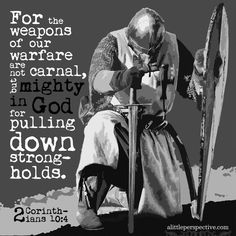 principles. These are human, carnal, weapons. They cannot stand against the attacks of spiritual forces.
Naturally, every human power and weapon available should be developed and used to the fullest extent possible. The human body is to be the temple of the Lord where He dwells. But the Christian knows that there is nothing in the world that can conquer the spiritual forces that lie behind the evil and death of this world. Therefore, he fights the spiritual battles of this life with spiritual weapons, weapons that are of God and are made mighty and powerful by God.
Notice that the Christian uses spiritual weapons to “pull down strongholds.”
The evils of this world are deeply entrenched and fortified.
This is clearly seen in the daily newscasts and behavior of people day by day. Evil and its inevitable consequence of destruction and death can never be permanently overcome by carnal weapons. Only the spiritual weapons of God can permanently conquer evil. We’re going to cover these spiritual weapons in the future.
Third: the Christian’s method of conquering the forces of evil is clearly described. Let’s take a look.
a. The Christian “casts down” imaginations, thoughts and imaginations that are uncontrolled, wild, evil, lustful, immoral, unjust, wrong, untrue, devilish, and set against God. These thoughts come straight from Satan. Does he know that they are there? Absolutely! Why? Simply because he puts them there and he knows exactly when to put them there.
Our part in this warfare is to resist them, to cast them down. Now in the
scriptures, there is a clear example of what happens when we fail to cast down these evil thoughts.
For starters, we become God’s enemies because these thoughts lead us away from God and His will. Let’s look at this in Rom 1: in the latter part of this chapter, Paul describes God’s wrath on unrighteousness and ungodliness. Looking at verses 20-21:
20 For the invisible things of him from the creation of the world are clearly seen, being understood by the things that are made, even his eternal power and Godhead; so that they are without excuse:
So the visible creation speaks clearly of its creator, so there’s simply no excuse for not acknowledging God. Let’s read on:
21 Because that, when they knew God, they glorified him not as God, neither were thankful; but became vain in their [imaginations], (their thinking) and their foolish heart was darkened. [cf. Eph 4:17-19]
When we fail to acknowledge God we allow evil thoughts to take over, hardening our hearts against God. Let’s look at the results in verses 28-32
28 And even as they did not like to retain God in their knowledge, God gave them over to a [reprobate mind], to do those things which are not convenient; [not becoming]
Now the scripture says, “God gave them over to a reprobate mind.” So what is a reprobate mind? It is a base mind, a condemned mind, a mind destitute of judgment. God gave them up to a mind disapproved, rejected, and Paul expresses that the state of their minds was such that God could not approve it.
This was a consequence of their headstrong passions, their determination to forget God, thus He left them to a state of mind which was evil, and which he could not approve. And who was the source of this reprobate mind? Satan and his demons. Think not that he didn’t know what they were thinking. The further results:
29 Being filled with all unrighteousness, fornication, wickedness, covetousness, maliciousness; full of envy, murder, debate, deceit, malignity [bad character-mischievousness]; whisperers,
30 Backbiters, haters of God, despiteful, proud, boasters, inventors of evil things, disobedient to parents,
31 Without understanding, covenant breakers, without natural affection, implacable, [cannot be appeased] unmerciful:
32 Who knowing the judgment of God, that they which commit such things are worthy of death, not only do the same, but have pleasure in them that do them.
This is the result of capitulating to the thoughts that Satan implants in us. Does he not know our thoughts? How could he possibly not?
The Christian wars, fights, and struggles to as the scripture reads, “cast down” evil imaginations. He fights to bring his imaginations under control. This is indeed a battle!
b. The Christian casts down “every high thing that exalts itself against the knowledge of God,” false ideas about God, false doctrine, false teaching, false reasonings, the human pride and arrogance, self-sufficiency and self-righteousness that set themselves up against God.
c. The Christian seeks to captivate every thought to the obedience of Christ. This is a phenomenal statement—every thought controlled and subjected to Christ! This is the spiritual objective of the true Christian. God created man

for fellowship and communion, and the Christian knows it; therefore, the Christian wars—struggles and fights—to captivate every thought and focus it upon God and His righteousness. He seeks to walk in an unbroken fellowship and communion with God.
So the question now is why does the scripture exhort us to bring every thought into captivity and submit it to Christ? Simply because Satan is no match to Christ. Christ overpowered Satan at the cross, and when we connect with Christ through the Holy Spirit, we connect with the almighty heavenly father, stopping Satan in his tracks.
Now for scriptural confirmation, let’s look at what it says in Colossians 1. The last half of this chapter addresses our being reconciled in Christ. Verses 21-22 read:
21 And you, that were sometime [alienated and enemies in your mind by wicked works], yet now hath he reconciled
22 In the body of his flesh through death, to present you holy and unblameable and unreproveable in his sight:
So in spite of our being alienated in our minds by the wicked works of Satan, the works of Christ allows us to overpower them. We must bring every thought into captivity and submit it to Christ. If we don’t submit it to Christ, Satan, knowing the thought, will grab it and use it against us. We only have a choice of two masters: God or Satan. And if we don’t subject our thoughts to Christ, we’ll subject them to Satan whether we like it or not.
Scripture instructs and warns us over and over against the thoughts that Satan implants in us. Remember what Scripture says in Romans 8:5. “For they that are after the flesh do mind [work to keep their minds upon] the things of the flesh; but they that are after the Spirit the things of the Spirit.”
Also, Romans 12:2: “And be not conformed to this world: but be ye transformed by the renewing of your [mind], that ye may prove what is that good, and acceptable, and perfect, will of God”.
1 Cor. 2:16 “For who hath known the mind of the Lord, that he may instruct  him? But we have the mind of Christ.”
Ephes. 4:23-24 “And be renewed in the spirit of your mind; and that ye put on the new man, which after God is created in righteousness and true holiness”.
Isaiah 26:3 describing the righteous: “Thou wilt keep him in perfect peace, whose mind is stayed on thee: because he trusteth in thee”.
And lastly Phil. 4:8 reads: “Finally, brethren, whatsoever things are true, whatsoever things are honest, whatsoever things are just, whatsoever things are pure, whatsoever things are lovely, whatsoever things are of good report; if there be any virtue, and if there be any praise, think on these things” We are warned and encouraged to think good thoughts, to renew our minds, to keep our minds on God and seek holiness. This is how we overcome carnality.
If Satan doesn’t know our thoughts, there would be no need for these warnings—there would be no Spiritual Warfare. Fact is evil thoughts come from him so he knows exactly what’s going on in our minds. He skillfully implants these thoughts and then he uses them against us if we allow them to remain and manifest themselves into strongholds. Satan will take our thoughts and will shake us until he devours us. As Jesus told Peter: “Simon, Simon, behold, Satan hath desired to have you, that he may sift you as wheat: [Luke 22:31]
Satan desires all of us, he hates us. As the people of God, we are his enemies. And I beg every one of you: not if
but when an evil thought comes into your minds, rebuke it—cast it down in the name of Jesus, and move on in the will of God. Don’t allow evil thought to hang around in your heads. Because if you think evil, negative thoughts, you’ll become evil. The bible clearly tells us: “For as he thinketh in his heart, so is he:” [Prov. 23:7]
Now there are some who feel that to acknowledge that Satan knows our thoughts, is giving him power that he doesn’t have—that it makes him omniscient—equal with God. But the fact is Satan’s knowledge of our thoughts is a far cry from him being omniscient.
Let’s look at a passage of scripture in Isaiah 55: This chapter contains prophesy where God expresses his free offer of mercy to all. In verses 7-9 the Lord says:
7 Let the wicked forsake his way, and the unrighteous man his [thoughts]: and let him return unto the LORD, and he will have mercy upon him; and to our God, for he will abundantly pardon.
8 For my thoughts are not your thoughts, neither are your ways my ways, saith the LORD.
9 For as the heavens are higher than the earth, so are my ways higher than your ways, and my thoughts than your thoughts.
So as the heavens are higher than the earth, God’s thoughts and ways are higher than ours. So Satan’s knowledge of our puny little thoughts is a far cry from omniscience. If we were to say: that Satan knew God’s thoughts, that would make him omniscient—that would put him equal with God.
So what is the remedy for this issue concerning our mind and our thoughts? Again, one last time, we must go to the scriptures.
1 Peter 1 13
13 Wherefore gird up the loins of your mind, be sober, and hope to the end for the grace that is to be brought unto you at the revelation of Jesus Christ.
“Gird up the loins,”
means, get ready for action. People in biblical times would gather up their long robes and tie them around their waists so that they could move or run quickly and freely. Peter was not asking his readers to free their legs for a footrace, but to free their minds for proper thinking.
Likewise, we need to do whatever it takes to focus our thoughts on those  things that allow us to serve God successfully, all the while eliminating any thoughts that would trip us up. [Heb. 12:1]
Peter also wrote, “be sober.” Peter’s concern here was primarily the using of mentally or spiritually sound judgment.
Next he wrote, “hope to the end.” We need to exhibit confidence that God will accomplish all that He promised He would do. [v. 3, Rom. 8:24, 25] In a word: faith! [gird-sober-faith]
Satan is a powerful enemy and it behooves us to never under estimate him. But even with him knowing our thoughts, he is no match to the Holy Spirit of God. So the wisest thing for us to do is apply the scriptures and bring every thought captive to the obedience of Christ, walk in His spirit, giving God all the Glory. As Daniel did, we must purpose in our hearts, not to be defiled.
Amen.
If you would like to read part 5, click here
Please feel free to leave any question, comment or concern below. You will receive a response.
Blessings!
 goodness, faith,
 he may abide with you for ever;
 Christian believer. But notice that this promised is bracketed by the first and last verses, based on obedience. God’s promise of the Holy Spirit is based on obedience to His commands—living righteous lives. This manifestation in a Christian’s life is paramount—for His survival as a child of God.
 back to faith, only to later go back to doubt and unbelief. We tend to be a little capricious with our faith, and we end up being miserable roller-coaster Christians, allowing our faith to take swells and dips. Many of us are double minded in our faith. One day, we’re a child of God and a disciple of Christ, and the next day, we’re in the flesh, acting like the world. The scripture says, “from faith to faith.” Also, “that ye may abound in hope, through the power of the Holy Ghost.” [Rom. 1:17; 15:13] But if we have doubt and unbelief, we will quench the Holy Ghost, and will not receive from God. Again to repeat what the bible tell us in Hebrews 11:6: “but without faith it is impossible to please Him.” If God is not pleased, we certainly cannot receive from Him.
 identified the problem of indwelling sin; that there is a problem between the law, sin and the flesh. Also, while the law identified sin, it was powerless because of his flesh. In verse 18 he Wrote “for I know that in me (that is in my flesh,) dwelleth no good thing; for to will is present with me; but how to perform that which is good I find not. So what he said I, while he has the will to do good, he couldn’t perform it because of his flesh. So I concluded by acknowledging just how powerful the flesh really is. How the flesh makes wrong seem right, and right seem wrong. I also pointed out the effects of being carnal—led by the flesh—how the flesh manifests itself according to
 law of sin and death.
 nature is such that it cannot be subject to God’s law. It is not only the aspiration that is missing, but the capability as well.
 opposition to the spirit of Christ, how can one be a carnal Christian? It won’t work! [James 1:8] The flesh—stifles—quenches—stamps out —the Spirit. [1 Thess 5:19; Eph. 4:30] Jesus said: “no man can serve two masters: for either he will hate the one, and love the other…Ye cannot serve God and mammon.”


 Galatian believers a sample listing of the works of the flesh, even though such works should be as the scripture says, “manifest.” This means that the source of these vices was “obvious” or “readily apparent.” They illustrate the kind of things the flesh will do when it is uncontrolled. Looking at verse 19 it reads:
 private. It means unrestrained
 prepare the way. A sinner must repent (turn away) from his or her sins to receive forgiveness. The Scripture reads in Prov. 28:13
 rewarder of them that diligently seek him.” Faith is the initiator of the Christian’s journey. [Don’t leave home without it!] For more on faith, please read the article:
  your Father also which is in heaven may forgive you your trespasses.
 not forgiven of our sins if we practice it.
 the other person including anger, hatred, bitterness, hurt, and oh yes, jealousy. Awareness will help to acknowledge the need to forgive. As mentioned earlier, holding on to the negative emotions is highly toxic and not good for health.

 this earth, and fulfill the plan and purpose God has for our lives.

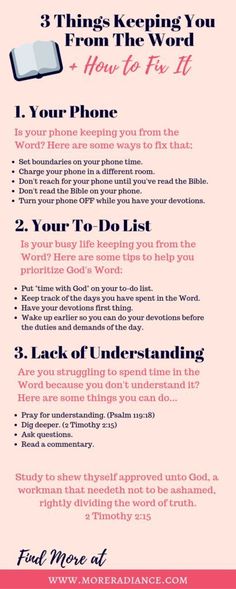 schedule for tomorrow, if you have one; and see if you are actually doing the things that reflect your priorities.
 worries concerning the past and the future steal our today s. But the bible tells us, “Therefore do not worry about tomorrow, for tomorrow will worry about itself. Each day has enough trouble of its own. [Matt 6:34 Niv]
 getting too technical, a homosexual is an individual, male or female, that has a tendency to direct their sexual desires toward another of the same sex.
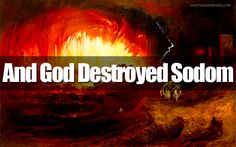 and objectionable to a holy God. After all, He destroyed an entire city because of homosexuality.
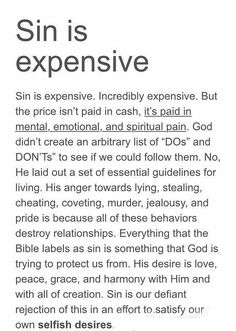 Further, homosexuals will not inherit the Kingdom of God—they will not make it into heaven.
 us [John 3:15]. To continue with the 1 Corinthians passage, verse 11 reads: “And that is what some of you were. But you were washed, you were sanctified, you were justified in the name of the Lord Jesus Christ and by the Spirit of our God. The blood of Jesus cleanses us from these vices if we accept Him and follow Him as our Savior.
 him should not perish, but have everlasting life.
 a plank in your own eye? 5 You hypocrite, first take the plank out of your own eye, and then you will see clearly to remove the speck from your brother’s eye. NIV
 wonder that God has allowed a virus that has even stopped worship gatherings. The world has infiltrated the church.
 But It can also be something non-material or not of a physical nature: conceptual or spiritual. So…what do you treasure?
 one individual in particular; King Solomon, Son of David.
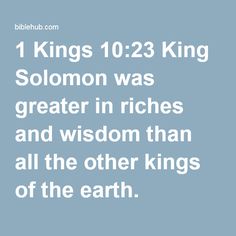 author of the book of Proverbs and is the author of the book of Ecclesiastes. Both books are packed with astounding wisdom. Ecclesiastes is basically an essay on life.
 and I myself perceived also that one event happeneth to them all.
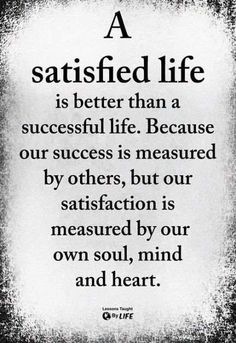 craving and desire for more and includes both material things and fleshly indulgence. Jesus wants us to realize that life isn’t measured by how much we own; our possessions—a beautiful home, the latest clothes, a new car, property, money and wealth. While these things are nice to have, they are not the whole of life. There are happy poor folks who are probably happier than the rich—as we saw with King Solomon.
 lives to the point that we deem them worthless because of our earthly circumstances. We must be wise and not be fools as the worldly. But let us keep our focus on the things above: the Kingdom of God and His righteousness and not on things of the earth and He will take care of us. Amen.
 rest of the world. We have access to a source that enables us to look beyond this and every other encounter of adversity we may face. We have Hope. But what is the reason for our hope?
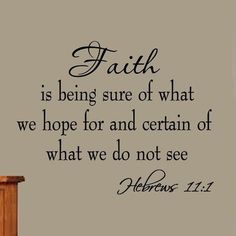 offering) for when we transgressed the Law in the past. “all have sinned” everybody needs Christ. But this hope only applies to, as verse 22 states: “upon all them that believe.” It’s all about faith. For more on faith, read the article:

 of the twelve apostles of the Lamb.
 according to the measure of a man, that is, of the angel.

 “beginning”? This is a translation from the Greek word, En archē [pronounced en ar-chay’] which means before there was a beginning. This is a statement of eternity; it doesn’t mean from the beginning but eternity past. God is preexistent and has no beginning, He just was and just is
 states: “and the Word was made flesh and dwelt among us.”
  person. Jesus is of the very same thing, of the very same substance as God. He was claiming to have the same nature of God, to be One with God…in nature, substance, essence, being, power and glory.